Circuit Theory 1 · Thevenin and Norton
#24 Thevenin and Norton equivalents #24 — independent sources
Reduces a linear network at the load terminals to its Thevenin and Norton equivalents, then solves equivalent resistance, open-circuit voltage, and load current in two examples.
Question
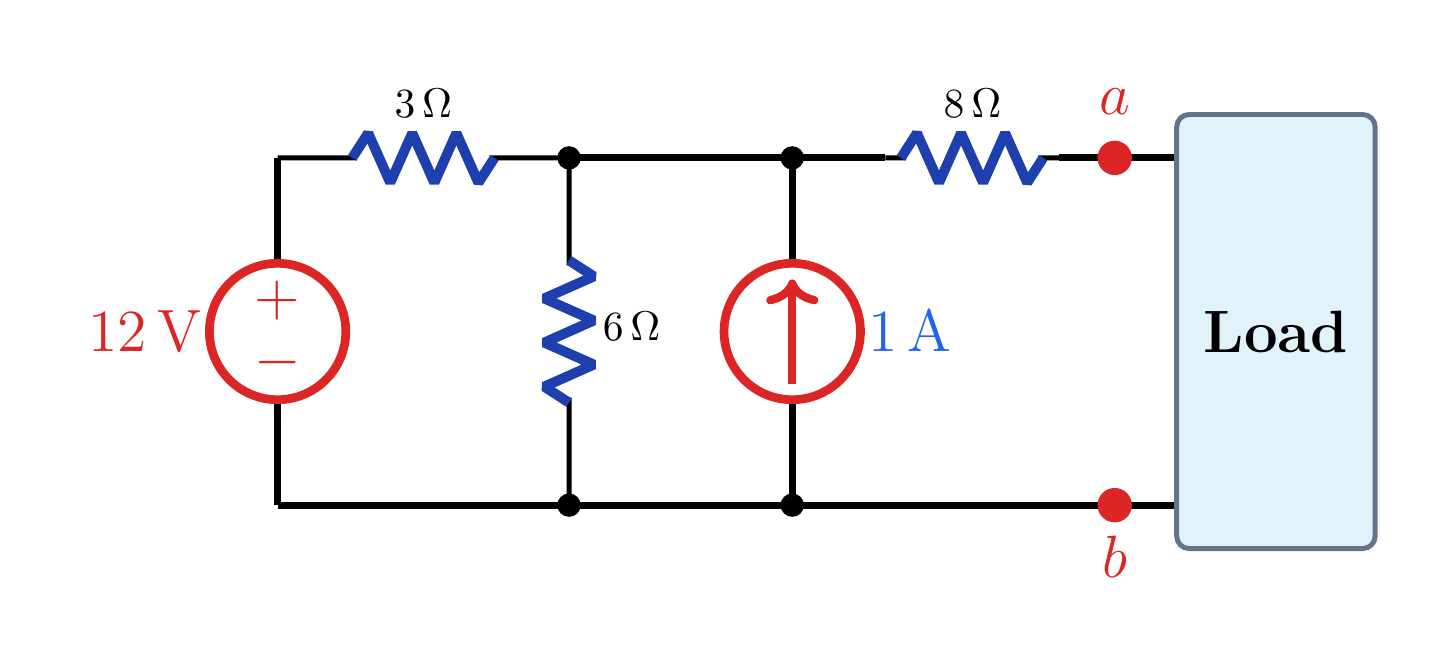
Find the Thevenin and Norton equivalents seen at terminals a-b for the independent-source circuits, and calculate the 6 Ω load current in the second example.
Written solution and narration transcript(shows the full solution)
Below are all the lines written in the notebook together with the full narration transcript.
1. Terminal equivalence
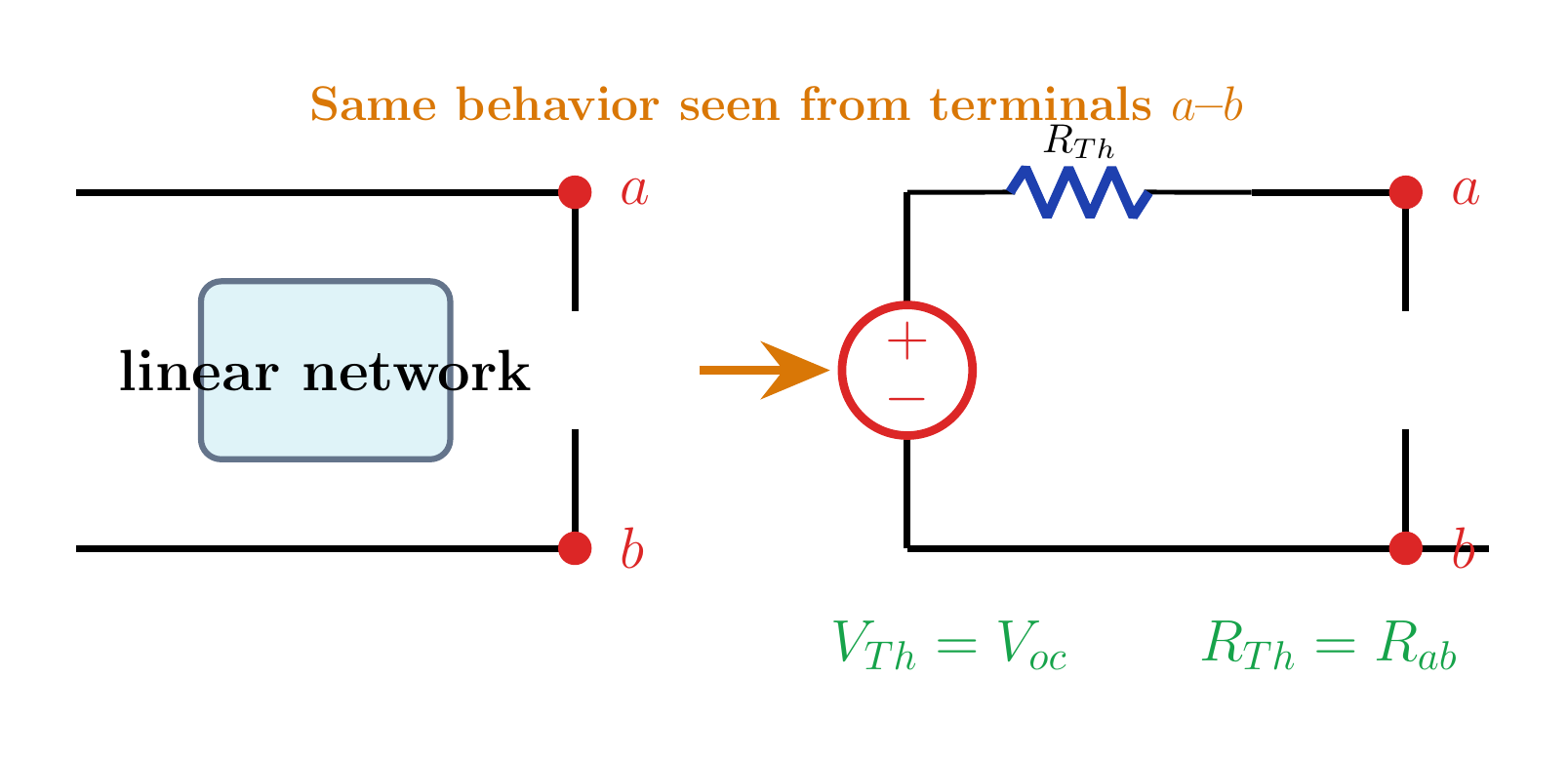
V_Th=V_oc and R_Th is the resistance seen after turning off independent sources. Look from terminals a-bComplex linear network → simple equivalentThevenin: VTh in series with RThNorton: IN in parallel with RNThe load sees the same v-i behaviorNarration transcript
We now begin Thevenin and Norton equivalents. The goal is to replace everything connected to two terminals, a and b, by a simpler circuit that behaves the same from the outside. If the equivalent is one voltage source in series with one resistance, we call it a Thevenin equivalent. If it is one current source in parallel with one resistance, we call it a Norton equivalent. In both cases the load sees the same terminal voltage-current behavior.
2. Independent-source procedure
The load is removed from a-b before finding the equivalent. Independent-source procedure1) Remove the load; leave a-b open2) Voltage source → short circuit3) Current source → open circuit4) Find RTh looking into the terminals6) Reconnect the load to the equivalentNarration transcript
For circuits with only independent sources, the procedure is direct. First, remove the load. To find R Thevenin, turn off the independent sources: ideal voltage sources become short circuits, and ideal current sources become open circuits. Then look into terminals a and b. Second, find V Thevenin as the open-circuit voltage across a and b. Third, draw V Thevenin in series with R Thevenin. If a Norton form is needed, use I Norton equals V Thevenin divided by R Thevenin, with the same resistance in parallel.
3. Example 1: R_Th
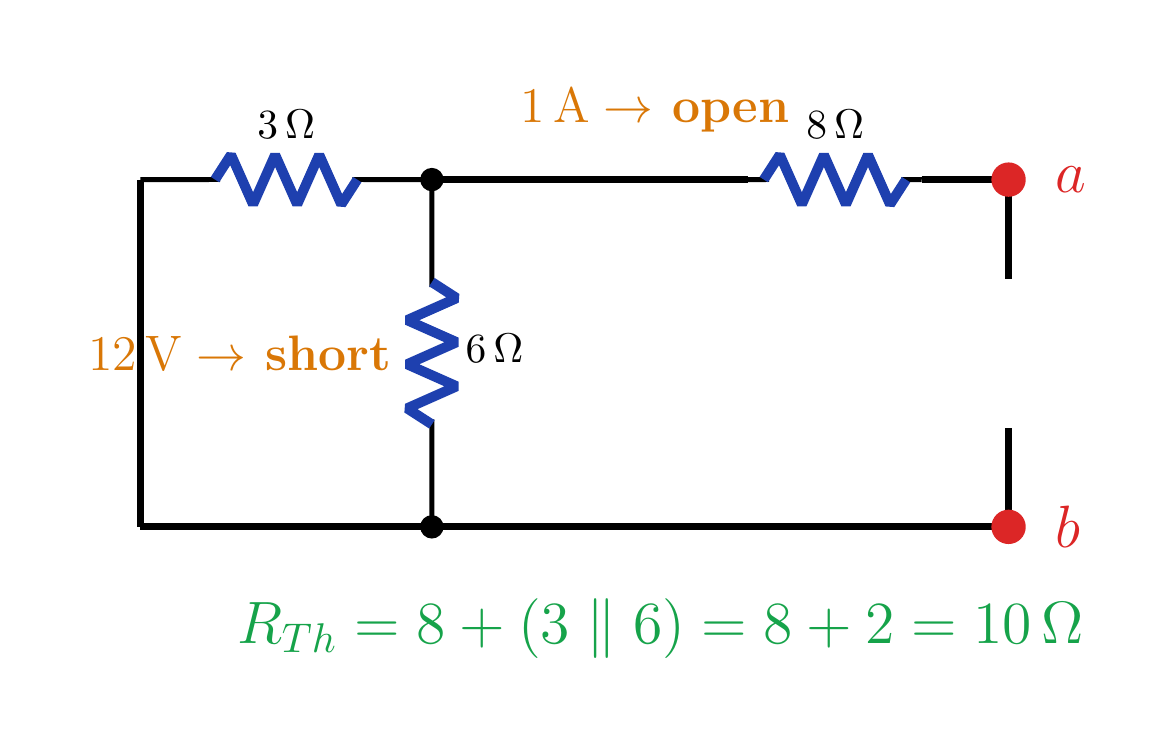
R_Th=8+(3∥6)=10 Ω. Example 1: RTh12 V → short circuit1 A → open circuit8 Ω is in series with this pairNarration transcript
Example one has a 12 volt source, a 3 ohm resistor on the top branch, a 6 ohm resistor to the bottom node, a 1 amp current source pointing upward, and an 8 ohm resistor leading to terminal a. The load is removed from terminals a and b. For R Thevenin, turn off the sources. The 12 volt source becomes a short circuit, and the 1 amp source becomes an open circuit. Looking from a to b, the 8 ohm resistor is in series with 3 ohms in parallel with 6 ohms. So R Thevenin is 8 plus 2, equal to 10 ohms.
4. Example 1: V_Th
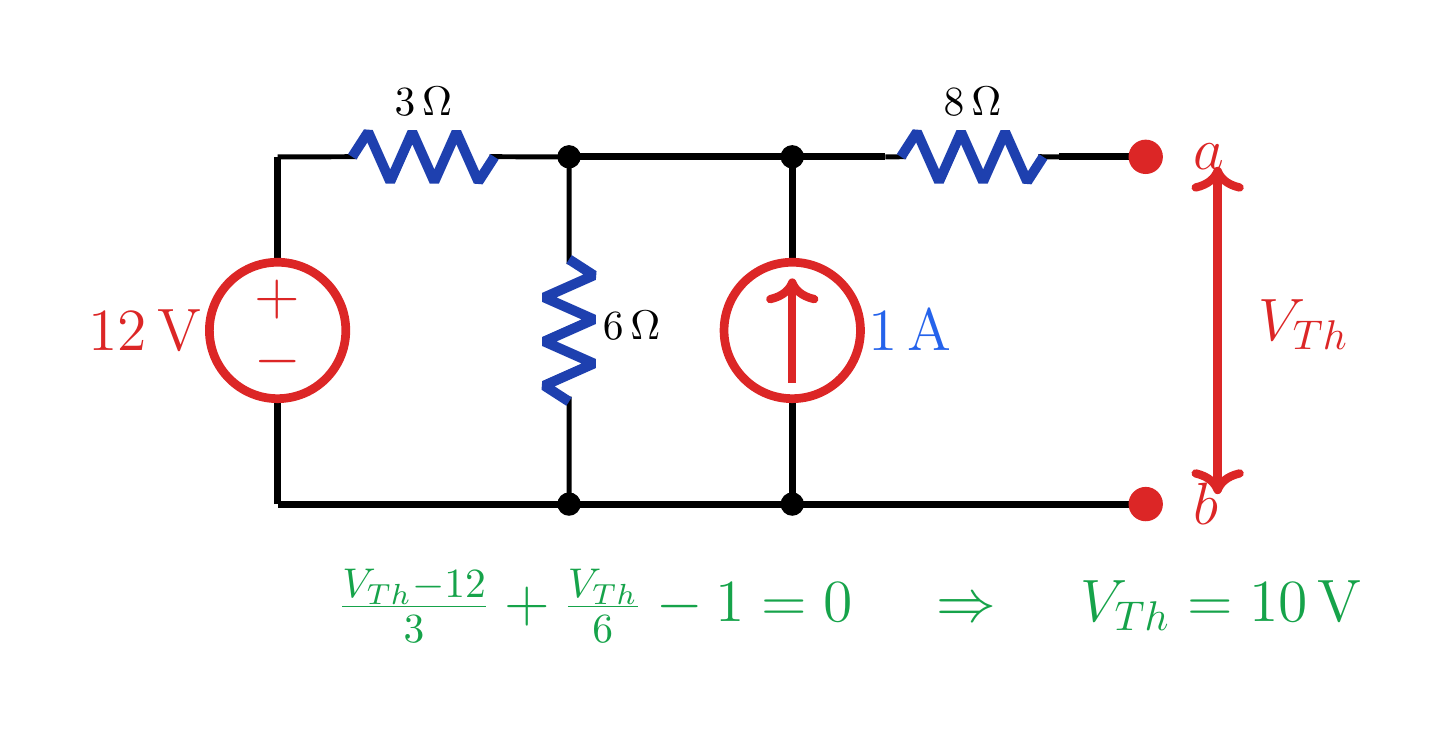
No current flows through 8 Ω; the node equation gives V_Th=10 V. Example 1: VThOpen load ⇒ i8Ω=0Narration transcript
Now find V Thevenin for example one. With the load open, no current flows through the 8 ohm resistor, so terminal a has the same voltage as the top middle node. Call that voltage V Thevenin. KCL at that node gives V Thevenin minus 12 over 3, plus V Thevenin over 6, minus 1 amp, equal to zero. Multiplying by 6 gives 2 V Thevenin minus 24 plus V Thevenin minus 6 equals zero. Therefore 3 V Thevenin equals 30, and V Thevenin is 10 volts.
5. Thevenin and Norton forms
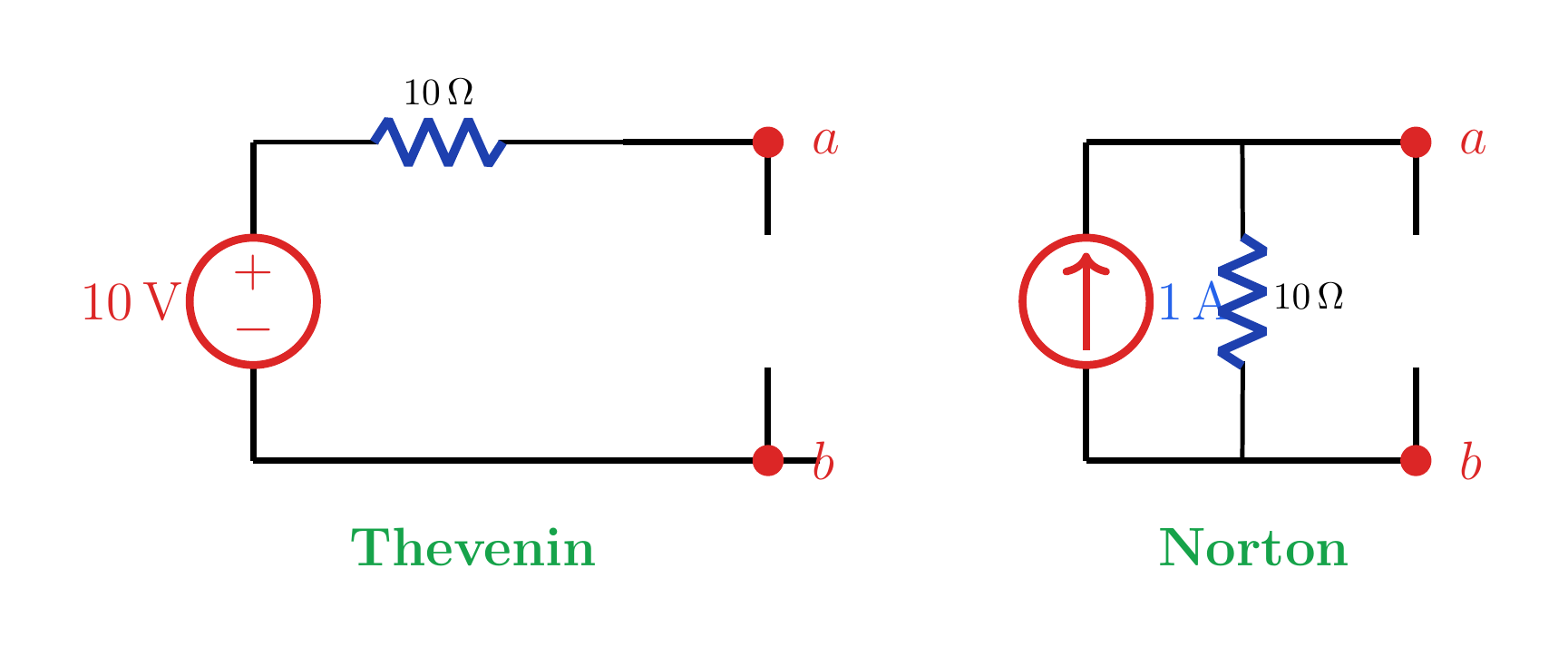
Thevenin: 10 V in series with 10 Ω; Norton: 1 A in parallel with 10 Ω. Example 1 equivalentsThevenin: 10 V in series with 10 ΩNorton: 1 A in parallel with 10 ΩThe same terminals a-b are preservedNarration transcript
The Thevenin equivalent of example one is a 10 volt source in series with 10 ohms, seen at terminals a and b. The Norton equivalent is obtained by dividing V Thevenin by R Thevenin. 10 volts divided by 10 ohms gives 1 amp. So the Norton form is a 1 amp source in parallel with 10 ohms. These two forms are equivalent at the same terminals.
6. Example 2: load current
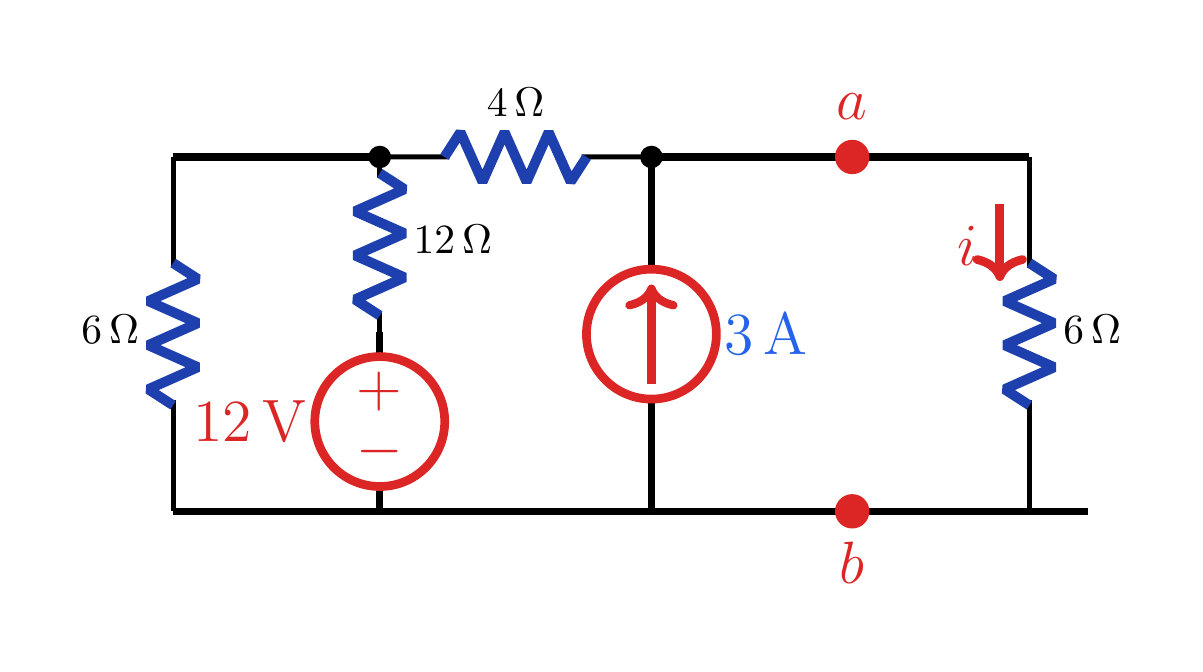
The load current i at terminals a-b is defined downward. Example 2: current through 6 ΩNarration transcript
The second source page uses the same idea to find the current through a 6 ohm load. After removing the load, the resistance seen from a and b is 4 ohms in series with 6 ohms parallel 12 ohms. The parallel part is 4 ohms, so R Thevenin is 8 ohms. For the open-circuit voltage, use two node equations. At the left top node V: V over 6 plus V minus 12 over 12 plus V minus V Thevenin over 4 equals zero. At the right top node: V Thevenin minus V over 4 minus 3 equals zero. Solving gives V equals 16 volts and V Thevenin equals 28 volts. With the 6 ohm load reconnected, the current is 28 divided by 8 plus 6, equal to 2 amperes downward.
7. Method summary
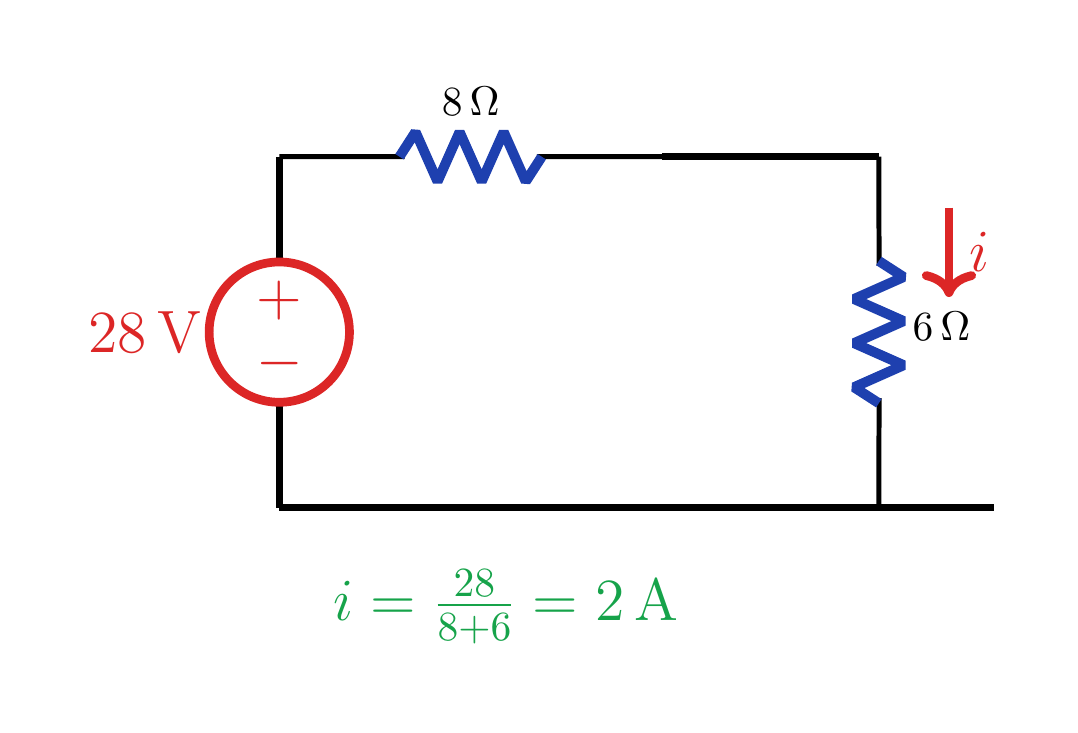
i=28/(8+6)=2 A downward. Thevenin-Norton checklistViewpoint: the load terminalsRTh: turn off independent sourcesVTh: open-circuit terminal voltagePreserve directions and polaritiesExamples: 10 V/10 Ω and 28 V/8 ΩNarration transcript
The main habit is to treat the load terminals as the viewpoint. Remove the load, find R Thevenin by turning off independent sources, find V Thevenin as the open-circuit terminal voltage, and then reconnect the load to the equivalent. For example one, R Thevenin is 10 ohms and V Thevenin is 10 volts, so the Norton current is 1 amp. For the load-current example, R Thevenin is 8 ohms, V Thevenin is 28 volts, and the load current is 2 amperes.
Source video: Circuit Theory #24 | Thevenin and Norton Equivalents - Introduction and Example (4:45)