Circuit Theory 1 · Thevenin and Norton
#28 Thevenin and Norton #28 — 1 A and 1 V test sources
Measures R_Th twice in the same dependent-source circuit using 1 A and 1 V test sources.
Question
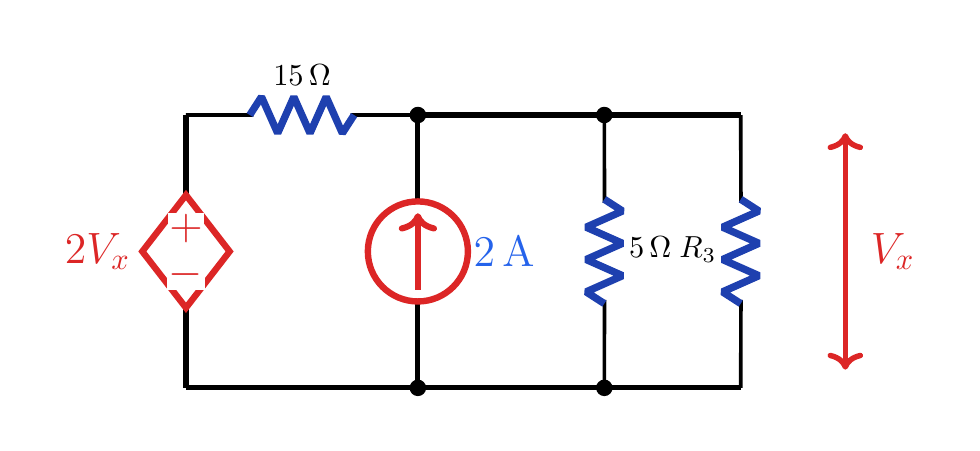
Find the R_Th seen by load R_3 first with a 1 A test current and then with a 1 V test voltage; state the Thevenin and Norton equivalents.
Written solution and narration transcript(shows the full solution)
Below are all the lines written in the notebook together with the full narration transcript.
1. Problem
V_x is the voltage of node a relative to b and the controlling variable of the dependent source. Problem and known valuesLoad: R3, terminals: a-bDependent source: 2VxKnown:Required: RThUse two test-source methodsNarration transcript
Let us state the question clearly before calculating. Looking into terminals a and b, where the load R 3 is connected, we want the Thevenin equivalent seen by that load. From the previous step we already know V Thevenin is 15 volts. In this lesson the unknown is R Thevenin. The voltage V x is the terminal voltage and also the controlling variable for the dependent source.
2. Open circuit
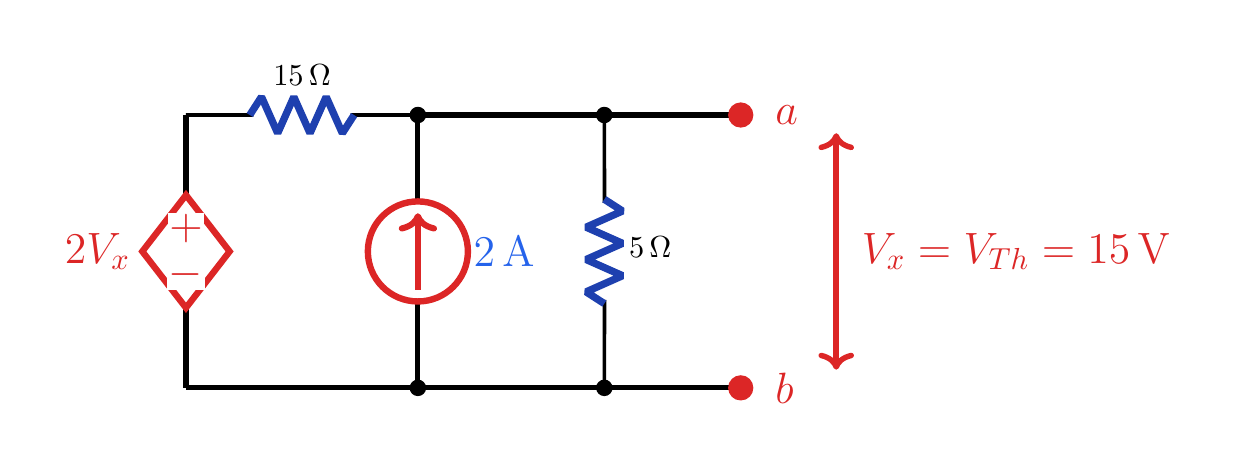
The node equation gives V_x=V_Th=15 V. Open-circuit referenceRemove R3Narration transcript
Here is the reference point. With the load removed, V x is the terminal voltage, so the KCL equation is V x minus 2 V x over 15, plus V x over 5, minus 2 equals zero. That gives 2 V x over 15 equals 2, so V x equals 15 volts.
3. 1 A test
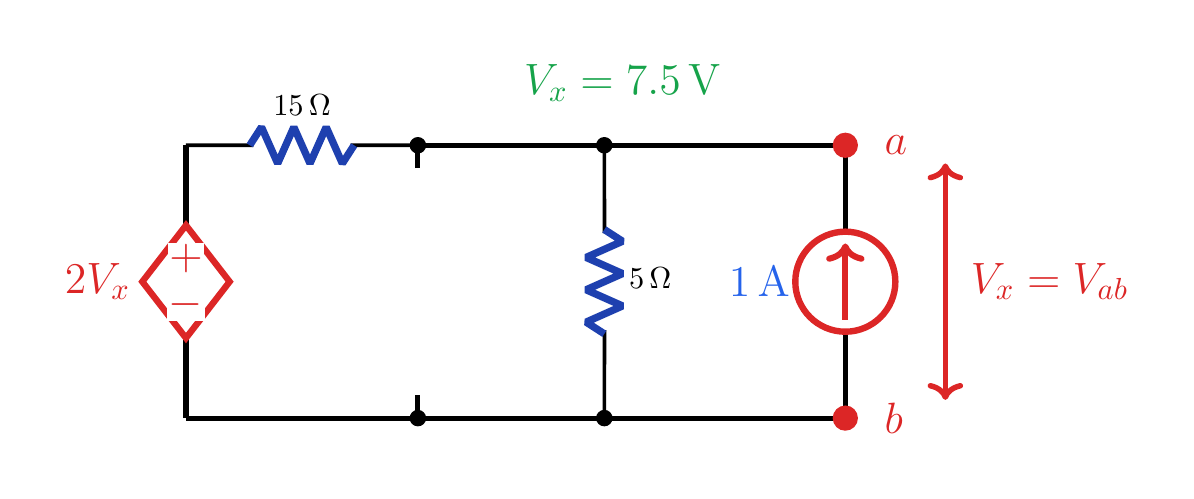
The test current produces V_x=7.5 V, so R_Th=7.5 Ω. 1 A test currentIndependent 2 A source → open circuitDependent source 2Vx stays activeDirection: b→aNarration transcript
For the current-source test method, turn off only the independent current source. A current source turned off becomes an open circuit. The dependent voltage source stays active because its value is still controlled by V x. Then connect a 1 amp test current source from b to a.
4. 1 A result
The test current produces V_x=7.5 V, so R_Th=7.5 Ω. 1 A test resultNarration transcript
Write KCL at the top terminal node. The current through the 15 ohm resistor is V x minus 2 V x over 15. The current through the 5 ohm resistor is V x over 5. The 1 amp test source enters the node, so the equation is V x minus 2 V x over 15 plus V x over 5 minus 1 equals zero. Therefore 2 V x over 15 equals 1, V x equals 7.5 volts, and R Thevenin is 7.5 ohms.
5. 1 V test
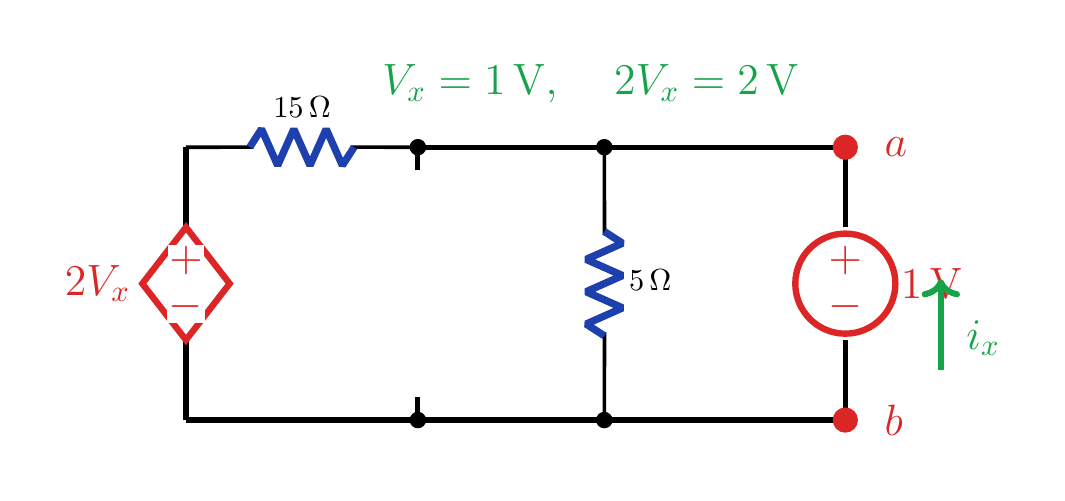
V_x=1 V, 2V_x=2 V, and i_x=2/15 A, so R_Th=7.5 Ω. 1 V test voltageIndependent 2 A source → open circuitDependent source 2Vx stays activeVt=1 V (+ at a)Test current: ixNarration transcript
Now repeat the resistance measurement with a one volt test source. Again the independent 2 amp current source is open, and the dependent source stays active. Put a 1 volt source at terminals a and b with the positive terminal at a. Since V x is the terminal voltage, V x is now 1 volt.
6. 1 V result
V_x=1 V, 2V_x=2 V, and i_x=2/15 A, so R_Th=7.5 Ω. 1 V test result15 Ω branch: (2−1)/155 Ω branch: 1/5Narration transcript
The dependent source is therefore 2 V x equal to 2 volts. Across the 15 ohm resistor, the left node is 2 volts and the right node is 1 volt, so the current from left to right is one fifteenth of an ampere. The 5 ohm branch takes one fifth of an ampere. KCL gives one fifteenth plus i x equals one fifth, so i x equals two fifteenths. R Thevenin is one divided by two fifteenths, or 7.5 ohms.
7. Equivalent circuit
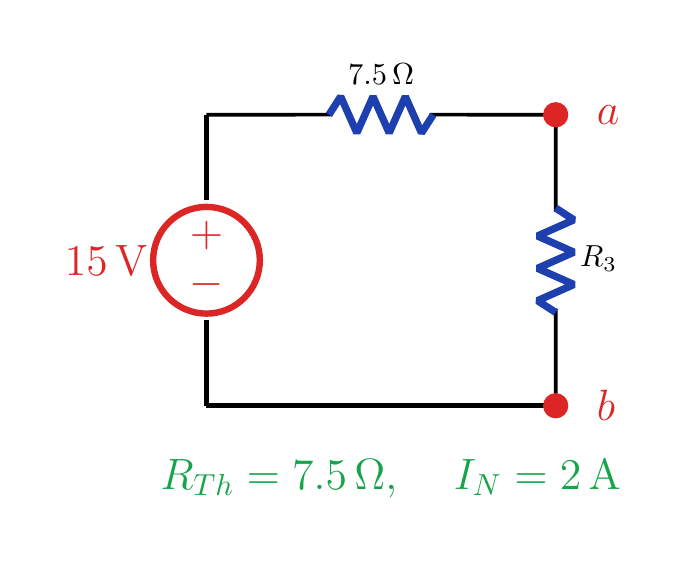
The Norton equivalent is 2 A in parallel with 7.5 Ω. Thevenin and NortonThevenin: 15 V in series with 7.5 ΩNorton: 2 A in parallel with 7.5 ΩNarration transcript
Both test-source methods agree. The Thevenin equivalent seen by R 3 is a 15 volt source in series with 7.5 ohms. The Norton current is the same voltage divided by the same resistance, so I Norton is 2 amperes.
8. Method summary
The Norton equivalent is 2 A in parallel with 7.5 Ω. Dependent-source ruleTurn off independent sources onlyKeep dependent sources active1 A test → 7.5 Ω1 V test → 7.5 ΩBoth methods agreeNarration transcript
The rule is the same every time dependent sources appear. Turn off independent sources only. Keep dependent sources in the circuit. Choose a convenient test source at the output terminals, solve for the matching voltage or current, and take R Thevenin as V test divided by I test.
Source video: Circuit Theory #28 | Thevenin Resistance with 1 A and 1 V Test Sources (3:25)