Communication Basics · Transmission Lines and Network Connections
#03 Two/four-wire circuit equivalents, the channel-line-trunk hierarchy, PVC/SVC virtual circuits, and switched-leased-dedicated services
Separate transmission structure into physical plant, logical resources, and commercial service; do not overgeneralize legacy telephony terminology to every modern network.
Question
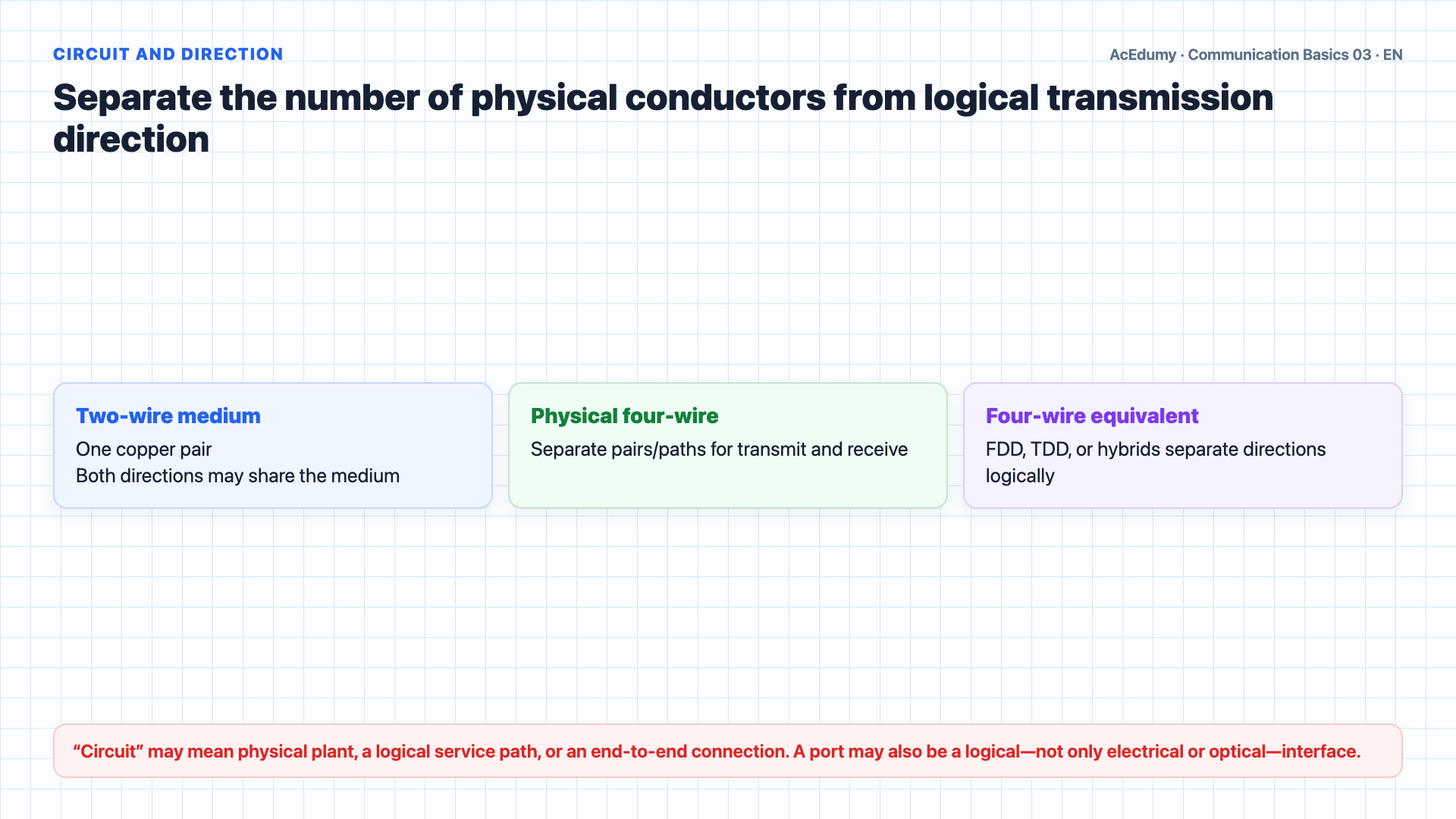
Separate physical conductor count from logical transmission direction. Define channel, line, and trunk in their technology context; compare PVC and SVC life cycles. Show that switching, leased circuits, dedicated capacity, and equipment ownership are different axes.
Written solution and narration transcript(shows the full solution)
Below are all the lines written in the notebook together with the full narration transcript.
1. Separate physical circuits from logical direction
Physical conductors, logical channels/VCs, and contracted network services are separate layers whose terminology must be scoped to the technology. Depending on context, circuit can mean physical plant, a logical service path, or an end-to-end connection; a port may be a physical or logical interface.Two-wire, physical four-wire, and four-wire-equivalent structures are useful teaching classes, not an exhaustive universal list of telecom circuits.Two-wire circuits use two electrical conductors.A single copper pair is common in legacy analog local loops; current access uses fiber, cable, copper, and radio technologies.Physical four-wire circuits use two pairs of electrical conductors, one pair for transmitting and one for receiving.Separate transmit/receive paths may be used in legacy PSTN trunks and various leased or digital links; the implementation is technology-dependent.A two-wire medium may separate directions logically with FDD frequencies or with TDD/hybrid methods to provide four-wire-equivalent behavior.This is a clever way to achieve full-duplex communication over a two-wire medium.Narration transcript
A circuit is a physical path between two or more points, where each end connects to a port, either an electrical or optical interface. There are three main types of circuits used in telecommunications. Two-wire circuits use two electrical conductors. These are the most common type, found in the analog local loop, the connection between your phone and the first point of access into the network. Physical four-wire circuits use two pairs of electrical conductors, one pair for transmitting and one for receiving. These are used for connections between PSTN switches, for leased lines, and for digital circuits where full-duplex communication is needed. Logical four-wire circuits physically have only two conductors, but they create separate transmit and receive paths by using two different frequencies. This is a clever way to achieve full-duplex communication over a two-wire medium.
2. Build the channel, line, and trunk hierarchy
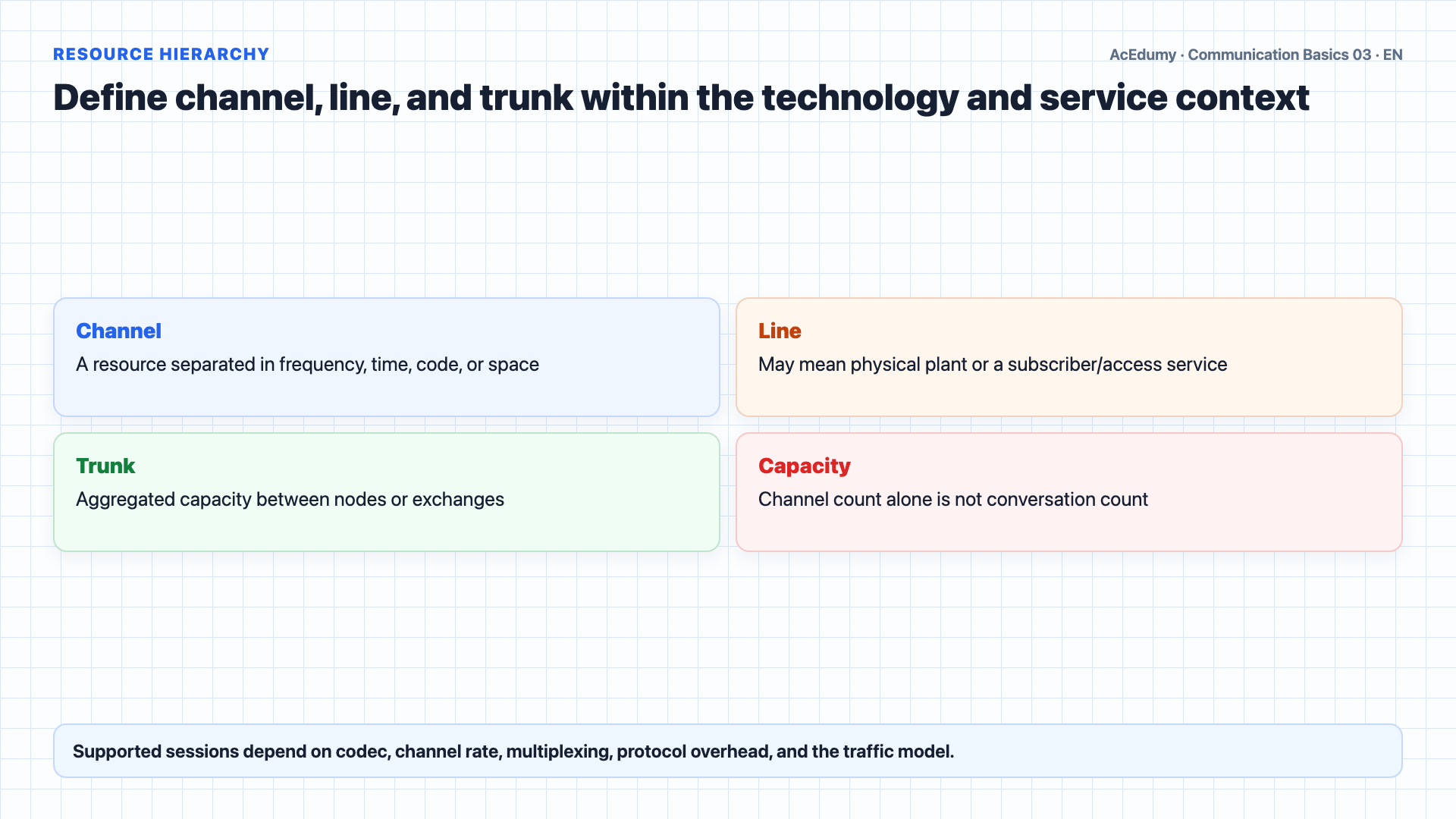
Physical conductors, logical channels/VCs, and contracted network services are separate layers whose terminology must be scoped to the technology. Now let us define three fundamental terms that describe how connections are organized in a network.A channel is a communication resource separated in frequency, time, code, or space; it need not carry speech.A channel may be a frequency band, time slot, code, or spatial stream; assignment to one or multiple traffic flows depends on the system.Concurrent session capacity depends on channel count plus codec, channel rate, multiplexing, protocol overhead, and the traffic model.Line may mean physical plant, an access link, or a subscriber service; it is not universally equivalent to one user.Think of the phone line coming into your house; it serves you, the individual subscriber.A trunk is aggregated capacity carrying multiple traffic flows between nodes or exchanges and may be circuit- or packet-based.Trunks typically provide aggregated transport between network nodes or exchanges; they are not limited to two telephone switches.While a line serves one user, a trunk is a shared highway between switches that handles traffic from many users simultaneously.Narration transcript
Now let us define three fundamental terms that describe how connections are organized in a network. A channel defines a logical conversation path. It is the frequency band, time slot, or code over which a single traffic flow travels. The number of channels in a transmission line determines how many simultaneous conversations that line can carry. A line is a connection configured to support calls generated by one user. Think of the phone line coming into your house; it serves you, the individual subscriber. A trunk is a circuit configured to carry calls from a group of users. Trunks connect two switches in the network. While a line serves one user, a trunk is a shared highway between switches that handles traffic from many users simultaneously.
3. Compare PVC and SVC life cycles
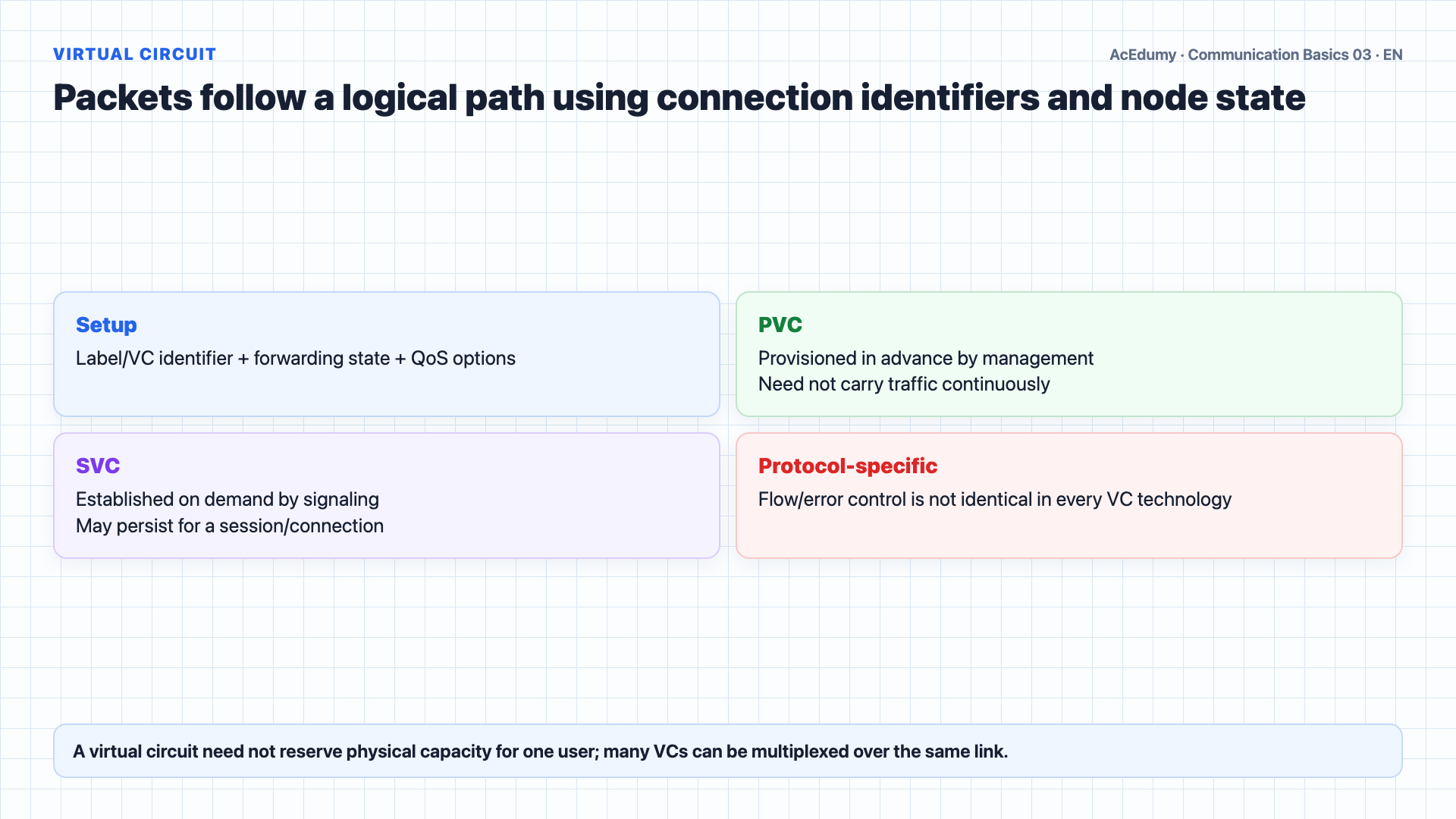
Physical conductors, logical channels/VCs, and contracted network services are separate layers whose terminology must be scoped to the technology. Virtual circuits are a series of logical connections between sending and receiving devices in a packet-switching network.A virtual circuit builds a logical path with node state and connection/label identifiers; dedicated physical capacity depends on protocol and QoS policy.Virtual-circuit setup may install connection identifiers, forwarding state, and optional QoS parameters; message size and flow/error control are not mandatory in every VC protocol.There are two types of virtual circuits.A Permanent Virtual Circuit, or PVC, is available on a permanent basis.A PVC is provisioned in advance by management and retains setup state; it need not carry traffic continuously and is only conceptually similar to a leased circuit.A Switched Virtual Circuit, or SVC, is set up on demand.An SVC is established on demand by signaling and may persist for a session or connection; it need not be rebuilt for every data unit.This is similar to a dial-up connection in the PSTN.Narration transcript
Virtual circuits are a series of logical connections between sending and receiving devices in a packet-switching network. Unlike a physical circuit that reserves a dedicated path, a virtual circuit uses table entries inside each switch to route data along a predefined path. The connection is established after the sending and receiving devices agree on communication parameters, including message size, the path to take, error acknowledgements, flow control, and error control procedures. There are two types of virtual circuits. A Permanent Virtual Circuit, or PVC, is available on a permanent basis. It is manually configured by the network management system and remains active at all times, similar to a leased line. A Switched Virtual Circuit, or SVC, is set up on demand. It is provisioned dynamically using signaling protocols, must be re-established each time data needs to be sent, and disappears after the data transfer is complete. This is similar to a dial-up connection in the PSTN.
4. Separate service, dedication, and ownership axes
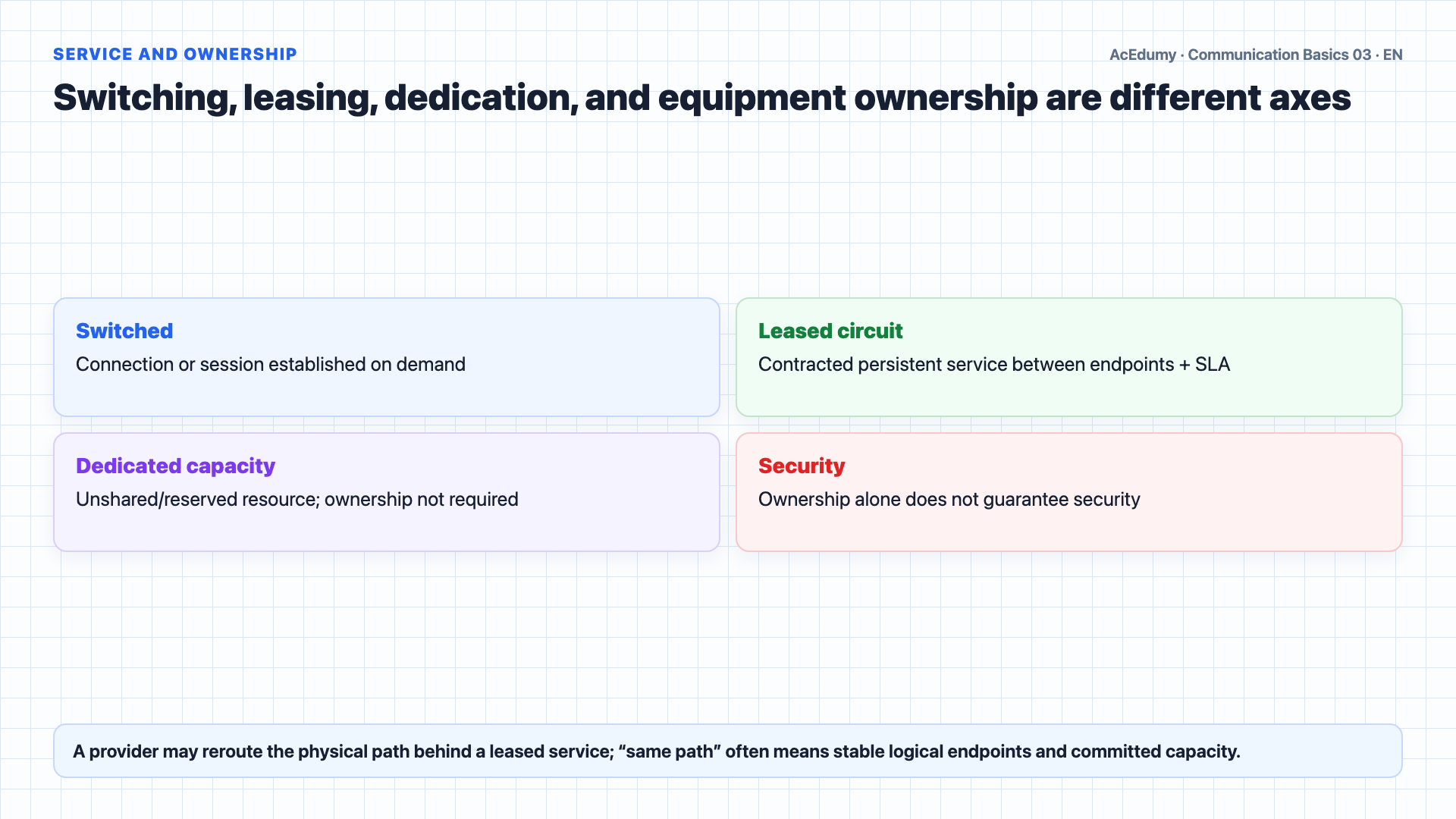
Physical conductors, logical channels/VCs, and contracted network services are separate layers whose terminology must be scoped to the technology. Finally, let us look at the three main types of network connections.Switched network connections work like a traditional dial-up call.The connection is established through a series of network switches, and it exists only for the duration of the communication.Each time you connect, the path through the network may be different.Leased line network connections provide a permanent link between two fixed points.A leased service offers stable logical endpoints and contracted capacity; the provider's physical route may change and availability is defined by its SLA.Organizations use leased lines when they need constant, reliable connectivity between locations.A dedicated connection or capacity is a resource reserved for one customer; it may be leased and does not require end-user ownership of equipment.A dedicated resource may improve control and isolation, but ownership or exclusive use alone does not guarantee maximum security.Narration transcript
Finally, let us look at the three main types of network connections. Switched network connections work like a traditional dial-up call. The connection is established through a series of network switches, and it exists only for the duration of the communication. Each time you connect, the path through the network may be different. Leased line network connections provide a permanent link between two fixed points. The transmission always follows the same path, and the connection is always available. Organizations use leased lines when they need constant, reliable connectivity between locations. Dedicated network connections are a special case of leased lines where the end user actually owns the transmission equipment. This makes the connection exclusive to that user, providing maximum control and security.
5. Summarize physical, logical, and commercial layers
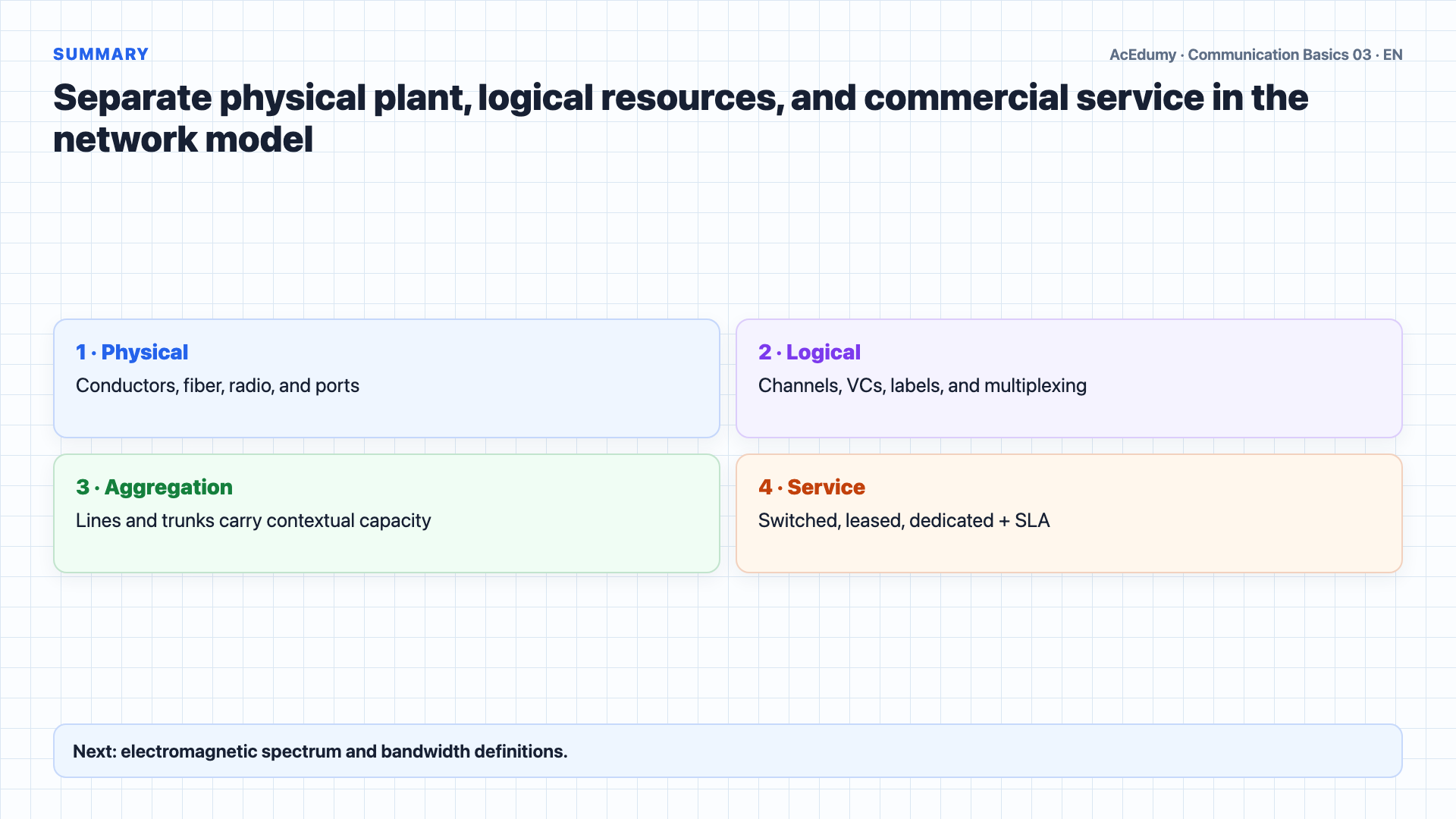
Physical conductors, logical channels/VCs, and contracted network services are separate layers whose terminology must be scoped to the technology. Let us review.Circuit may be physical or logical; distinguish a two-wire medium from physical or four-wire-equivalent directional separation.Channels, lines, and trunks organize network connections.Channels are general communication resources; line and trunk meanings vary by technology, while a trunk typically carries aggregated capacity between nodes.Virtual circuits provide logical path state in packet networks; PVCs are provisioned in advance and SVCs are established on demand by signaling.Switching, leased service, and dedicated capacity are different service axes; trade-offs depend on capacity, SLA, cost, flexibility, and security design.In the next lesson, we will explore the electromagnetic spectrum and how bandwidth is defined.Narration transcript
Let us review. A circuit is a physical path that comes in three forms: two-wire for the local loop, physical four-wire with separate conductor pairs, and logical four-wire using frequency separation. Channels, lines, and trunks organize network connections. Channels carry individual conversations, lines serve single users, and trunks connect switches. Virtual circuits provide logical paths in packet networks, as either permanent PVCs or on-demand SVCs. And network connections can be switched, leased, or dedicated, each offering different trade-offs between flexibility and reliability. In the next lesson, we will explore the electromagnetic spectrum and how bandwidth is defined.
Source video: Communication Basics #03 Transmission Lines & Network Connections (4:34)