Communication Basics · Transmission-Medium Selection: Conditional Engineering Decisions in Six Scenarios
#28 compare fiber, twisted-pair ADSL, satellite broadcast, terrestrial microwave, free-space optics, and coax/HFC candidates across six scenarios; extend the distance/bandwidth/cost/mobility/coverage starter framework with availability, latency, LOS/terrain, regulation/spectrum, right-of-way, security, lifecycle, and hybrid-architecture acceptance gates
Conditionally match six media to six scenarios, then turn short ‘sweet spot’ answers into engineering decisions with availability, LOS, regulation, lifecycle, and hybrid-architecture gates.
Question
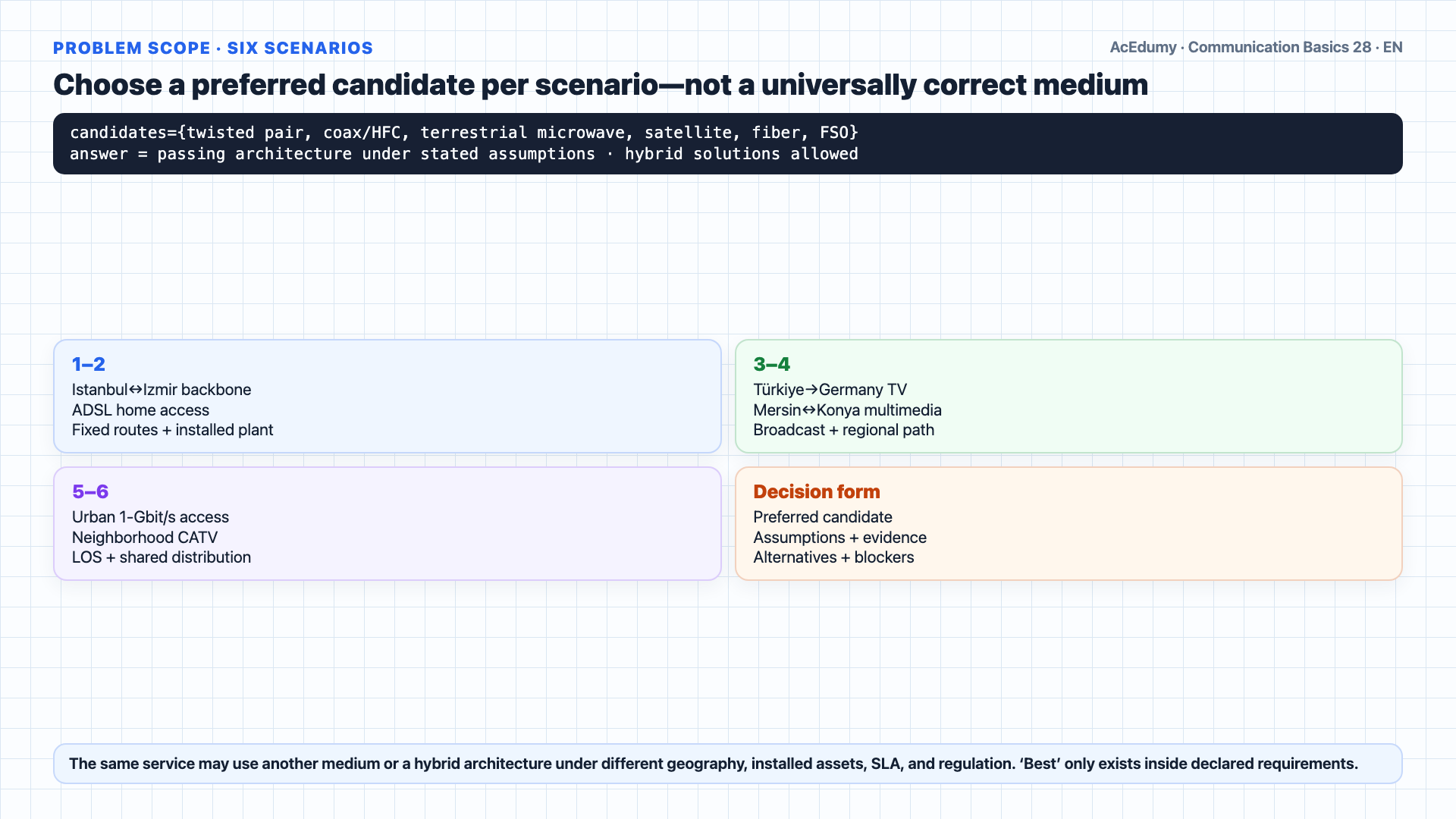
Treat each medium as a candidate under the stated scenario rather than a universal single answer; extend the requirements baseline with capacity/rate distribution, latency/jitter, availability, resilience, topology, installed assets, terrain/LOS/Fresnel clearance, weather, regulation/spectrum/laser safety, right-of-way, security, energy/operations, upgrade path, and lifecycle TCO; prefer fiber for the Istanbul–Izmir high-capacity fixed backbone while requiring route diversity/right-of-way and regeneration design; select ADSL only if the existing copper loop is qualified and meets the service target; treat satellite as a wide-area broadcast candidate but reject only-medium/one-transmitter/one-third-Earth and delay-does-not-matter claims; require path profile, hop count, Fresnel clearance, spectrum, and rain-fade availability for Mersin–Konya microwave; verify fog/rain/scintillation, alignment/building sway, eye safety, local regulation, and backup path for urban 1-Gbit/s FSO; keep coax/HFC as an installed-plant CATV candidate while comparing FTTH/RFoG/IP alternatives and an upgrade plan.
Written solution and narration transcript(shows the full solution)
Below are all the lines written in the notebook together with the full narration transcript.
1. Fix the six scenarios and candidate technology set
Keep each scenario answer conditional; do not declare a best medium until measurable requirements, alternative/hybrid architectures, and deployment constraints pass. Welcome back.After two heavy dB videos, today's question is different — no formulas, just engineering judgement.Here is the setup.We have six telecommunication scenarios.For each scenario, select a preferred candidate from these six under explicit assumptions; real networks may be hybrid and the answer may change when requirements change.The scenarios.One: heavy telephone backbone traffic between two major Turkish cities.Two: an ADSL home internet connection.Three: broadcasting Turkish TV channels to viewers in Germany.Four: a multimedia microwave link between two regional cities.Five: a one gigabit per second access link in a dense urban area.Six: cable TV distribution in a city neighborhood.We will work through each one and explain not just the answer, but the reasoning.Narration transcript
Welcome back. After two heavy d B videos, today's question is different — no formulas, just engineering judgement. Here is the setup. We have six telecommunication scenarios. For each one, you must pick the best transmission medium from twisted pair, coaxial, microwave, satellite, fiber optic, and free space optics. The scenarios. One: heavy telephone backbone traffic between two major Turkish cities. Two: an A D S L home internet connection. Three: broadcasting Turkish T V channels to viewers in Germany. Four: a multimedia microwave link between two regional cities. Five: a one gigabit per second access link in a dense urban area. Six: cable T V distribution in a city neighborhood. We will work through each one and explain not just the answer, but the reasoning.
2. Extend five axes into a full requirements and lifecycle framework
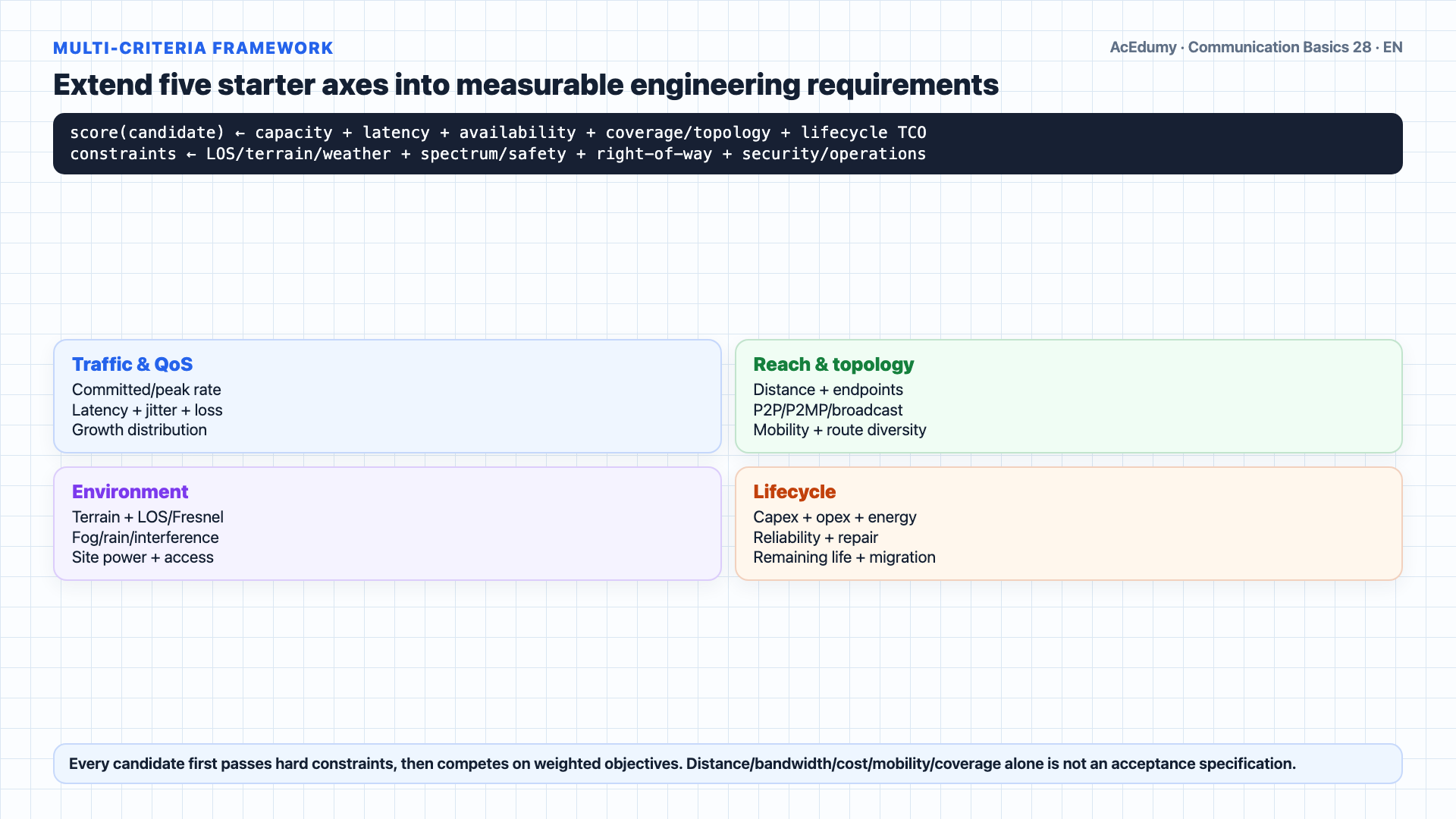
Keep each scenario answer conditional; do not declare a best medium until measurable requirements, alternative/hybrid architectures, and deployment constraints pass. Before the answers, the framework.Five axes are a useful start; the decision also needs availability/resilience, latency/jitter, terrain/LOS, regulation/spectrum, right-of-way, security, operations, upgrade path, and lifecycle TCO.Distance: how far does the signal need to travel?Bandwidth: how much data per second?Cost: capital expense plus operations.Mobility: stationary nodes or moving users?Coverage: point to point, point to multipoint, or broadcast to many?Match those five against what each medium does best.Twisted pair: short distance, low cost, existing infrastructure.Coaxial: short to medium, broadcast distribution, established for cable TV.Microwave: medium distance line of sight, terrestrial backbone, no trenching.Satellite is a wide-area/broadcast and remote-reach candidate; footprint, capacity, terminals, spectrum, weather, regulation, latency, availability, and cost constrain it—there is no ‘anywhere’ guarantee.Fiber optic is a strong high-capacity fixed-backbone candidate; route/right-of-way, span equipment, protection, latency, repairability, and lifecycle economics still require design.FSO is a high-rate candidate for short LOS paths; verify local spectrum/regulatory and laser-safety status, fog/rain/scintillation, sunlight, alignment/building sway, and availability.Now apply this framework to each scenario.Narration transcript
Before the answers, the framework. Picking a transmission medium comes down to five questions. Distance: how far does the signal need to travel? Bandwidth: how much data per second? Cost: capital expense plus operations. Mobility: stationary nodes or moving users? Coverage: point to point, point to multipoint, or broadcast to many? Match those five against what each medium does best. Twisted pair: short distance, low cost, existing infrastructure. Coaxial: short to medium, broadcast distribution, established for cable T V. Microwave: medium distance line of sight, terrestrial backbone, no trenching. Satellite: very long distance, broadcast coverage, expensive but reaches anywhere. Fiber optic: long distance, very high bandwidth, the gold standard for backbones. Free space optics: short distance, very high bandwidth, no licence required, but weather sensitive. Now apply this framework to each scenario.
3. Condition the fiber-backbone and ADSL-reuse selections
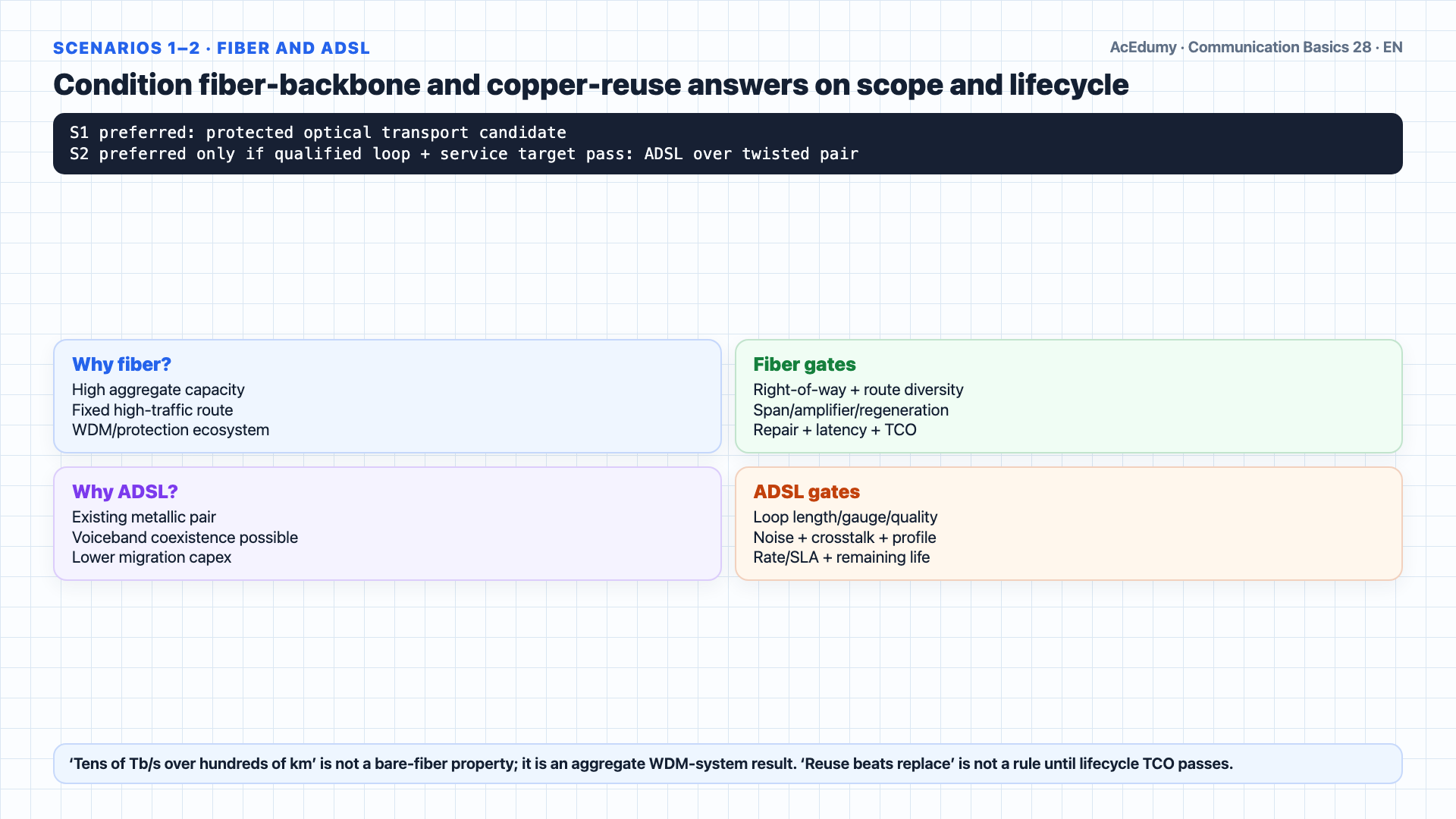
Keep each scenario answer conditional; do not declare a best medium until measurable requirements, alternative/hybrid architectures, and deployment constraints pass. Scenario one: heavy telephone backbone, Istanbul to Izmir, about five hundred kilometers.Long distance, very high bandwidth, point to point, stationary endpoints, cost amortized over millions of calls.Pick: optical fiber.Under the Istanbul–Izmir high-capacity fixed-backbone assumptions, fiber is the preferred candidate; other media are not absolutely impossible and must be compared on route diversity, right-of-way, protection, and TCO.Microwave would need many repeater towers and is bandwidth limited.Satellite has the latency problem we covered last video.Aggregate WDM systems can offer very high line capacity; rate and transparent reach are system results of channel plan, modulation, amplification/regeneration, and margins—not properties of bare fiber alone.Scenario two: ADSL home internet.Short distance, moderate bandwidth, and crucially the infrastructure already exists.Pick: twisted pair copper.Existing qualified copper may reduce replacement cost; use measured loop inventory and lifecycle TCO for this service area instead of an unsupported blanket global cost claim.ADSL/ADSL2+ can coexist with voiceband service on metallic twisted pair; achievable rate/reach depends on loop length, gauge, noise/crosstalk, profile, and operator qualification.Choose reuse only when service target, reliability, energy/operations, upgrade path, and lifecycle TCO outperform new-build alternatives.Narration transcript
Scenario one: heavy telephone backbone, Istanbul to Izmir, about five hundred kilometers. Long distance, very high bandwidth, point to point, stationary endpoints, cost amortized over millions of calls. Pick: optical fiber. Fiber wins because at this distance, every other medium either loses too much signal or runs out of bandwidth. Microwave would need many repeater towers and is bandwidth limited. Satellite has the latency problem we covered last video. Fiber gives you tens of terabits per second over hundreds of kilometers. Scenario two: A D S L home internet. Short distance, moderate bandwidth, and crucially the infrastructure already exists. Pick: twisted pair copper. We solved this in our midterm prep — replacing the world's twisted pair with fiber would cost trillions. A D S L re-uses the same copper that carries voice, delivering tens of megabits per second over a few kilometers. Reuse beats replace.
4. Condition the satellite-broadcast and microwave-path selections
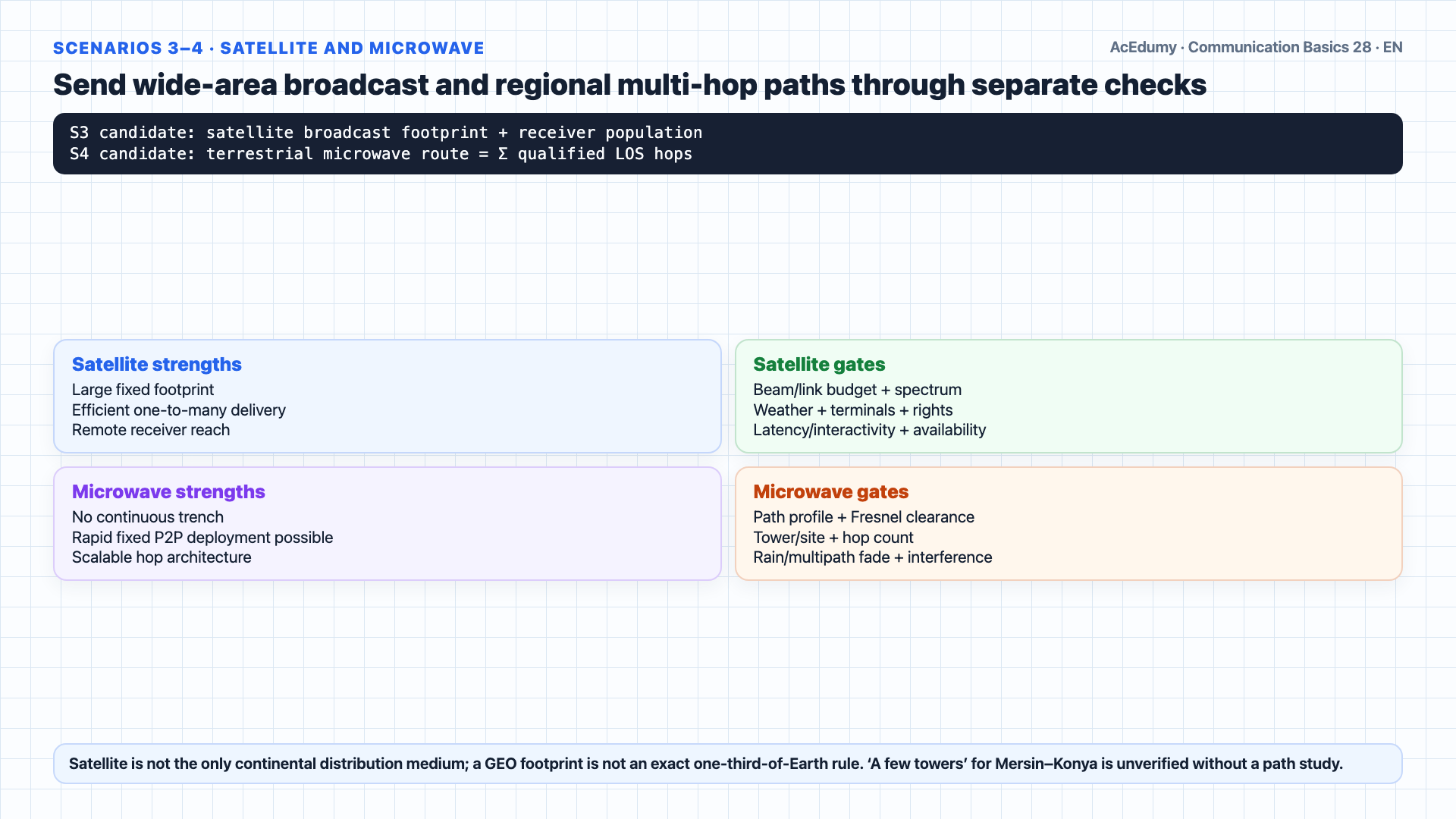
Keep each scenario answer conditional; do not declare a best medium until measurable requirements, alternative/hybrid architectures, and deployment constraints pass. Scenario three: broadcast Turkish TV channels to viewers in Germany.Very long distance, broadcast coverage, millions of receivers all over Europe.Pick: satellite.A satellite uplink plus satellite downlink can provide wide-area broadcast; terrestrial broadcast and fiber/CDN/IP distribution are alternatives, so satellite is not the only medium.Fiber contribution/backhaul and access/CDN architectures differ; comparison with satellite must not assume one dedicated long-haul fiber to every home.Individual terrestrial microwave hops require LOS and Fresnel clearance; Earth curvature, terrain, and tower heights are solved in a path profile, and multi-hop routing is possible.One GEO satellite can provide a large fixed footprint; usable service area follows antenna pattern, elevation mask, link budget, spectrum rights, and regional beam design—not an exact one-third rule.GEO propagation latency is often less critical for non-interactive linear TV, but still matters to contribution, channel change, interactivity, live production, and error-recovery requirements.Scenario four: multimedia link from Mersin to Konya, a regional connection of a few hundred kilometers.Pick: microwave.Mersin–Konya microwave feasibility requires route distance, terrain/curvature, hop profile, tower heights, Fresnel clearance, site access, and spectrum coordination; ‘a few towers’ is unverified.Hundreds of Mbit/s cannot be called sufficient until committed/peak throughput, latency/jitter, growth, protection, and availability requirements are known.The microwave candidate must pass licensed-spectrum, interference, rain/multipath fade, hop-availability, redundancy, operations, and lifecycle-TCO gates.Narration transcript
Scenario three: broadcast Turkish T V channels to viewers in Germany. Very long distance, broadcast coverage, millions of receivers all over Europe. Pick: satellite. Satellite is the only medium that can broadcast to a continent from one transmitter. Fiber would need a wired connection to every home in Germany. Microwave cannot bend around the curvature of the Earth at this distance. A single geostationary T V satellite covers a third of the planet. Yes, the propagation delay is two hundred forty milliseconds end to end, but for one way T V broadcast that does not matter. Scenario four: multimedia link from Mersin to Konya, a regional connection of a few hundred kilometers. Pick: microwave. Mid range distance, line of sight is achievable with a few repeater towers, and microwave avoids the cost of trenching for fiber. Bandwidth in the hundreds of megabits per second is enough for the multimedia traffic. Microwave is the practical, cost effective middle ground for these regional hops.
5. Condition the urban FSO and coax/HFC distribution selections
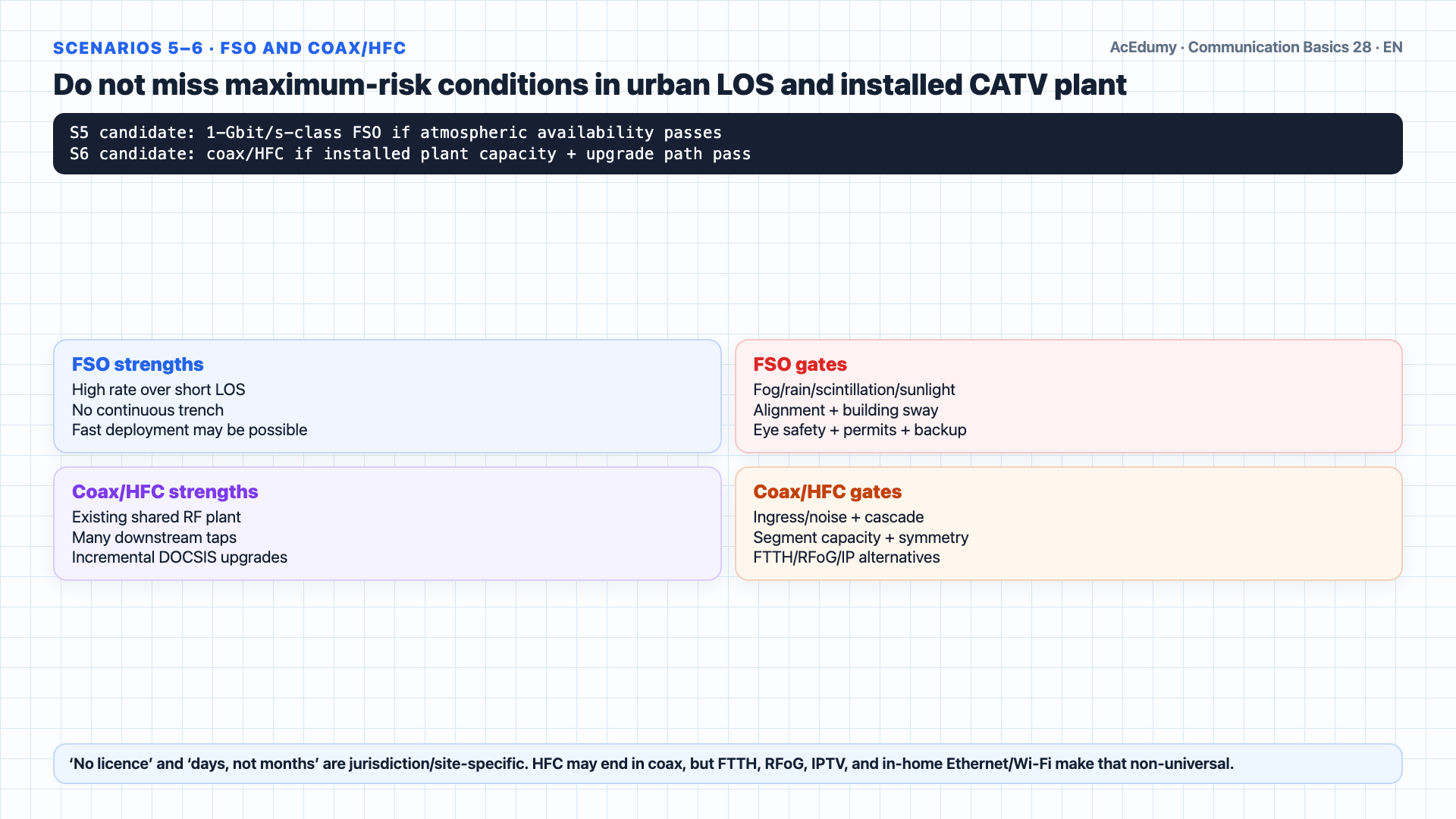
Keep each scenario answer conditional; do not declare a best medium until measurable requirements, alternative/hybrid architectures, and deployment constraints pass. Scenario five: a one gigabit per second access link in a dense urban area.Short distance, very high bandwidth, rooftop to rooftop or building to building, and you cannot easily trench through a city.Pick: free space optics.FSO sends a laser beam through air between two telescopes.FSO can deliver a 1-Gbit/s-class short link without trenching; deployment time, permits/site rights, spectrum treatment, and eye/laser safety depend on jurisdiction and installation.Put fog/rain/clear-air/scintillation and sunlight impairments into the availability model; accept a short urban hop only when target availability, alignment/building sway, and backup path pass.Scenario six: cable TV distribution in a city neighborhood.Short distance, broadcast distribution to many homes, and existing infrastructure built over decades.Pick: coaxial cable.In existing CATV/HFC plant, coax is a strong shared-distribution candidate; verify spectrum plan, tap/amplifier cascade, ingress/noise, capacity segmentation, and upgrade path.HFC combines fiber feeder with a downstream coax segment; that last segment may be coax, but FTTH/RFoG/IPTV and in-home Ethernet/Wi-Fi alternatives make this non-universal.Narration transcript
Scenario five: a one gigabit per second access link in a dense urban area. Short distance, very high bandwidth, rooftop to rooftop or building to building, and you cannot easily trench through a city. Pick: free space optics. F S O sends a laser beam through air between two telescopes. It gives you fiber like bandwidth, no trenching, no spectrum licence, set up in days not months. The downside is fog and heavy rain can drop the link, but for short urban hops this is acceptable. Scenario six: cable T V distribution in a city neighborhood. Short distance, broadcast distribution to many homes, and existing infrastructure built over decades. Pick: coaxial cable. Coax was designed exactly for this — high bandwidth, distributable to many taps along the same cable, with the necessary shielding to carry T V channels. Modern hybrid fiber coaxial networks combine fiber backbones with coax to the home, but the last mile to the T V is still coaxial.
6. Compare six candidate answers with assumptions and blockers
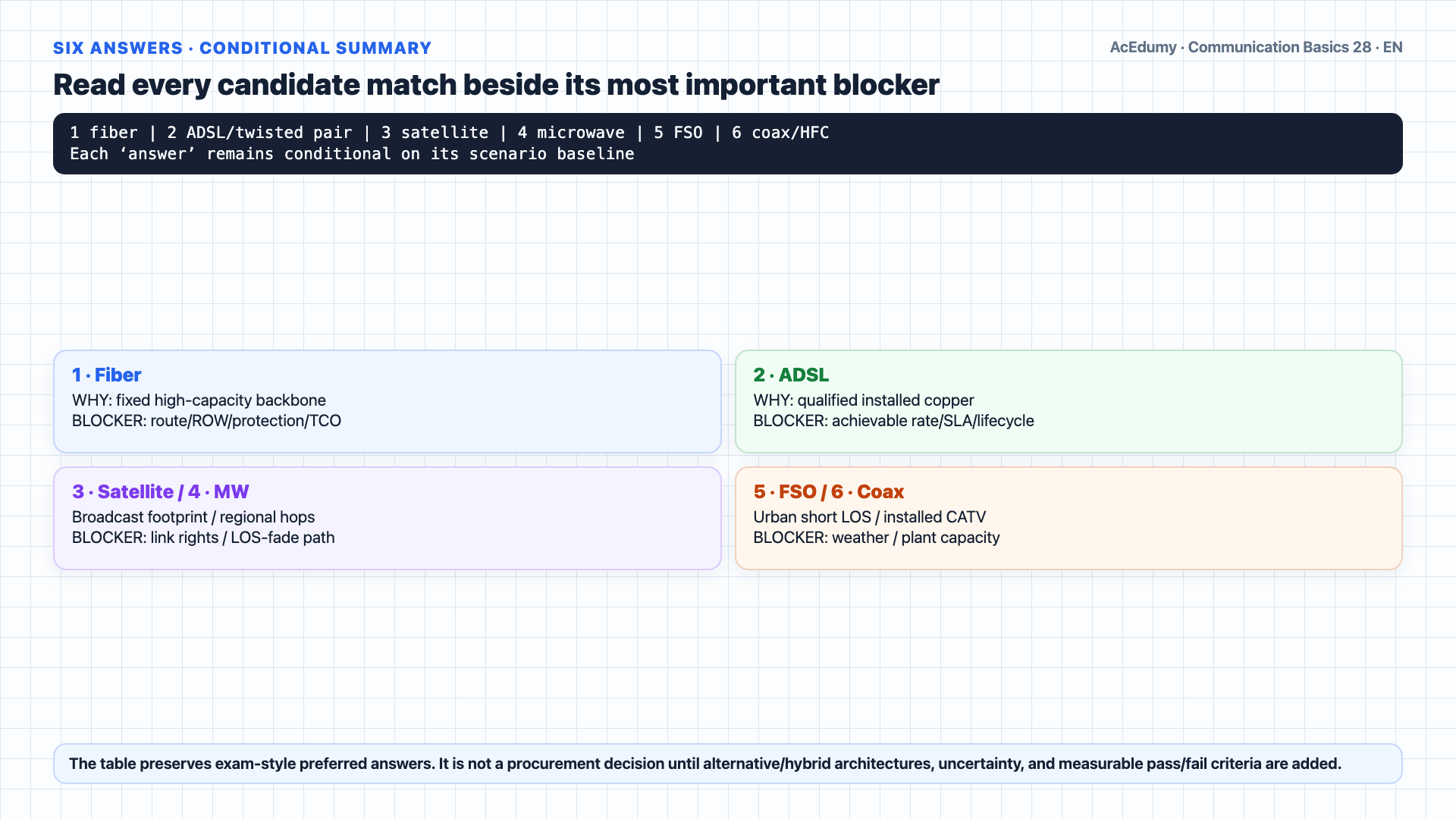
Keep each scenario answer conditional; do not declare a best medium until measurable requirements, alternative/hybrid architectures, and deployment constraints pass. All six answers side by side.Heavy telephone backbone Istanbul Izmir: optical fiber, for distance and bandwidth.ADSL home internet: twisted pair, for the existing copper infrastructure.Turkish TV broadcast to Germany: satellite, for continental broadcast coverage.Multimedia link Mersin to Konya: microwave, for cost effective mid range.One gigabit access in dense city: free space optics, for high bandwidth without trenching.C A TV neighborhood distribution: coaxial cable, for broadcast distribution.Notice the pattern.Each medium offers a different trade-space; a preferred solution exists only under stated assumptions and measurable gates, and real architectures may combine multiple media.There is no universally best technology.The right answer depends on the question.Narration transcript
All six answers side by side. Heavy telephone backbone Istanbul Izmir: optical fiber, for distance and bandwidth. A D S L home internet: twisted pair, for the existing copper infrastructure. Turkish T V broadcast to Germany: satellite, for continental broadcast coverage. Multimedia link Mersin to Konya: microwave, for cost effective mid range. One gigabit access in dense city: free space optics, for high bandwidth without trenching. C A T V neighborhood distribution: coaxial cable, for broadcast distribution. Notice the pattern. Each medium has a sweet spot defined by distance, bandwidth, cost, mobility, and coverage. There is no universally best technology. The right answer depends on the question.
7. Verify the decision with measurable gates and lifecycle TCO
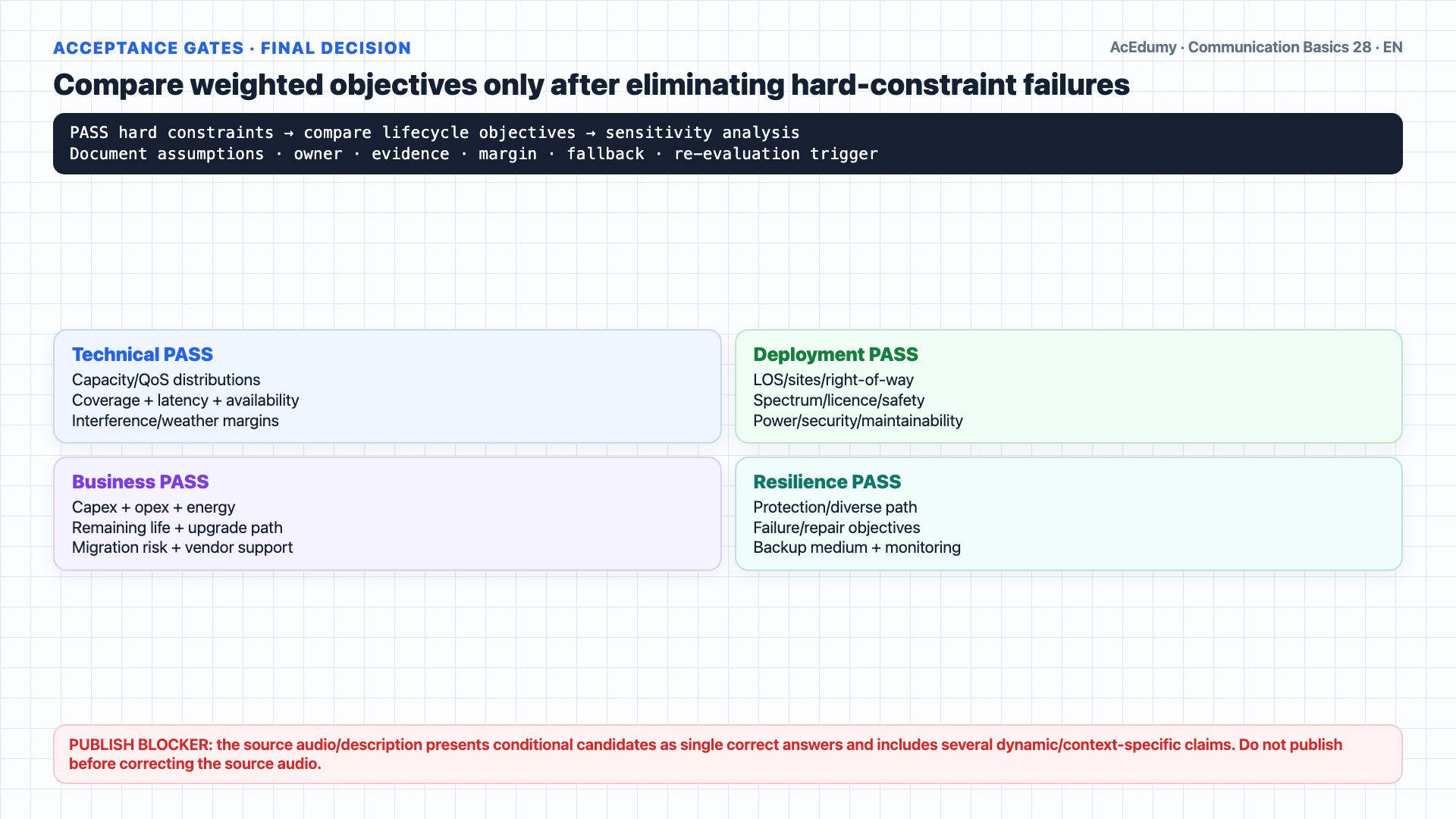
Keep each scenario answer conditional; do not declare a best medium until measurable requirements, alternative/hybrid architectures, and deployment constraints pass. Three takeaways.One: match the medium to the application — every transmission technology has a sweet spot, none dominates everywhere.Two: installed plant is an important input, weighted by condition, remaining life, capacity, operations, upgradeability, and lifecycle TCO.Twisted pair carries DSL plus voice, control, and other installed-access uses; continued use has no single cause.Coax carries CATV/HFC broadband, RF distribution, and other installed uses; continued use has no single cause.Compare reuse and new build on capex plus opex, energy, reliability, capacity, repair, remaining life, upgrade path, and migration risk.Three: when in doubt, walk through the five questions: distance, bandwidth, cost, mobility, coverage.Select the best passing architecture under weighted requirements and uncertainty; the five baseline axes alone are not sufficient acceptance.Narration transcript
Three takeaways. One: match the medium to the application — every transmission technology has a sweet spot, none dominates everywhere. Two: existing infrastructure is half the answer. Twisted pair survives because of A D S L. Coax survives because of cable T V. Building from scratch is expensive — reuse what is already in the ground. Three: when in doubt, walk through the five questions: distance, bandwidth, cost, mobility, coverage. The medium that best fits all five is your answer.
Source video: Communication Basics #28 Worked Example: Match the Medium — 6 Real Scenarios (7:27)