Communication Basics · Twisted Pair & DSL Technologies
#08 Balanced twisted pair, screen notation, cabling categories, ISDN/xDSL scope, copper-access rate/reach, and cost assumptions
Analyze copper access without conflating cabling category, screening, access standard, line condition, or economic assumptions.
Question
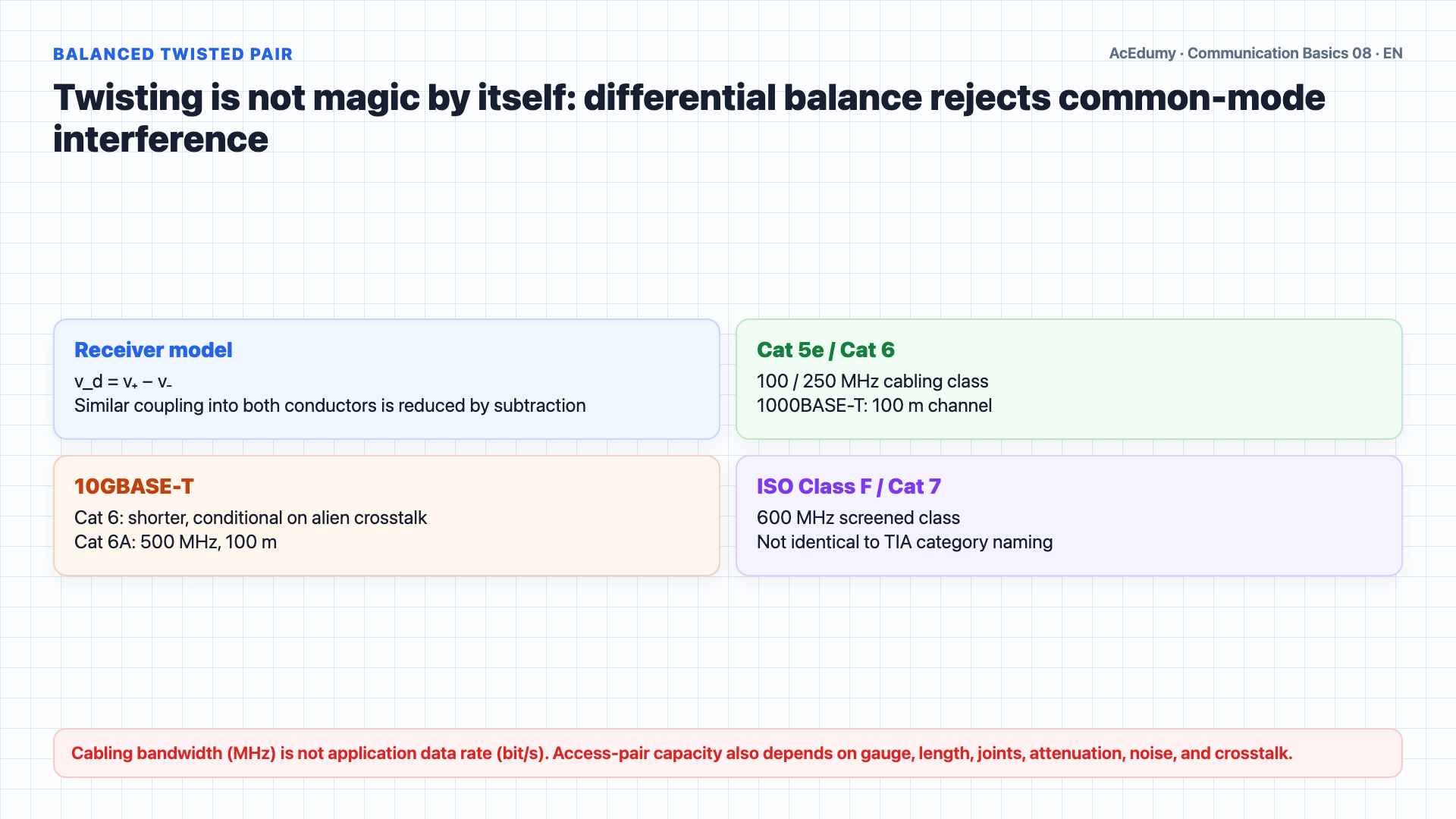
Build differential balance and common-mode rejection for twisted pair; distinguish cabling category from Ethernet application; compare ISDN and xDSL families with explicit standards, line conditions, rates, and reach assumptions.
Written solution and narration transcript(shows the full solution)
Below are all the lines written in the notebook together with the full narration transcript.
1. Build balanced twisted pair and category limits
Twisted pair and DSL are compared while keeping cabling category, access standard, line conditions, and economic scope explicit. Twisted pair is the oldest and most common transmission medium.UTP, which stands for Unshielded Twisted Pair, consists of two thin copper wires that are separately insulated and twisted around each other.Twisting supports balanced differential transmission and common-mode rejection: external fields tend to couple similarly into both conductors, and the receiver rejects the shared component.UTP comes in several categories.Category 1 was designed for voice only.Category 3 supports data up to 16 megahertz.Cabling bandwidth is not the same quantity as application data rate: Category 5 is a historical 100 MHz class; current structured cabling uses Cat 5e for 1000BASE-T over a 100 m channel.Cat 6 is specified to 250 MHz; it supports 1000BASE-T over 100 m, while 10GBASE-T reach on installed Cat 6 depends on channel length and alien-crosstalk performance.ISO/IEC Class F/Category 7 is a screened 600 MHz class; Cat 6A/Class EA is also a 500 MHz, 100 m option for 10GBASE-T. TIA and ISO category/class names are not identical.Installed twisted-pair scale depends on source and metric; an access local loop may connect the premises to an operator node at a central office or fibre-fed cabinet.A telephone access pair may have been installed for voiceband service; DSL and digital-carrier capability depends on gauge, length, joints, attenuation, noise, crosstalk, modem profile, and number of pairs.Unscreened balanced pair can be exposed to EMI and crosstalk; the result depends on twist geometry, balance, routing, frequency, termination, and environment, so 'highly susceptible' is not universal.Narration transcript
Twisted pair is the oldest and most common transmission medium. UTP, which stands for Unshielded Twisted Pair, consists of two thin copper wires that are separately insulated and twisted around each other. The twisting reduces electromagnetic interference by canceling out external signals. UTP comes in several categories. Category 1 was designed for voice only. Category 3 supports data up to 16 megahertz. Category 5 is used in LAN applications, handling 100 megabits per second over 100 megahertz at distances up to 100 meters. Category 6 supports up to 1 gigabit per second over short distances. And Category 7 operates over 600 megahertz for 10 gigabit Ethernet. Billions of miles of UTP are installed worldwide, most notably in the local loop, which is the circuit connecting your premises to the Central Office switch at the edge of the PSTN, the Public Switched Telephone Network. UTP was originally installed for analog voice at 4 kilohertz, but with proper conditioning it can support digital transmission including DSL and even T1 or E1 links. UTP is inexpensive and easy to install, but it is highly susceptible to EMI, which stands for Electromagnetic Interference, causing crosstalk and signal distortion.
2. Name screening and DSL scope precisely
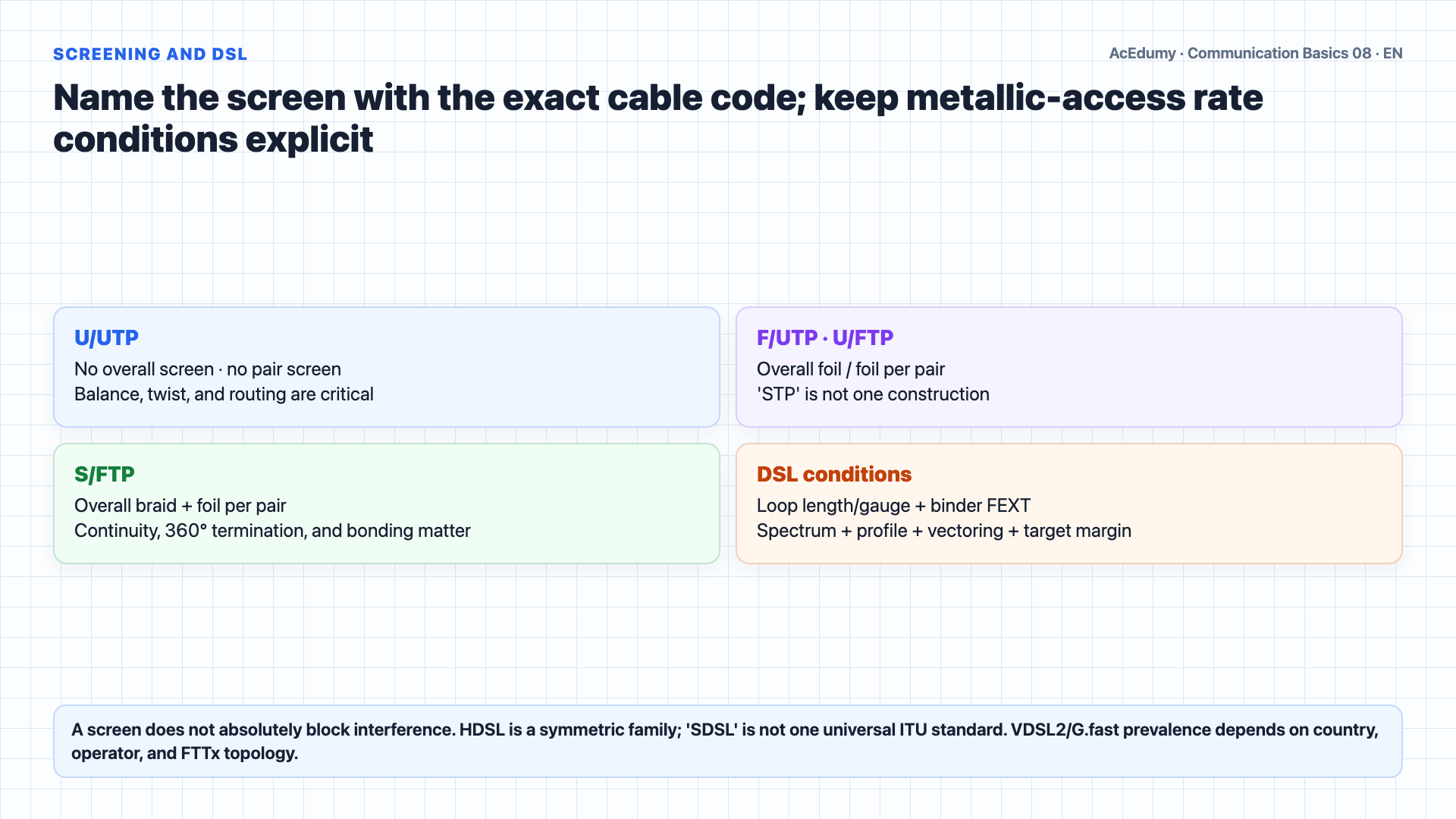
Twisted pair and DSL are compared while keeping cabling category, access standard, line conditions, and economic scope explicit. To combat the noise problems of UTP, shielded versions were developed.Use precise ISO/IEC screen notation: for example F/UTP has an overall foil, U/FTP has foil per pair, and S/FTP has an overall braid plus foil per pair; 'STP' is not one construction.ScTP/STP terminology varies by region; foil and braid are both screen types, and the exact construction should be stated with the cable code.Screening can reduce field coupling; performance depends on screen continuity, 360° termination, bonding/earthing, and pair balance, and it does not absolutely 'block' interference.They are more expensive and harder to install than UTP, but essential for high performance applications.Cat 6 may be screened or unscreened; Class F/Category 7 is screened. A category alone does not imply the same screen construction.Now, the local loop represents an enormous installed base of copper twisted pair.DSL reuses an existing metallic pair; attainable rate depends on loop length/gauge, attenuation, binder crosstalk, spectrum plan, vectoring, and profile.DSL technologies come in two flavors.HDSL is a symmetric digital-access family; 'SDSL' is not one universal ITU standard name, so its implementation/vendor context must be stated.Asymmetrical services provide higher downstream speeds, like ADSL, which is optimized for web browsing and streaming where you download far more than you upload.VDSL2 and G.fast can remain on copper segments; prevalence depends on country, operator, FTTx topology, and date. As fibre expands, the copper segment may shorten or be retired.Narration transcript
To combat the noise problems of UTP, shielded versions were developed. STP, Shielded Twisted Pair, wraps each pair in a metal foil shield, sometimes with an additional shield around all pairs in the cable. ScTP, Screened Twisted Pair, uses a metal screen instead of foil. Both STP and ScTP block interference by absorbing it and conducting it to ground. They are more expensive and harder to install than UTP, but essential for high performance applications. Category 6 and 7 cables often use this shielded approach. Now, the local loop represents an enormous installed base of copper twisted pair. Rather than replacing it all with fiber, engineers developed DSL, Digital Subscriber Line technologies, to squeeze high speed digital data through existing copper. DSL technologies come in two flavors. Symmetrical services provide equal speeds upstream and downstream, like HDSL and SDSL. Asymmetrical services provide higher downstream speeds, like ADSL, which is optimized for web browsing and streaming where you download far more than you upload. Today, while fiber to the home is expanding, DSL technologies, especially VDSL2 and G.fast, remain widely deployed worldwide.
3. Compare ISDN and xDSL by standard and line condition
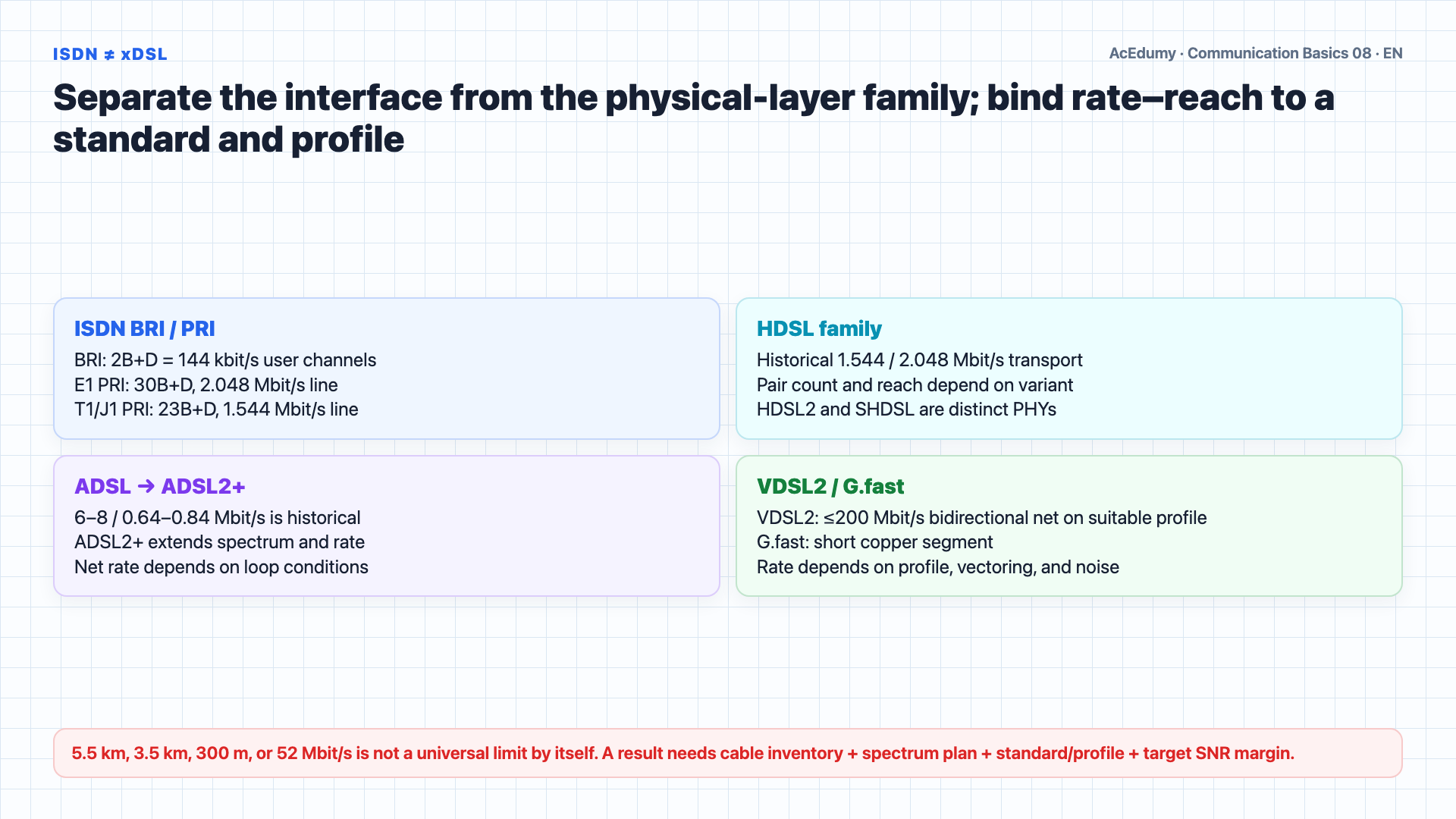
Twisted pair and DSL are compared while keeping cabling category, access standard, line conditions, and economic scope explicit. First separate classes: ISDN BRI/PRI are digital access interfaces; HDSL/ADSL/VDSL are xDSL physical-layer families. A single rate/reach table is meaningful only with a stated standard, profile, and line assumptions.BRI user channels are 2B+D = 2×64+16 = 144 kbit/s; U-interface line rate and coding are separate. 5.5 km is not a universal maximum and depends on pair and feeding conditions.E1 PRI commonly carries 30B+D on a 2.048 Mbit/s E1 line; T1/J1 PRI belongs to the 23B+D, 1.544 Mbit/s family. Pair count and reach depend on interface and transport equipment.HDSL rate, pair count, and reach depend on variant and line conditions; historical systems can transport 1.544 or 2.048 Mbit/s, while HDSL2 and SHDSL are distinct physical layers.6–8/0.64–0.84 Mbit/s is a historical ADSL example; ADSL2+ uses extended spectrum and supports higher rates. Actual net rate and reach depend on loop/line conditions and profile.SDSL is not one universal standard/rate label; symmetric access should identify HDSL, HDSL2, SHDSL, or another specified implementation and pair count.Rate adaptation can be a feature of several DSL families; RADSL should not be treated as one unique universal physical-layer standard.52 Mbit/s is a historical VDSL profile example; in-force VDSL2 defines bidirectional net data rates up to 200 Mbit/s on suitable profiles. Actual rate depends on reach, spectrum, vectoring, and noise.At 1.5 kilometers, VDSL drops to about 13 megabits per second.The general trend is shorter reach for higher-frequency profiles; the exact rate–reach curve depends on cable, crosstalk, profile, vectoring, target margin, and operator plan.Narration transcript
Let us look at the key DSL technologies and their specifications. N-ISDN BRI, or Basic Rate Interface, provides 2 bearer channels plus a delta channel, totaling 144 kilobits per second symmetrically, over a maximum distance of 5.5 kilometers. N-ISDN PRI, the Primary Rate Interface, offers 30 bearer channels plus delta, totaling 2 megabits per second, over 3.5 kilometers using two twisted pairs. HDSL, High bit rate DSL, delivers up to 2 megabits per second symmetrically over 3.5 kilometers. ADSL, Asymmetric DSL, is the most widely deployed consumer technology, providing 6 to 8 megabits per second downstream and 640 to 840 kilobits per second upstream, over 3.5 kilometers. SDSL offers symmetrical speeds up to 2.3 megabits per second. RADSL adaptively adjusts its data rate based on line conditions. And VDSL, Very high bit rate DSL, reaches up to 52 megabits per second downstream, but only over very short distances of about 300 meters. At 1.5 kilometers, VDSL drops to about 13 megabits per second. The trade off is clear: higher speed means shorter maximum distance.
4. Audit the copper-replacement cost assumptions
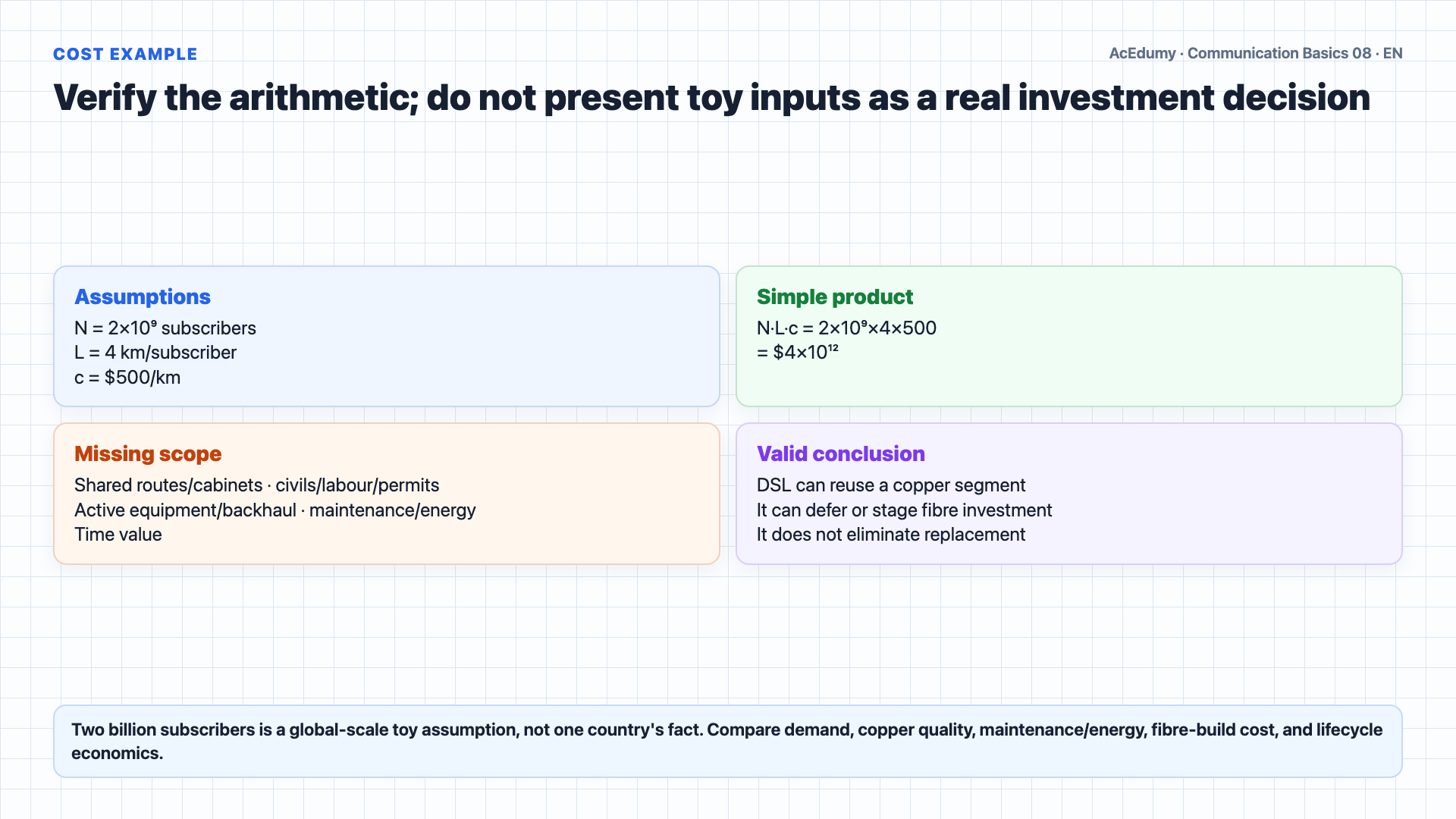
Twisted pair and DSL are compared while keeping cabling category, access standard, line conditions, and economic scope explicit. Let us work through an example that illustrates why DSL makes economic sense.Two billion subscribers is a global-scale toy assumption, not a factual count for one country.A 4 km average loop and an independent 4 km cable per subscriber are unverified inventory assumptions; shared routes, cabinet topology, and pair bundles matter.2×10⁹×4 km×$500/km = $4×10¹² is arithmetically correct, but $500/km is only an assumption and excludes civils, labour, permits, active equipment, shared infrastructure, and time value.That is an astronomical sum that no country could afford to replace at once.DSL can reuse some copper segments and defer or stage fibre investment; it does not eliminate maintenance, cabinets, backhaul, or eventual cable replacement.ADSL can deliver broadband over the same copper pairs that were installed decades ago for analog voice, making internet access economically viable for billions of subscribers worldwide.Narration transcript
Let us work through an example that illustrates why DSL makes economic sense. Consider a country with 2 billion telephone subscribers. The average local loop length is about 4 kilometers per subscriber. If we were to replace all this copper with new cable, at a cost of 500 dollars per kilometer, the total would be 2 billion times 4 times 500, which equals 4 trillion dollars. That is an astronomical sum that no country could afford to replace at once. This is exactly why DSL technologies were developed: they allow high speed digital services over the existing copper infrastructure, avoiding the need for costly replacement. ADSL can deliver broadband over the same copper pairs that were installed decades ago for analog voice, making internet access economically viable for billions of subscribers worldwide.
5. Summarize copper reuse and the fibre transition
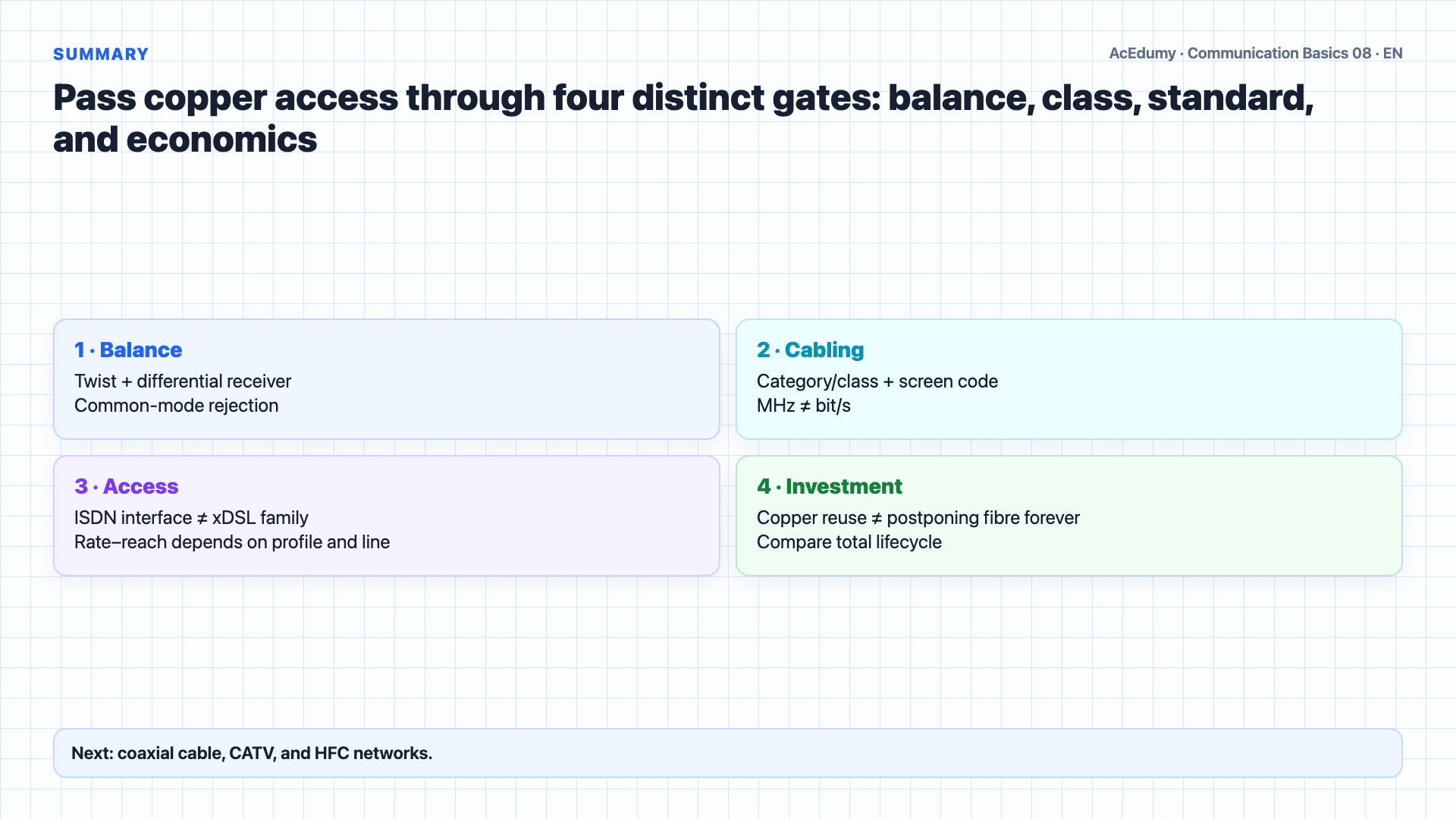
Twisted pair and DSL are compared while keeping cabling category, access standard, line conditions, and economic scope explicit. Let us review.UTP, Unshielded Twisted Pair, is the most common medium, ranging from Category 1 voice to Category 7 for 10 gigabit Ethernet.STP and ScTP add metal shielding to combat EMI and crosstalk.DSL technologies leverage the massive installed base of copper in the local loop.ADSL provides asymmetric broadband at 6 to 8 megabits per second downstream.VDSL reaches 52 megabits per second but only over short distances.The key trade off: higher speed means shorter maximum loop length.The toy trillion-dollar calculation does not make DSL universally essential; the best access choice depends on demand, copper quality, energy/maintenance, fibre-build cost, and lifecycle economics.In the next lesson, we will cover coaxial cable, its structure, CATV systems, and Hybrid Fiber Coax networks.Narration transcript
Let us review. UTP, Unshielded Twisted Pair, is the most common medium, ranging from Category 1 voice to Category 7 for 10 gigabit Ethernet. STP and ScTP add metal shielding to combat EMI and crosstalk. DSL technologies leverage the massive installed base of copper in the local loop. ADSL provides asymmetric broadband at 6 to 8 megabits per second downstream. VDSL reaches 52 megabits per second but only over short distances. The key trade off: higher speed means shorter maximum loop length. The economic reality of trillions of dollars in installed copper makes DSL essential even as fiber expands. In the next lesson, we will cover coaxial cable, its structure, CATV systems, and Hybrid Fiber Coax networks.
Source video: Communication Basics #08 Twisted Pair & DSL Technologies (7:03)