Communication Basics · Twisted-Pair Local Loop: Length, Cost, and Fiber–DSL Feasibility
#23 derive 8×10^12 m and a 4×10^12-TL cable-material amount from the exercise assumptions of two billion subscribers, 4 km per local loop, and 0.5 TL/m; then bound YTL/TL history, currency conversion, VDSL reach, and fiber–DSL total cost of ownership
Derive the hypothetical global copper local-loop length and cable-material amount with unit checks, then make the fiber–DSL decision through currency, reach, and total-cost boundaries.
Question
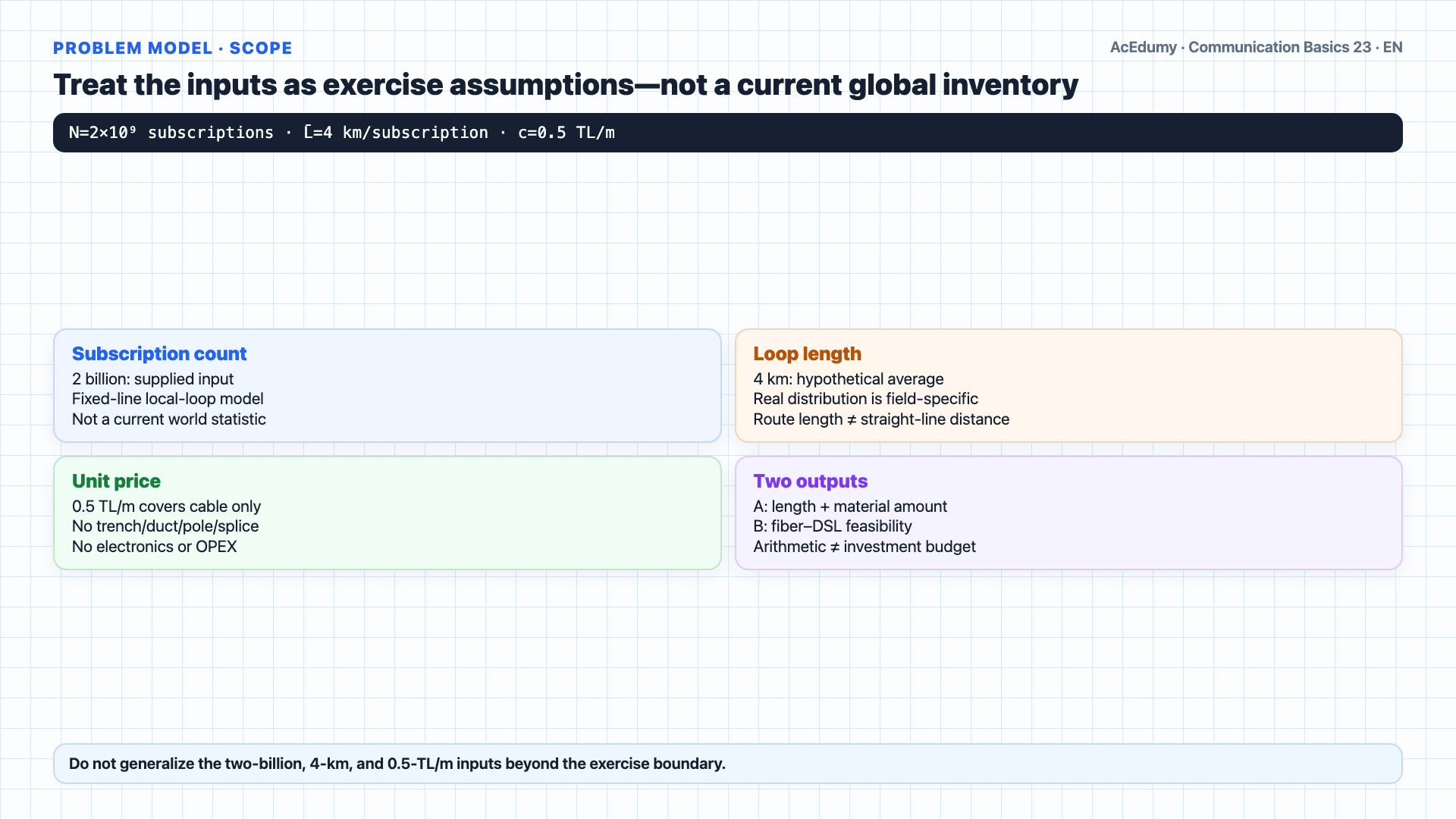
From the exercise assumptions 2×10^9 subscribers, 4 km/subscriber, and 0.5 TL/m, derive 8×10^9 km=8×10^12 m of cable and a 4×10^12-TL cable-only material amount; check the 200,000 Earth-circumference and about 53.3-AU scale comparisons; note that the YTL name reverted to TL in 2009 and that a 3-trillion-USD conversion requires a dated exchange rate; compare fiber with DSL using loop length, copper condition, DSLAM/backhaul, PON/split, and civil-build gates; show that 52 Mbit/s is not guaranteed on the same 4-km loop and that the 50-USD/subscriber and 30× claims require sourced, like-for-like scope.
Written solution and narration transcript(shows the full solution)
Below are all the lines written in the notebook together with the full narration transcript.
1. Separate exercise assumptions from an observed global inventory
Keep the arithmetic, but do not present exercise inputs as current global statistics, cable-only value as a replacement budget, or short-loop VDSL rate as a 4-km guarantee. Welcome back.Today we tackle a fundamental telecommunications cost problem.Here is the setup.The exercise assumes two billion fixed-telephone local-loop subscriptions; this is not a current global subscriber inventory.The model maps every assumed subscription to one twisted-pair copper local loop terminating at an exchange.4 km per subscription is the exercise average; the real loop-length distribution varies by network and geography.0.5 TL/m is only the exercise's cable unit-price input; it excludes trenching, duct, poles, splicing, labor, electronics, and operations.We have two questions.Part a: find the total value, in YTL, of the twisted pair infrastructure.Part b: based on this number, comment on the feasibility of fiber optics versus DSL technologies for the local loop.Narration transcript
Welcome back. Today we tackle a fundamental telecommunications cost problem. Here is the setup. There are about two billion telephone subscribers in the world. Each subscriber is connected to the local telephone exchange with twisted pair copper cable. The average distance from subscriber to exchange is four kilometers. The cost of the twisted pair cable is zero point five Y T L per meter. We have two questions. Part a: find the total value, in Y T L, of the twisted pair infrastructure. Part b: based on this number, comment on the feasibility of fiber optics versus D S L technologies for the local loop.
2. Define the local loop and what twisting actually does to interference
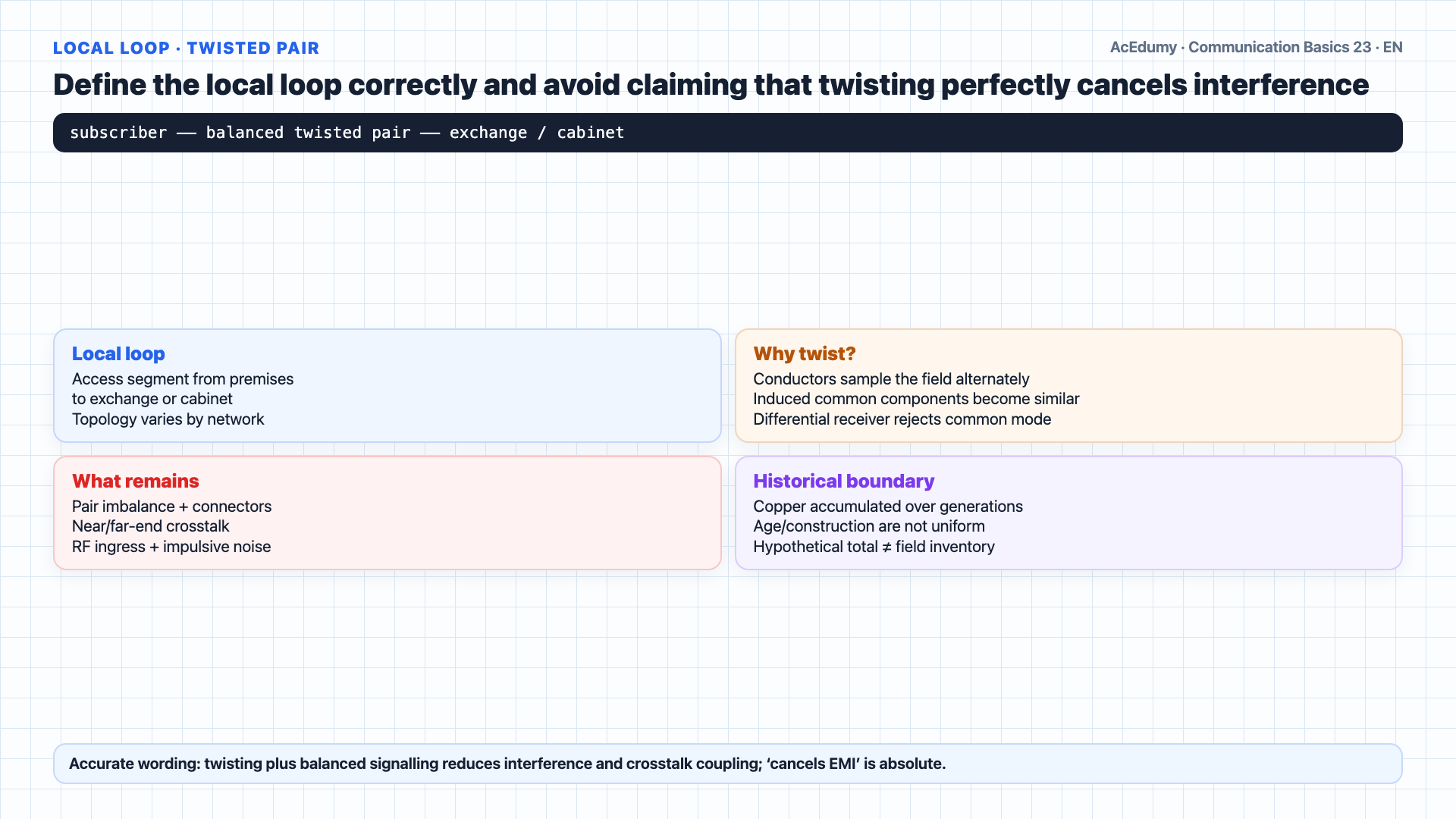
Keep the arithmetic, but do not present exercise inputs as current global statistics, cable-only value as a replacement budget, or short-loop VDSL rate as a 4-km guarantee. Before we crunch numbers, let us understand what we are counting.The local loop is the last segment of the telephone network.It runs from the subscriber's home or office all the way to the local telephone exchange, also called the central office.Copper local loops accumulated over more than a century, but their age and construction are not uniform.Twisting helps balanced/differential reception reduce common-mode interference and crosstalk coupling; it does not perfectly cancel electromagnetic interference.Two billion×4 km is only the exercise scale, not a measured global copper-loop inventory or a defensible infrastructure ranking.The next multiplication is not an inventory valuation; it prices the assumed cable length using the supplied material-rate input.Narration transcript
Before we crunch numbers, let us understand what we are counting. The local loop is the last segment of the telephone network. It runs from the subscriber's home or office all the way to the local telephone exchange, also called the central office. For more than a century, this connection has been made with twisted pair copper cable. Two thin copper wires twisted together to cancel electromagnetic interference. With about two billion subscribers worldwide and an average four kilometer run for each, this represents one of the largest infrastructure deployments in human history, accumulated since the eighteen eighties. Now let us put a price tag on it.
3. Derive 8×10^9 km and treat the comparisons only as scale checks
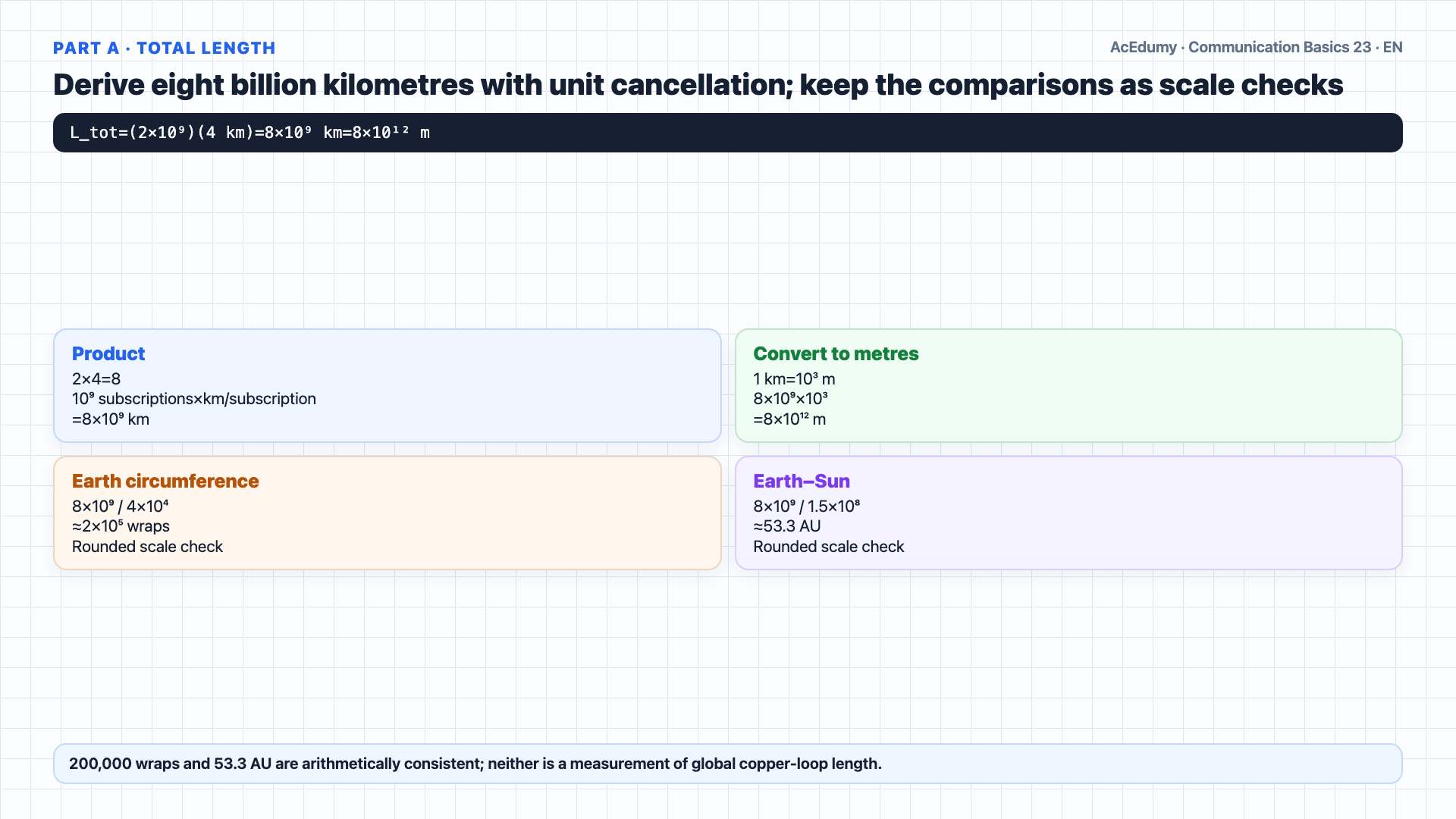
Keep the arithmetic, but do not present exercise inputs as current global statistics, cable-only value as a replacement budget, or short-loop VDSL rate as a 4-km guarantee. Part a, step one: total length of cable.We have two times ten to the nine subscribers.Each one needs four kilometers of twisted pair.Total length equals two times ten to the nine, times four kilometers.That is eight times ten to the nine kilometers.To grasp the scale: Earth's circumference is about forty thousand kilometers.8×109 km / 40,000 km≈200,000; use this only as an order-of-magnitude scale check.Or, the distance from Earth to the sun is about one hundred fifty million kilometers.8×109 km / 150×106 km≈53.3 using rounded astronomical values.This is the hypothetical scale produced by the exercise, not a measurement of the global network.Narration transcript
Part a, step one: total length of cable. We have two times ten to the nine subscribers. Each one needs four kilometers of twisted pair. Total length equals two times ten to the nine, times four kilometers. That is eight times ten to the nine kilometers. To grasp the scale: Earth's circumference is about forty thousand kilometers. So this much cable could wrap around the planet two hundred thousand times. Or, the distance from Earth to the sun is about one hundred fifty million kilometers. So our total cable length is roughly fifty three times the Earth-Sun distance. That is the scale of the global twisted pair network.
4. Calculate 4×10^12 TL; check YTL/TL naming and exchange-rate date
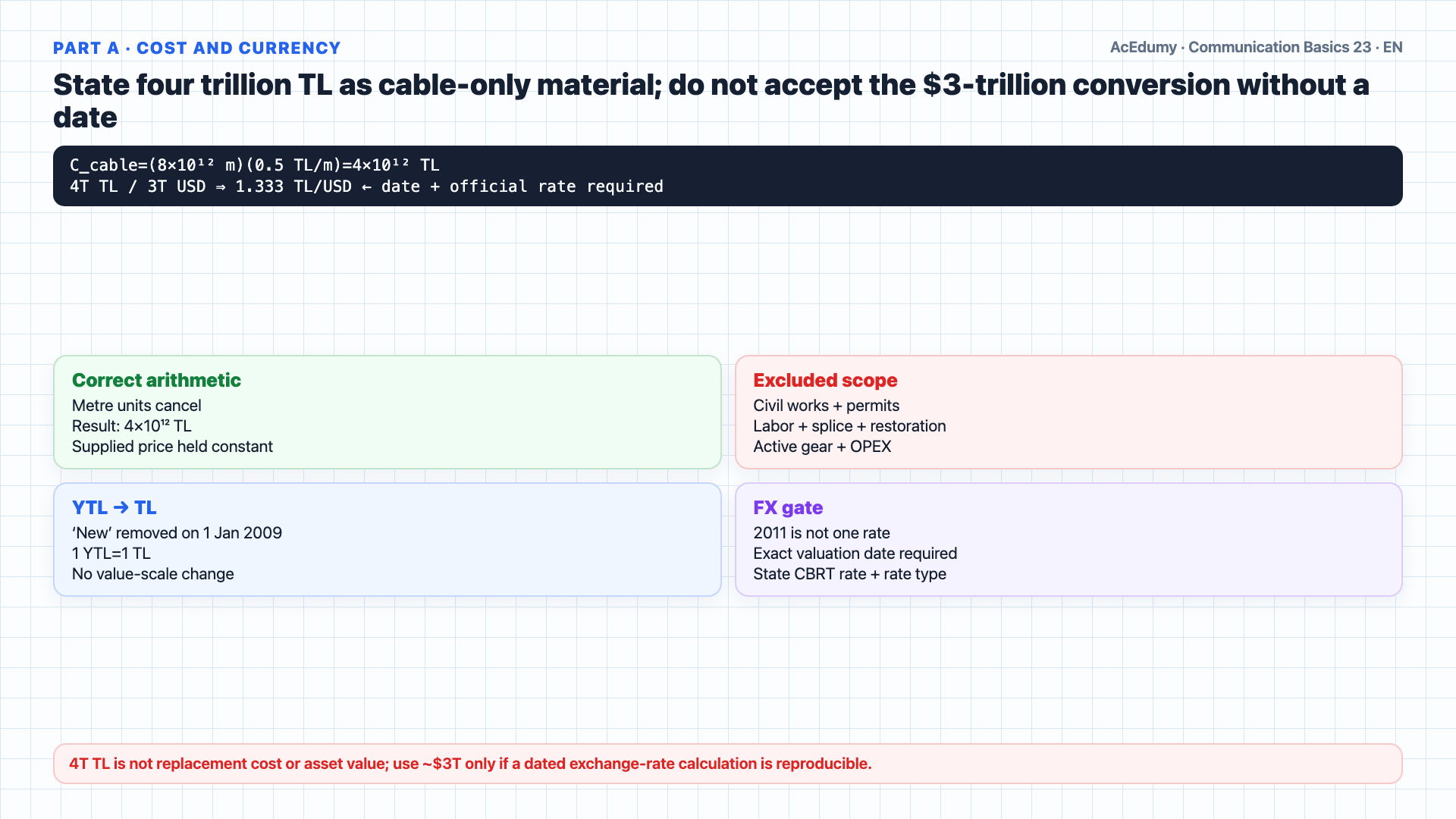
Keep the arithmetic, but do not present exercise inputs as current global statistics, cable-only value as a replacement budget, or short-loop VDSL rate as a 4-km guarantee. Now multiply by cost.We need the length in meters, not kilometers.Eight times ten to the nine kilometers, times one thousand meters per kilometer, equals eight times ten to the twelve meters of cable in total.Cost equals total length times price per meter.Eight times ten to the twelve meters, times zero point five YTL per meter.Eight times zero point five is four.8×1012 m×0.5 TL/m=4×1012 TL is correct only inside the supplied cable-material model.4 trillion TL is not replacement cost, market value, or total cost of ownership; outside plant and active equipment are excluded.Although 1 YTL=1 TL, “New” was removed from the name on 1 January 2009; 4 trillion TL≈3 trillion USD implies 1.333 TL/USD and needs an exact 2011 date plus an official rate.Narration transcript
Now multiply by cost. We need the length in meters, not kilometers. Eight times ten to the nine kilometers, times one thousand meters per kilometer, equals eight times ten to the twelve meters of cable in total. Cost equals total length times price per meter. Eight times ten to the twelve meters, times zero point five Y T L per meter. Eight times zero point five is four. So total infrastructure value is four times ten to the twelve Y T L. That is four trillion Y T L. At the time of this problem, in two thousand eleven, that converted to roughly three thousand billion U S dollars, or three trillion dollars.
5. Anchor patent, elapsed-time, and GDP comparisons to a date
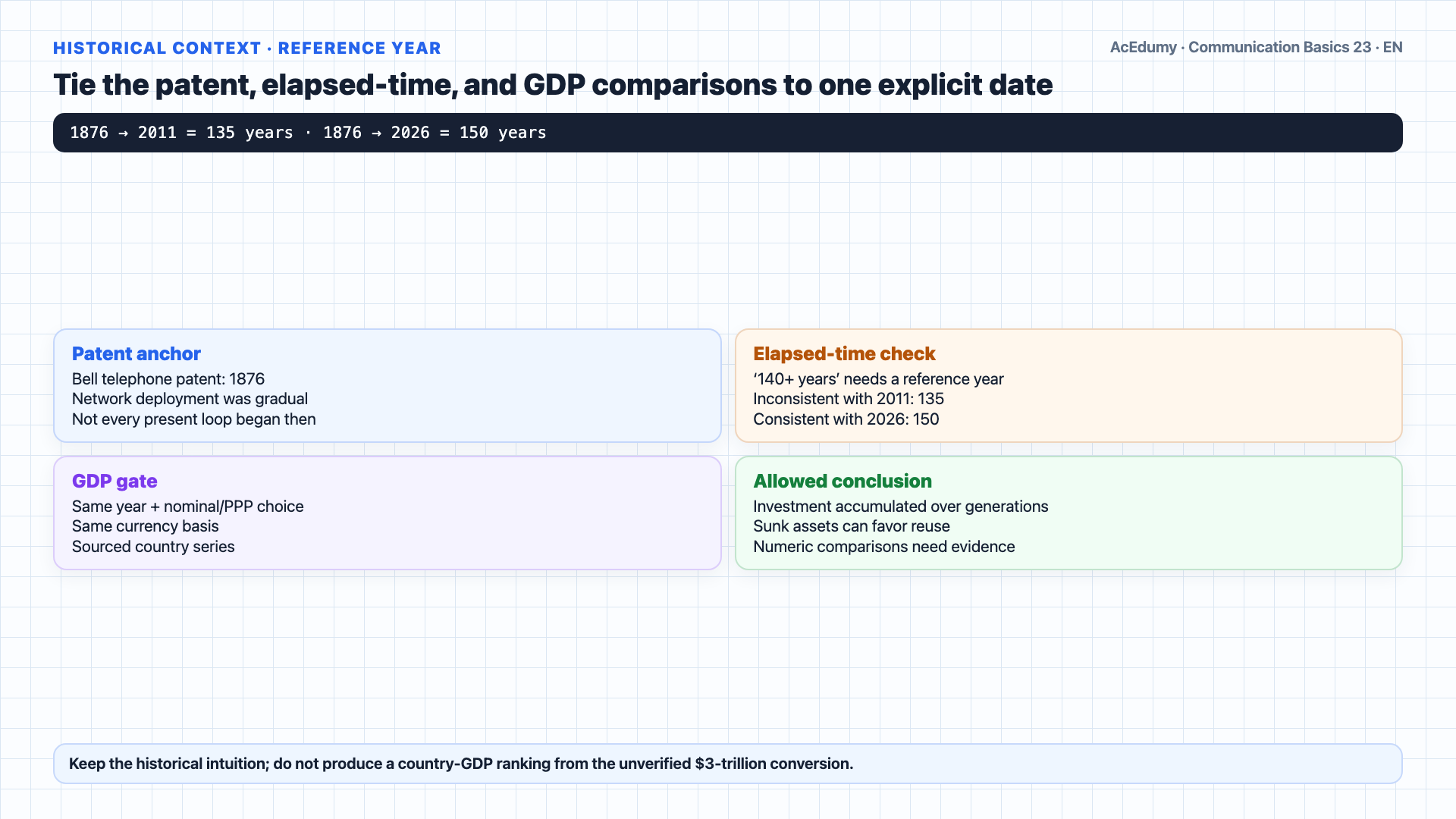
Keep the arithmetic, but do not present exercise inputs as current global statistics, cable-only value as a replacement budget, or short-loop VDSL rate as a 4-km guarantee. A GDP comparison needs the same year, price basis, and verified currency date; do not use it before validating the 3-trillion-USD input.Country rankings vary by year and metric; remove this generalization without dated primary data.How did the world accumulate this much value?The answer is time.Bell's US telephone patent dates to 1876; do not assign that single start date to the age of every present local loop.1876→2011 is 135 years and 1876→2026 is 150 years; use “140+” only with a consistent reference year.Every kilometer of every subscriber loop, paid for and installed over generations.Narration transcript
To put this in perspective, three trillion dollars is several times the gross domestic product of an entire country like Turkey. It exceeds the annual G D P of all but a handful of nations. How did the world accumulate this much value? The answer is time. Telephone networks have been built up gradually since Alexander Graham Bell's first patent in eighteen seventy six. One hundred forty plus years of pole stringing, trench digging, and cable laying. Every kilometer of every subscriber loop, paid for and installed over generations.
6. Compare fiber and DSL through rate–reach, field, and endpoint gates
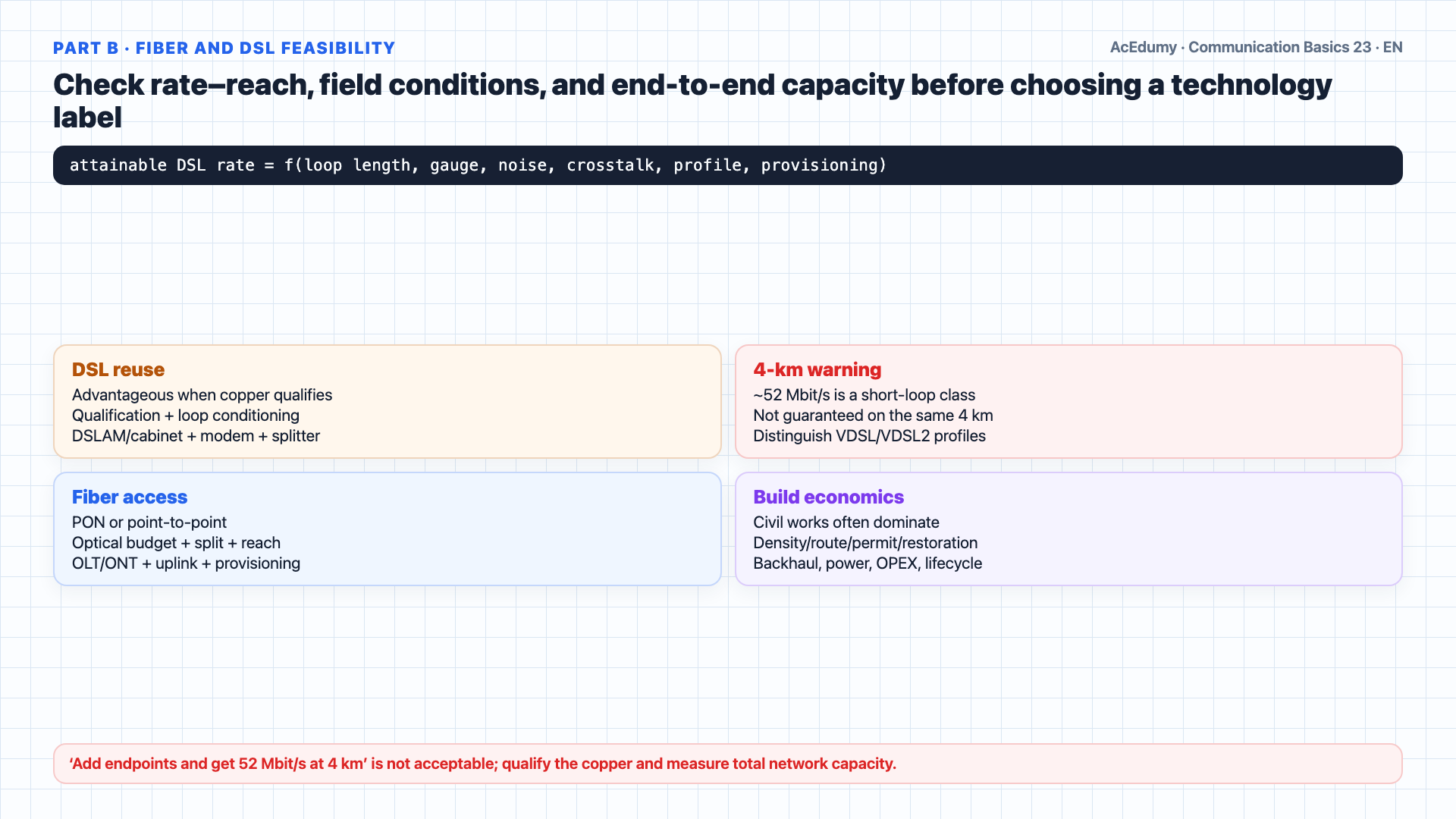
Keep the arithmetic, but do not present exercise inputs as current global statistics, cable-only value as a replacement budget, or short-loop VDSL rate as a 4-km guarantee. Part b: should we tear it all out and replace it with fiber optics?Fiber access can support very high rates; provisioned service depends on PON or point-to-point design, optical budget, split, OLT/ONT, uplink, and policy.Fiber build cost cannot be inferred from the cable-only product; civil works, route, density, permits, backhaul, and active equipment require a site-specific estimate.Demand depends on users, applications, concurrency, and time; do not base feasibility on a universal demand judgment.Application requirements vary with codec, quality, concurrent sessions, upload, latency, and availability targets.So instead of replacement, the smart solution is reuse.DSL, or Digital Subscriber Line technologies, keep the existing twisted pair in place and only upgrade the endpoints.A DSLAM at the central office, and a small modem at the subscriber.POTS and DSL can share a suitable loop through filtering and frequency separation; attainable rate remains line-condition dependent.The roughly 52-Mbit/s VDSL class is associated with short, suitable copper loops; it is not guaranteed on the same 4-km loop, and VDSL2 defines additional higher-rate profiles.Narration transcript
Part b: should we tear it all out and replace it with fiber optics? Fiber would give every home a multi gigabit connection. But the cost would be similar — trillions of dollars to redeploy the entire local loop. For most subscribers, multi gigabit speeds are overkill. Email, web browsing, video streaming — all comfortably handled by tens of megabits per second. So instead of replacement, the smart solution is reuse. D S L, or Digital Subscriber Line technologies, keep the existing twisted pair in place and only upgrade the endpoints. A D S L A M at the central office, and a small modem at the subscriber. The same copper that carries voice can simultaneously carry tens of megabits of data. V D S L, the most aggressive variant, pushes up to fifty two megabits per second over the same four kilometer copper that already exists.
7. Reject the $50 and 30× claims without sources and matched scope
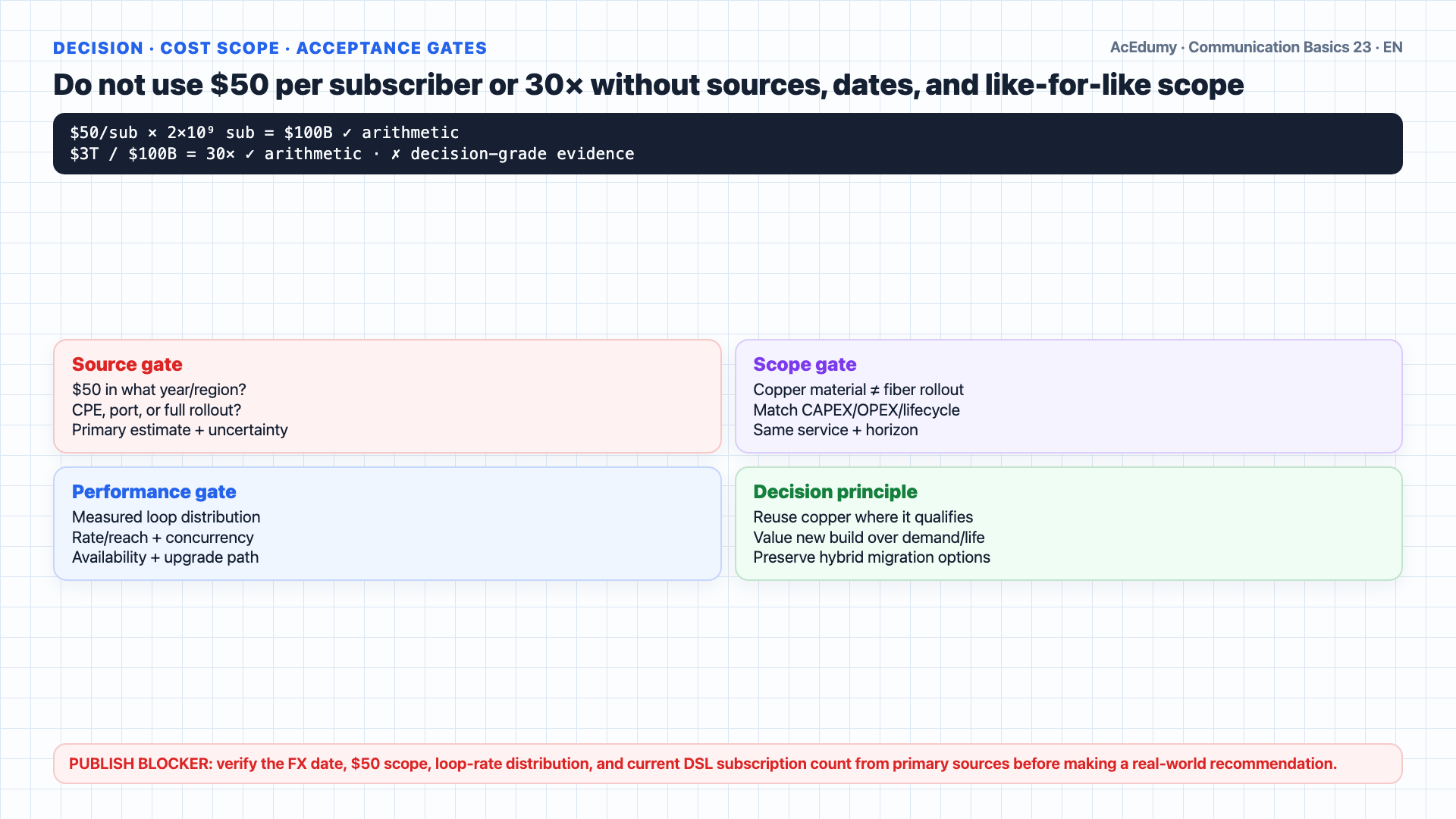
Keep the arithmetic, but do not present exercise inputs as current global statistics, cable-only value as a replacement budget, or short-loop VDSL rate as a 4-km guarantee. The big picture.Option one: replace twisted pair with fiber.4 trillion TL is the hypothetical existing-cable material product, not a budget for a new fiber rollout.Option two: upgrade to DSL.If $50/subscriber is separately sourced and scoped, the arithmetic is00 billion; specify whether DSLAM, modem, field work, backhaul, power, and operations are included.The 30× ratio compares unverified $3-trillion and $50/subscriber inputs with unlike cost scopes; it is not decision-grade.The lesson from this problem is not just the arithmetic.It is an engineering principle.Existing infrastructure has enormous accumulated value.Smart engineering reuses what is already there.DSL is a triumph of reuse — squeezing modern data rates out of decades old copper.DSL can extend the life of copper; add a current household-count claim only with dated, clearly defined primary subscription data.Good luck on your midterm.Narration transcript
The big picture. Option one: replace twisted pair with fiber. Cost: roughly four trillion Y T L of new infrastructure. Option two: upgrade to D S L. Cost: roughly fifty dollars per subscriber, times two billion subscribers, equals about one hundred billion dollars. That is roughly thirty times cheaper. The lesson from this problem is not just the arithmetic. It is an engineering principle. Existing infrastructure has enormous accumulated value. Smart engineering reuses what is already there. D S L is a triumph of reuse — squeezing modern data rates out of decades old copper. That is why D S L still serves billions of homes today, even in the age of fiber. Good luck on your midterm.
Source video: Communication Basics #23 Worked Example: Twisted Pair Infrastructure Cost (5:40)