Communication Basics · What Is Telecommunications?
#01 The transmitter–medium–receiver model, digitized sensory representations, M2M/IoT, traffic classes, and QoS requirements
Build the telecommunications chain and compare traffic classes and QoS trade-offs in a scoped, measurable framework.
Question
Explain telecommunications with the transmitter, transmission medium, and receiver model. Compare voice, data, image, video, and multimedia traffic by bandwidth, latency, jitter, and loss requirements, and qualify claims about M2M/IoT scale and future capacity.
Written solution and narration transcript(shows the full solution)
Below are all the lines written in the notebook together with the full narration transcript.
1. Build the transmitter–medium–receiver model
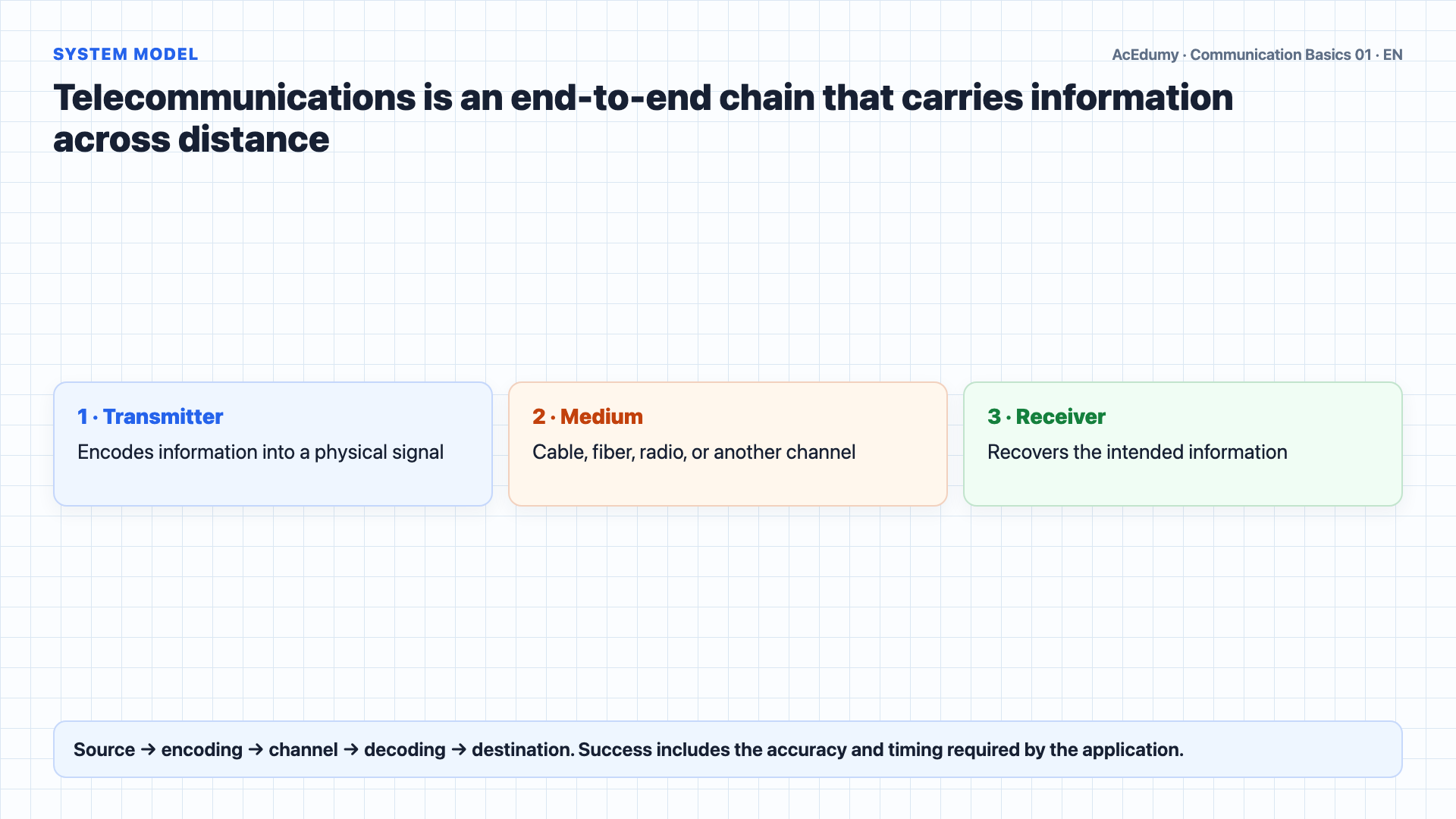
A telecommunications design combines the transmitter–medium–receiver chain, the traffic class, and application-dependent QoS targets. Telecommunication means communicating over a distance.The word comes from the Greek tele, meaning far, and the Latin communicare, meaning to share.Every time you make a phone call, send a text message, stream a video, or browse the internet, you are using a telecommunication system.At its core, every telecom system has three parts: a transmitter that sends information, a transmission medium that carries it, and a receiver that collects it.In this series, we will explore how these systems work, from the physical signals all the way up to global network architectures.Narration transcript
Telecommunication means communicating over a distance. The word comes from the Greek tele, meaning far, and the Latin communicare, meaning to share. Every time you make a phone call, send a text message, stream a video, or browse the internet, you are using a telecommunication system. At its core, every telecom system has three parts: a transmitter that sends information, a transmission medium that carries it, and a receiver that collects it. In this series, we will explore how these systems work, from the physical signals all the way up to global network architectures.
2. Distinguish senses from their digital representations
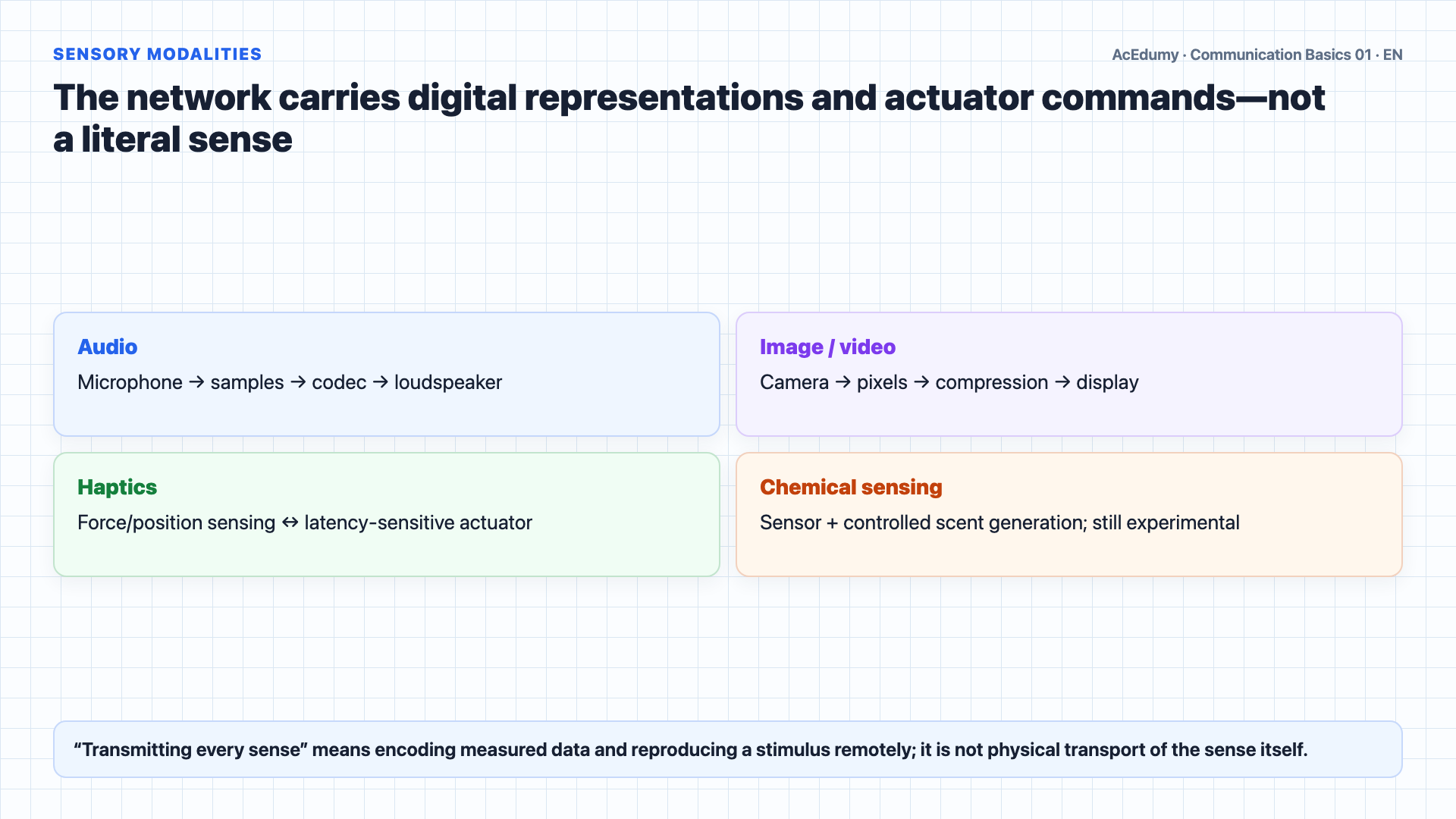
A telecommunications design combines the transmitter–medium–receiver chain, the traffic class, and application-dependent QoS targets. Modern telecommunications goes far beyond voice calls.Engineers study networked sensor data and actuator commands for modalities such as audio, vision, touch, and chemical sensing; the network does not literally transmit a sense.Hearing was the first: voice-activated services, internet radio, and voice assistants all rely on audio transmission.Touch is next, through a technology called haptics.Haptic devices let you feel the weight of a virtual object or the texture of a surface remotely.This enables applications like virtual reality job training, remote surgery, and interactive museums.Networked smell remains experimental, combining chemical sensing with controlled scent generation rather than a widely deployed service.And of course, vision: cameras capture and transmit images and high-definition video streams across the globe in real time.Narration transcript
Modern telecommunications goes far beyond voice calls. Engineers are finding ways to transmit every human sense over a network. Hearing was the first: voice-activated services, internet radio, and voice assistants all rely on audio transmission. Touch is next, through a technology called haptics. Haptic devices let you feel the weight of a virtual object or the texture of a surface remotely. This enables applications like virtual reality job training, remote surgery, and interactive museums. Even smell is being explored for e-commerce and entertainment. And of course, vision: cameras capture and transmit images and high-definition video streams across the globe in real time.
3. Interpret M2M and IoT scale with the right metric
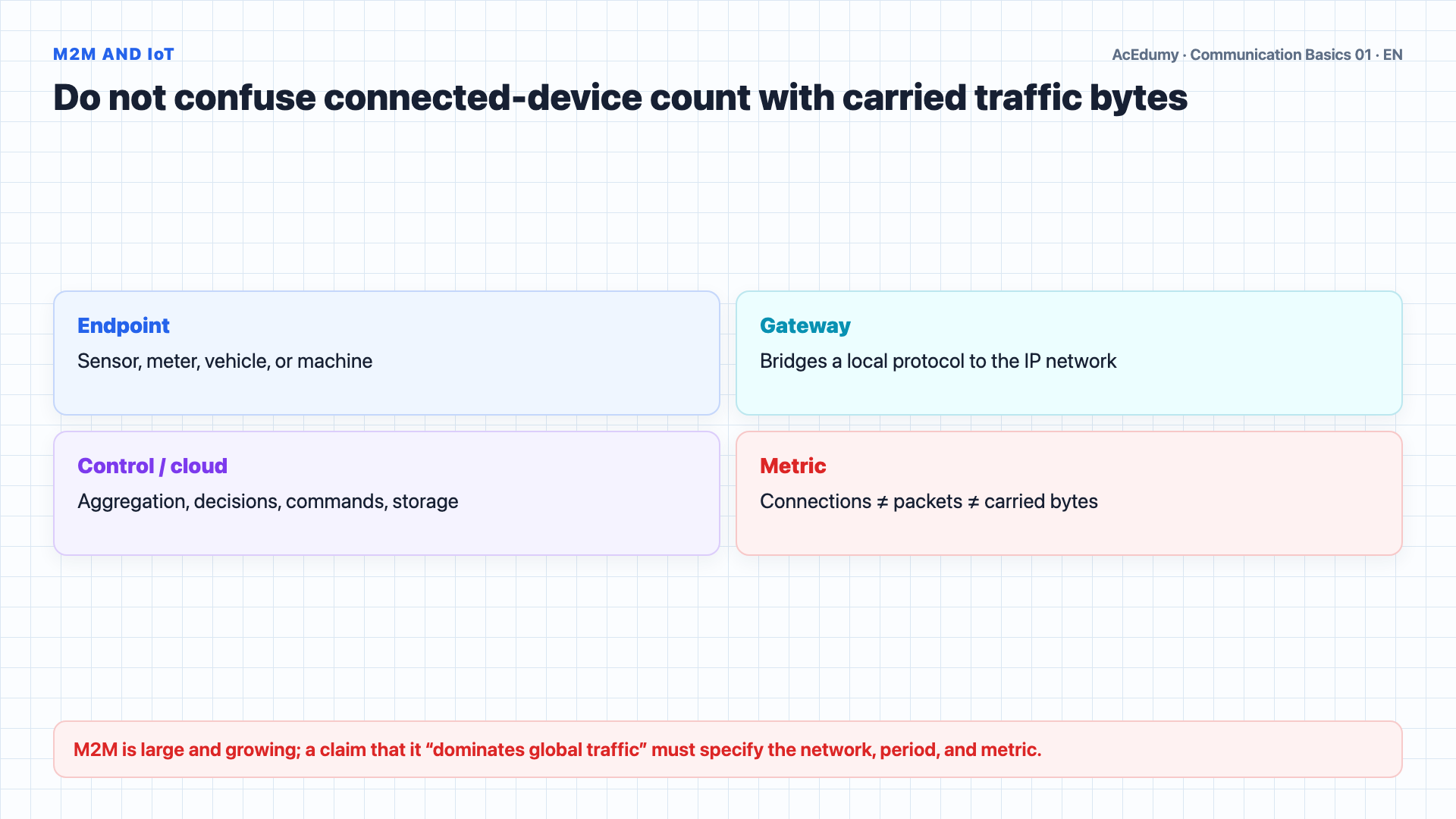
A telecommunications design combines the transmitter–medium–receiver chain, the traffic class, and application-dependent QoS targets. M2M connections are a large and growing class by device count; whether they form most traffic bytes depends on the metric, network, and time period.This traffic class is called machine-to-machine, or M2M.Sensors in factories report measurements to control systems.Smart appliances in your home communicate with each other and with cloud servers.Autonomous vehicles exchange data with traffic infrastructure.This is often called the Internet of Things.Connected-device counts can exceed the human population, but that fact alone does not prove M2M dominates global traffic volume under every metric.Designing networks that can handle this enormous volume of automated communication is one of the central challenges in modern telecommunications.Narration transcript
Here is a surprising fact: the vast majority of communication traffic is not between humans. It is machine-to-machine. Sensors in factories report measurements to control systems. Smart appliances in your home communicate with each other and with cloud servers. Autonomous vehicles exchange data with traffic infrastructure. This is often called the Internet of Things. The number of connected devices in the world vastly exceeds the number of people, and machine-to-machine traffic dominates global network usage. Designing networks that can handle this enormous volume of automated communication is one of the central challenges in modern telecommunications.
4. Separate five traffic classes and typical rates
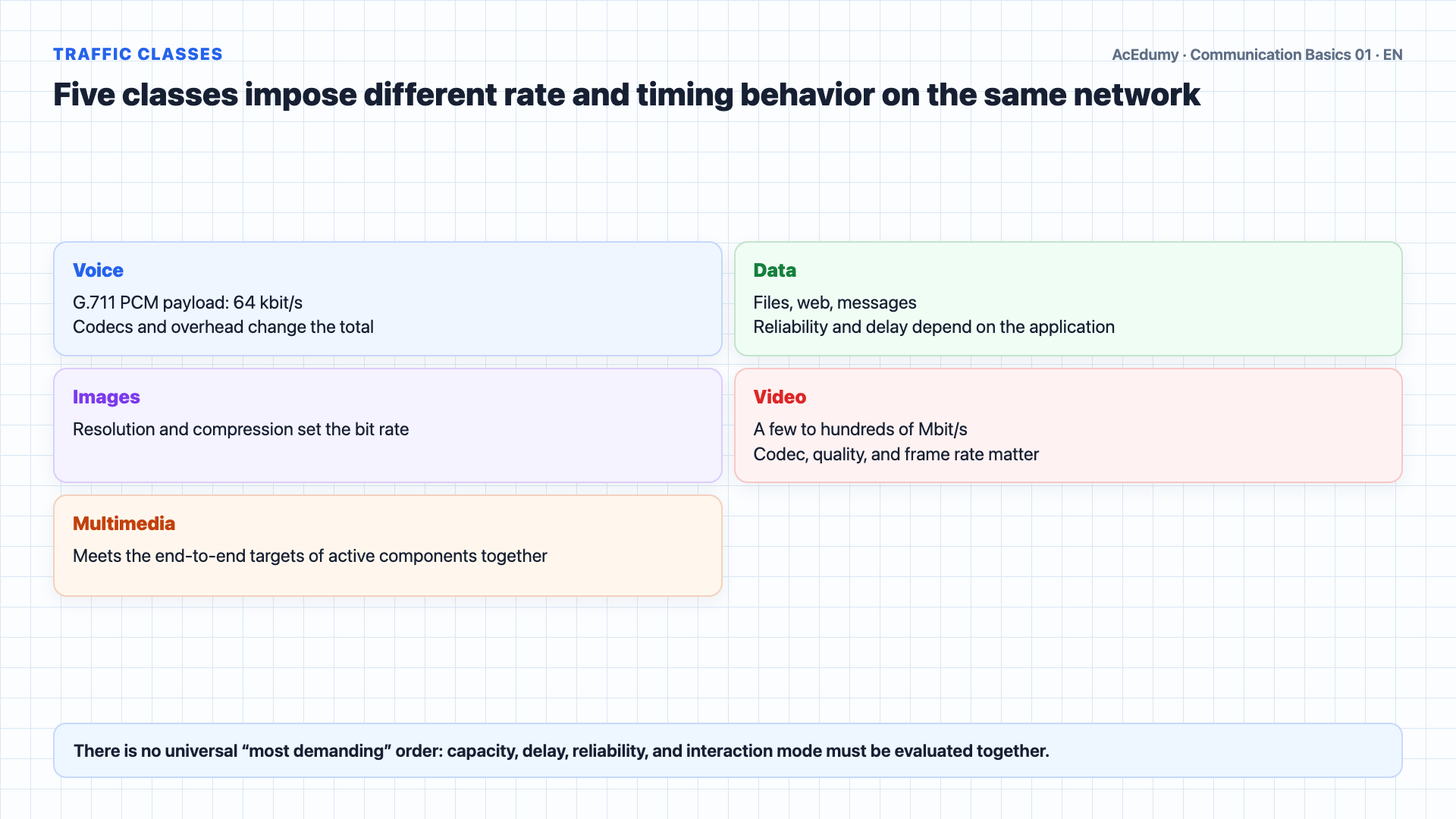
A telecommunications design combines the transmitter–medium–receiver chain, the traffic class, and application-dependent QoS targets. Networks carry five main types of traffic.First, voice: a classic G.711 PCM telephony channel carries a 64 kbit/s payload; modern codecs and total network overhead can differ.Second, data: text, files, and web pages.Data traffic varies widely in size and can tolerate some delay.Third, images: photos and graphics need more bandwidth than text, and the requirement grows with resolution.Fourth, video: bit rate depends on resolution, frame rate, codec, quality, and whether it is live or stored; examples range from a few to hundreds of Mbit/s.Fifth, multimedia, which combines voice, data, images, and video together, like a video conference.A multimedia session must meet the end-to-end needs of every active component; which QoS dimension dominates is application-dependent.Narration transcript
Networks carry five main types of traffic. First, voice: traditional phone calls require relatively low bandwidth, around 64 kilobits per second for one digital voice channel. Second, data: text, files, and web pages. Data traffic varies widely in size and can tolerate some delay. Third, images: photos and graphics need more bandwidth than text, and the requirement grows with resolution. Fourth, video: live or recorded video demands the most bandwidth, often tens or hundreds of megabits per second. Fifth, multimedia, which combines voice, data, images, and video together, like a video conference. Multimedia is the most demanding because it inherits the strictest requirements of all its components.
5. Compare bandwidth, latency, jitter, and loss
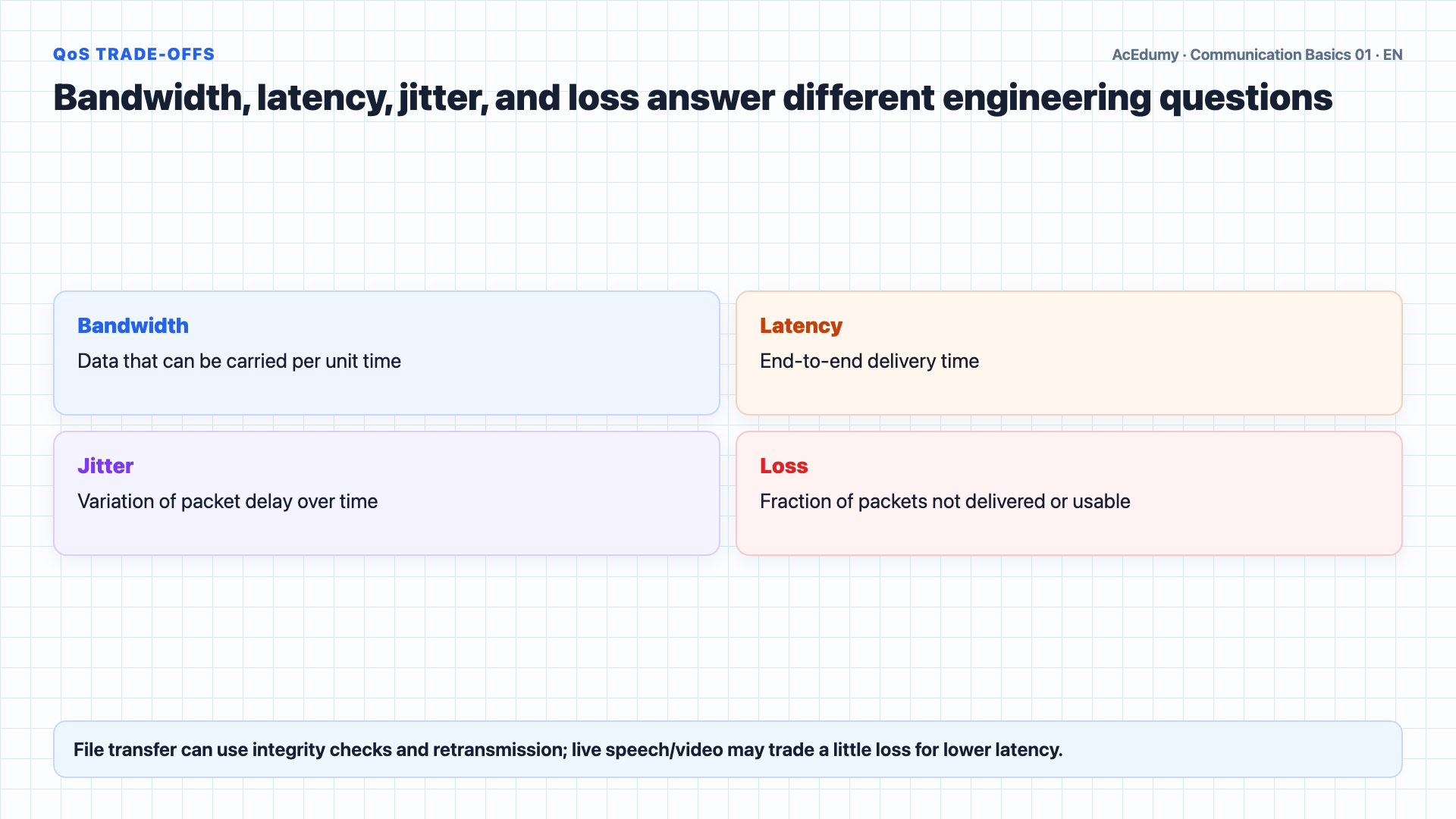
A telecommunications design combines the transmitter–medium–receiver chain, the traffic class, and application-dependent QoS targets. Not all traffic types have the same network requirements.There are four key factors: bandwidth, latency, jitter, and loss tolerance.Voice needs low bandwidth but is very sensitive to delay and jitter.Even a small delay makes conversation awkward.Reliable applications such as file transfer use integrity checks and retransmission to recover loss; delay and loss tolerance depend on the application and transport protocol.Interactive live video is sensitive to delay and jitter, while buffered video may conceal errors or retransmit; tolerance depends on the service mode.Understanding these trade-offs is fundamental to network design.An engineer must choose the right technology and allocate the right resources based on the type of traffic the network will carry.Narration transcript
Not all traffic types have the same network requirements. There are four key factors: bandwidth, latency, jitter, and loss tolerance. Voice needs low bandwidth but is very sensitive to delay and jitter. Even a small delay makes conversation awkward. Data is more tolerant of delay but cannot accept data loss, because a missing bit corrupts the file. Video needs high bandwidth and is extremely sensitive to both delay and jitter, since any disruption causes visible artifacts. Understanding these trade-offs is fundamental to network design. An engineer must choose the right technology and allocate the right resources based on the type of traffic the network will carry.
6. Evaluate applications and capacity scenarios
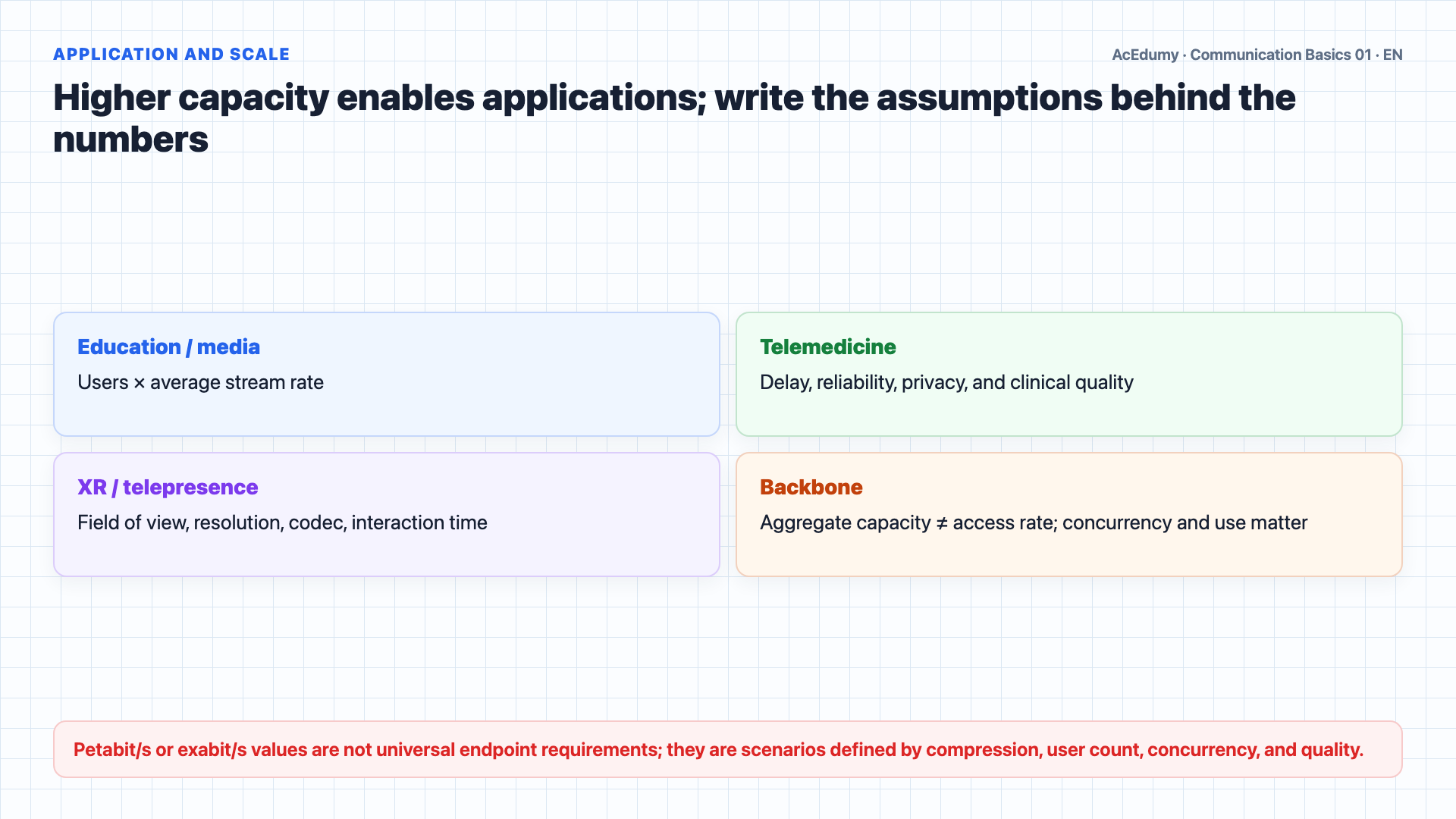
A telecommunications design combines the transmitter–medium–receiver chain, the traffic class, and application-dependent QoS targets. As bandwidth increases, entirely new applications become possible.Streaming media, online education, and telemedicine consultations all require reliable, high-speed connections.Digital entertainment and three-D gaming push bandwidth demands even further.Rate estimates for holographic telepresence depend strongly on representation, compression, user count, and quality; petabit/s is not a universal endpoint requirement.Inferring exabit/s aggregate traffic from 100 Gbit/s residential access requires subscriber count, concurrency, and utilization; it is a capacity scenario, not an automatic outcome.Throughout this course, we will see how different technologies, from copper wires to optical fibers to satellites, each address different parts of this bandwidth challenge.Narration transcript
As bandwidth increases, entirely new applications become possible. Streaming media, online education, and telemedicine consultations all require reliable, high-speed connections. Digital entertainment and three-D gaming push bandwidth demands even further. Virtual reality applications like holographic telepresence could require petabits per second on backbone networks. Even everyday residential broadband, once we reach 100 gigabits per second, would open the door to exabit-scale aggregate traffic. Throughout this course, we will see how different technologies, from copper wires to optical fibers to satellites, each address different parts of this bandwidth challenge.
7. Summarize system, traffic, and QoS decisions
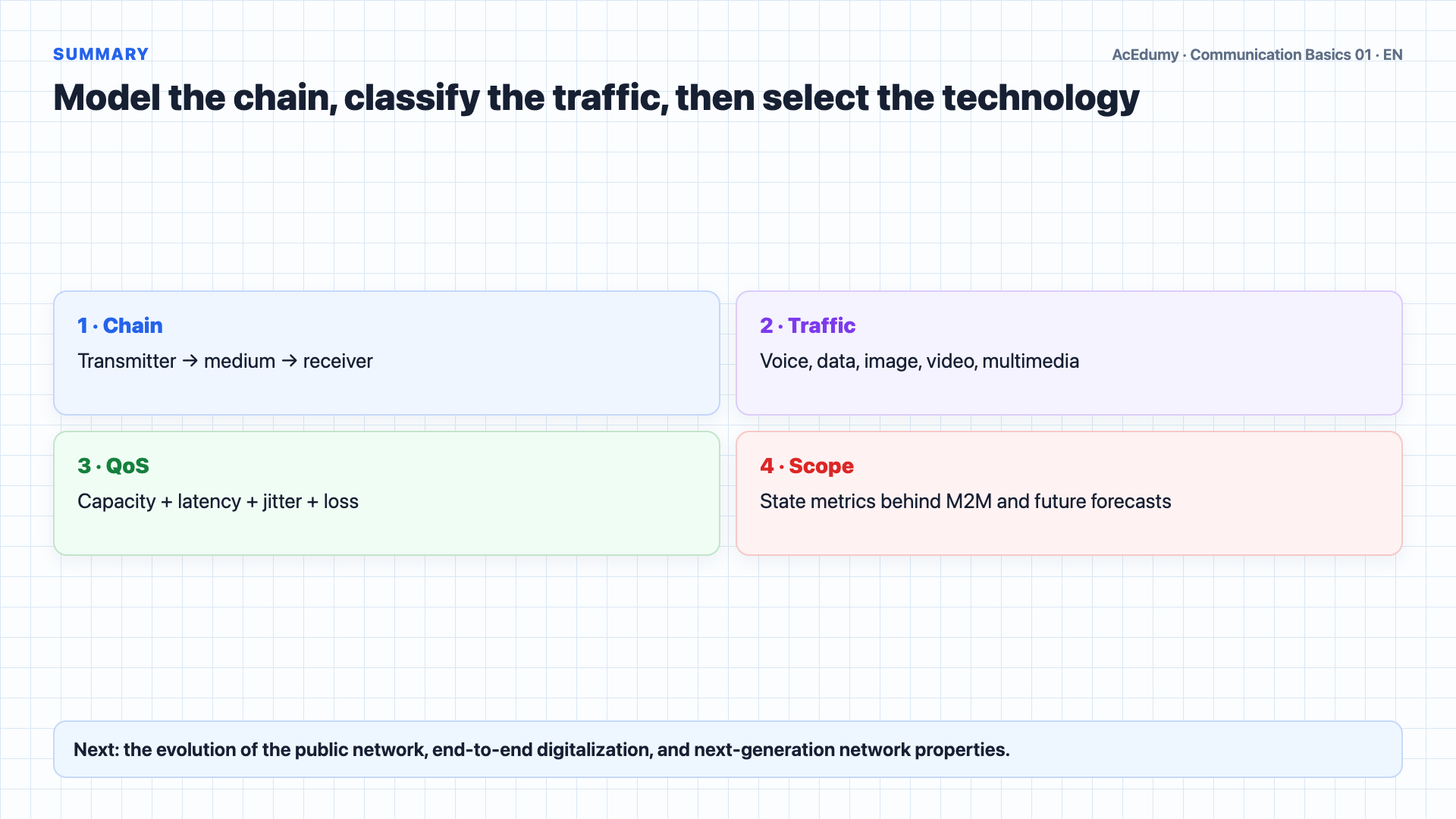
A telecommunications design combines the transmitter–medium–receiver chain, the traffic class, and application-dependent QoS targets. Let us review.Telecommunication is the transmission of information over a distance.Modern networks can carry digital representations for audio, vision, haptics, and other sensor/actuator modalities, not literal senses.M2M connections are important and growing; device count and carried byte volume must be distinguished.There are five traffic types: voice, data, image, video, and multimedia.Each has different requirements for bandwidth, latency, jitter, and loss.In the next lesson, we will look at how the public network is evolving to meet these demands, including end-to-end digitalization and the key features of the new public network.Narration transcript
Let us review. Telecommunication is the transmission of information over a distance. Modern telecom carries all human senses, not just voice. Machine-to-machine traffic now dominates global networks. There are five traffic types: voice, data, image, video, and multimedia. Each has different requirements for bandwidth, latency, jitter, and loss. In the next lesson, we will look at how the public network is evolving to meet these demands, including end-to-end digitalization and the key features of the new public network.
Source video: Communication Basics #01 What is Telecommunications? (5:15)