Analog Communication · Why modulation?
#01 Baseband, carrier translation and the communication chain
Quantify the 3 kHz wavelength example, derive linear carrier translation and distinguish antenna, tuning and channel-sharing benefits under explicit conditions.
Question
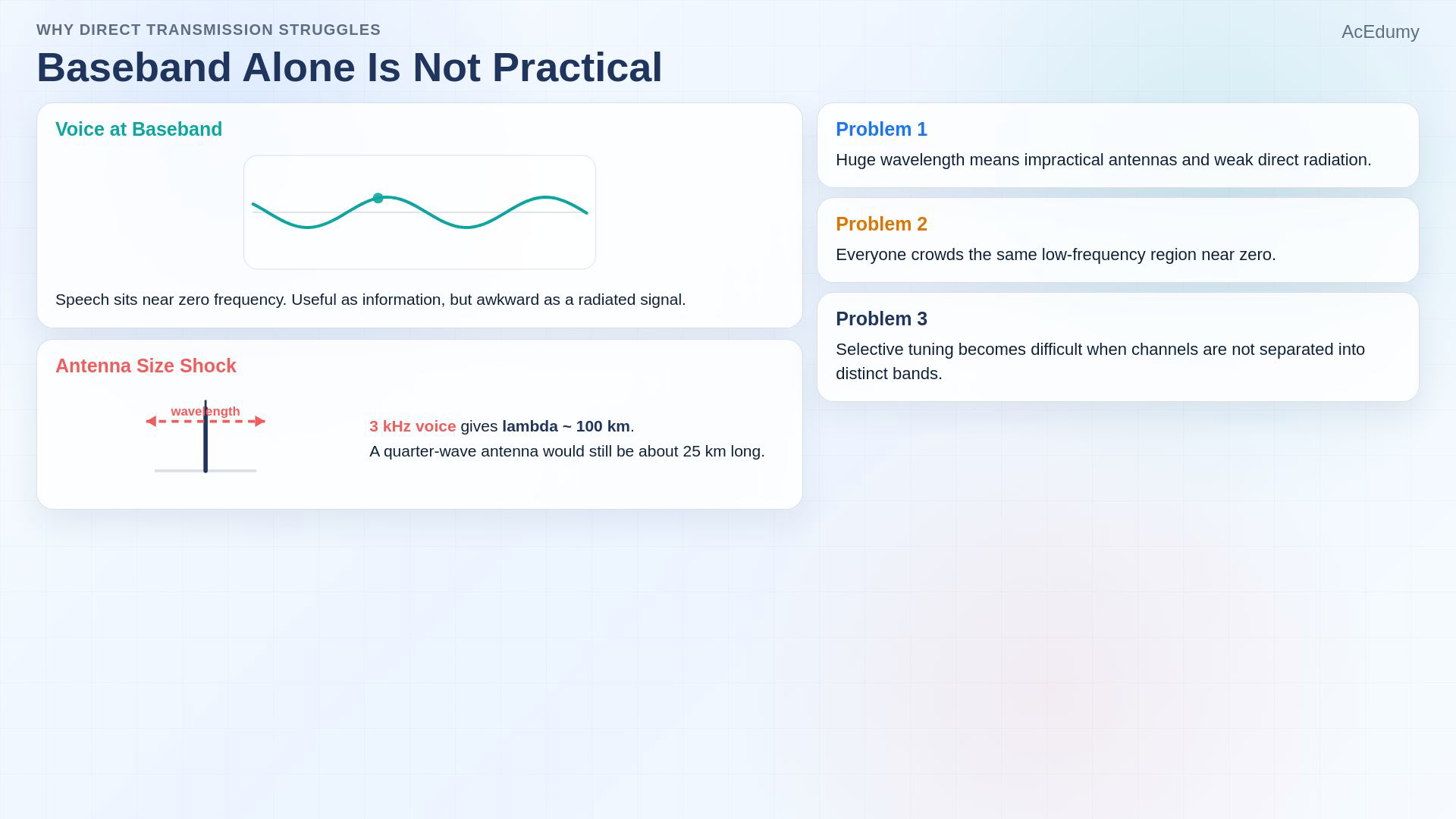
Explain why a chosen narrowband audio message is awkward to radiate directly using an ordinary compact far-field antenna. The example message band edge W is 3 kHz; this is not the full bandwidth of all speech or music. Compute wavelength for a 3 kHz sinusoidal component, not a single wavelength for a whole broadband message: in free space c≈3×10^8 m/s, λ=c/f=100000 m=100 km. A quarter-wave near-resonant antenna example has L=25000 m=25 km, not a universal minimum antenna length. Electrically small antennas are possible with efficiency/bandwidth tradeoffs; specialized VLF/ELF, near-field and wired baseband links exist. Choosing a higher usable carrier reduces wavelength at a given phase velocity, but does not guarantee propagation, range, SNR or amplify the signal. Carrier c(t)=Ac cos(2πfc t) is a known unmodulated reference without an independent message. As one explicitly linear DSB-SC example, s(t)=Ac m(t)cos(2πfc t), S(f)=(Ac/2)[M(f−fc)+M(f+fc)], using the two-sided Fourier convention with frequency in Hz. The two shifted copies have gain Ac/2. This is not a general formula for FM/PM spectra; conventional AM also has a carrier term. For real m bandlimited to |f|≤W and fc>W, the positive-frequency occupied band is [fc−W,fc+W] and has width 2W. FDM requires disjoint occupied bands plus realistic guards and receiver filtering; distinct centre frequencies alone are insufficient. Equal-width DSB channels need carrier separation at least 2W before extra guards; time/code alternatives also exist. A coherent, correctly phased and gain-normalized detector multiplies DSB-SC by (2/Ac)cos(2πfc t), Ac nonzero; the result is m(t)[1+cos(4πfc t)]. An ideal low-pass filter passes |f|≤W and rejects the high-frequency copy whose nearest edge is 2fc−W>W. Phase or frequency error and channel distortion spoil this ideal result. Explain source → modulator → channel → demodulator → recovered estimate; a well-designed real link may preserve shape up to gain/delay, not promise exact error-free recovery. The diagram's 'message + carrier' describes inputs to a modulation operation, not arithmetic addition. Source slides are conceptual, not calibrated antenna or spectrum drawings. The original frequency-translation raster lacks a correct quantitative two-sided spectrum and the tuning rectangle overshoots the selected band; both roles use the reviewed same-final summary instead. The system-chain boxes remain readable but the two small output labels overlap; notebook text supplies the correct chain explicitly. The summary's general statements are scoped to this ordinary compact-radio example, not a prohibition on all baseband transmission. Source SCENES were read by AST only from the 158-line English generator; 538-line ACD01 component, 77-line ACRoot and 158-line existing TR canonical were reviewed without modifying them. Current original five MP3s and timings have six verified Hetzner/local hashes but do NOT match this final video: all normal and wider-offset correlations failed; their total endpoint is 224.257 s versus actual final 222.101333 s. No simple speed/offset repair is asserted. Recover audio only from the authenticated existing Bunny original (22,619,253 bytes, SHA256 937f6aabf7dbf3235b5d69eec0d51e47605f97dd7e71a1fe6272c32e38a1dbe2). Five actual visual scene cuts, nearby silence and full-video word timestamps establish boundaries 3,58,100.6,143.133333,182.833333 s. Extracted audio and 90-percent stills use these actual scene intervals. Same-source extraction-integrity correlations .98741–.99975 have zero measured offset; this is NOT independent original-TTS provenance. Re-alignment yields 35 real cues, confidences .9817–1 at unchanged .62 threshold; all source sentences, recognized text, cues, full final speech and five additional cached-small outputs were reviewed. Small correctly recognizes 'basic chain' where large writes 'basic change'; no source-symbol, number or unit contradiction was established. No narration or alignment override, new TTS, paid generation, model download, video render/upload, publication, access, security or egress change. Existing source audio files are untouched. This is an unpublished technical draft, not full human listening, animation, teaching or publication approval.
Written solution and narration transcript(shows the full solution)
Below are all the lines written in the notebook together with the full narration transcript.
1. Distinguish a baseband message from its radiated components
Original video reference, with scope stated in the notebook. Two misleading schematic frames are replaced by the same video's summary; the 3 kHz and quarter-wave example is not a universal antenna-size limit. Before modulation: distinguish the message from the radio-frequency waveform.Chosen narrowband audio example; wider-band music is also possible:For ordinary compact far-field antennas, direct radiation of such low frequencies is difficult, not impossible.For its 3 kHz component in free space, wavelength in metres:A quarter-wave resonant example, not a universal minimum antenna length:Overlapping users need a multiple-access plan; separate carrier bands are one possible solution.Direct baseband transmission remains useful on wires and in specialized low-frequency or near-field links.The engineering choice depends on antenna efficiency, bandwidth, propagation and the available channel.Narration transcript
Before modulation, the information exists as a baseband signal. Think of speech or music occupying only a few kilohertz around zero frequency. Sending that low-frequency signal directly into space is a poor engineering choice. A three kilohertz voice signal has a wavelength of roughly one hundred kilometers. A practical antenna is only a small fraction of wavelength, so direct radiation would demand absurdly large structures. Baseband transmission also makes channel sharing difficult, because everybody wants to live in the same low-frequency neighborhood. So the question is not whether we can send baseband directly. The real question is why we would choose such an inefficient and crowded approach.
2. Translate a message with a carrier under stated conditions
Original video reference, with scope stated in the notebook. Two misleading schematic frames are replaced by the same video's summary; the 3 kHz and quarter-wave example is not a universal antenna-size limit. Use a carrier and specify how the message controls it.A known unmodulated carrier has no independent message:One linear example is double-sideband suppressed-carrier modulation:Its two-sided Fourier spectrum:In an ideal recoverable link the message is preserved; frequency translation alone does not guarantee better reception.AM changes amplitude; FM and PM change angle. Their spectra are not all unchanged copies of the baseband shape.Narration transcript
Modulation solves that problem by using a carrier. A carrier is a high-frequency sinusoid that does not carry useful information by itself. When we combine the message with that carrier, the spectrum of the message is shifted away from zero and moved up to a radio-frequency band. This process is often called frequency translation. The message stays the same in meaning, but it is now riding on a signal that is much easier to radiate, receive, and tune. Later in the series we will see different ways to imprint information on the carrier, such as changing its amplitude, frequency, or phase.
3. Separate antenna size, spectrum allocation and tuning
Original video reference, with scope stated in the notebook. Two misleading schematic frames are replaced by the same video's summary; the 3 kHz and quarter-wave example is not a universal antenna-size limit. Choose a usable RF band; antenna size, tuning and channel organization are distinct benefits.For the same propagation speed, a higher carrier has a shorter wavelength:For the stated double-sideband example with carrier above the message band edge:Assign non-overlapping occupied bands, allow guard bands and use a receiver filter that passes the whole desired signal.Radio links commonly use carriers; different users may also be separated by time, code or other resources.Frequency translation does not, by itself, amplify the message or guarantee a larger signal-to-noise ratio.Practical communication needs a joint bandwidth, power, antenna and receiver design.Narration transcript
Once the message is moved to a high carrier frequency, several practical advantages appear at the same time. First, antenna size becomes realistic. Second, many users can share the same physical medium without collapsing into one giant overlap at baseband. Each station can occupy its own band, and a receiver can tune to the desired one while rejecting the others. That is why radio broadcasting, wireless links, and cellular systems depend on carrier-based transmission. Modulation is not only about making the signal stronger. It is about organizing the spectrum so communication becomes practical.
4. Follow the source, channel and recovered message
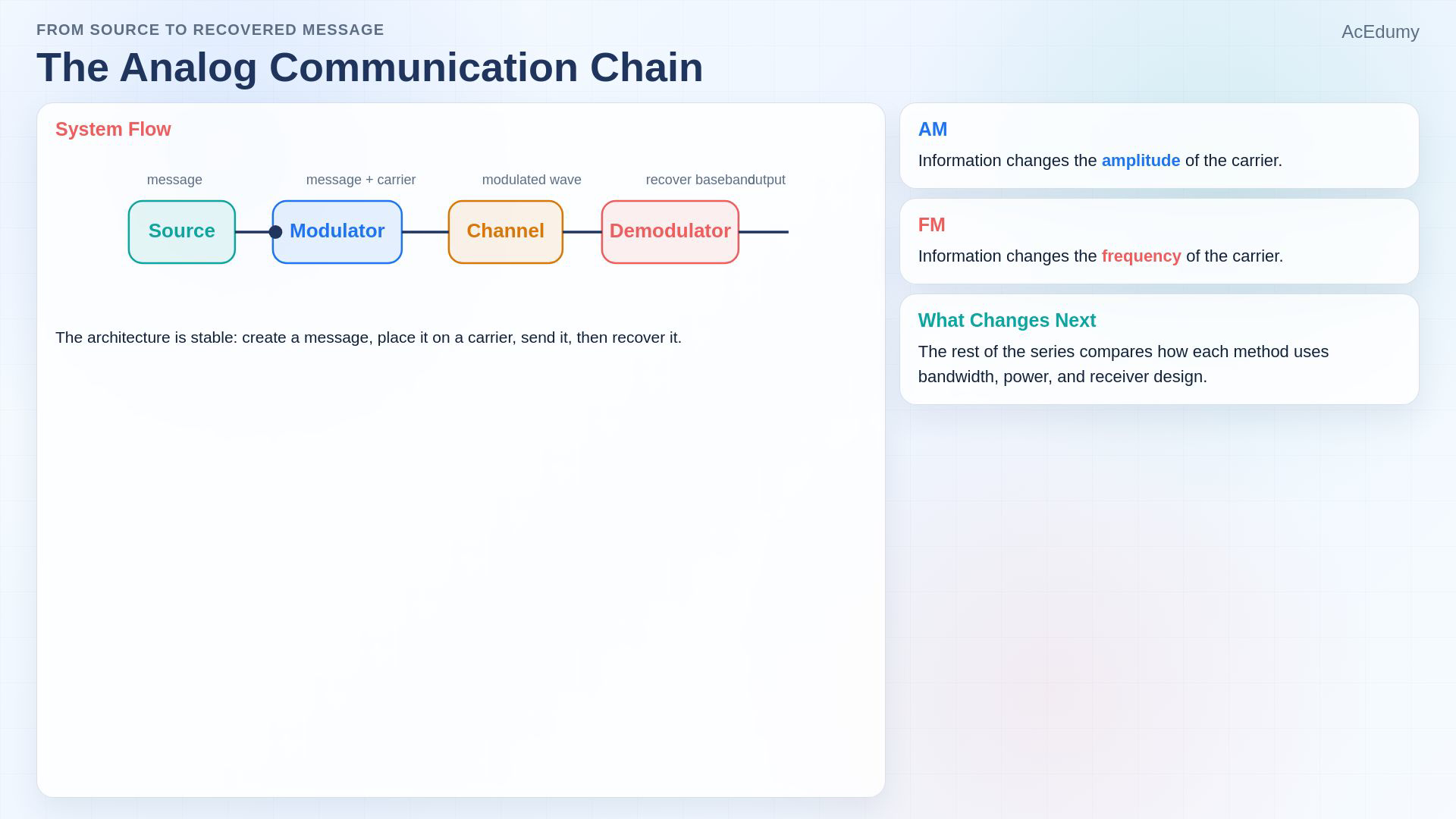
Original video reference, with scope stated in the notebook. Two misleading schematic frames are replaced by the same video's summary; the 3 kHz and quarter-wave example is not a universal antenna-size limit. Follow the message from its source through the transmitter and channel to the receiver.The source produces a baseband information signal.The modulator makes a carrier parameter depend on the message; this is not merely adding two waveforms.The channel may be space or cable and may introduce gain, delay, noise and distortion.A matched demodulator recovers a baseband estimate; ideal coherent product detection also requires low-pass filtering.The recovered shape may track the source up to gain and delay; perfect reconstruction needs additional ideal assumptions.The source–modulator–channel–demodulator architecture remains the reference chain.The modulation method determines bandwidth, power and synchronization requirements.Narration transcript
The full analog communication chain is straightforward. A source produces the information signal. A modulator combines that message with a carrier. The channel transports the modulated wave through space, cable, or some other medium. At the receiver, a demodulator extracts a baseband version of the original message. If the system is well designed, the recovered output closely follows what the source created. This basic chain stays with us throughout the series. What changes from lesson to lesson is the specific modulation method and how the receiver recovers the information.
5. Summarize the radio-link motivation and its limits
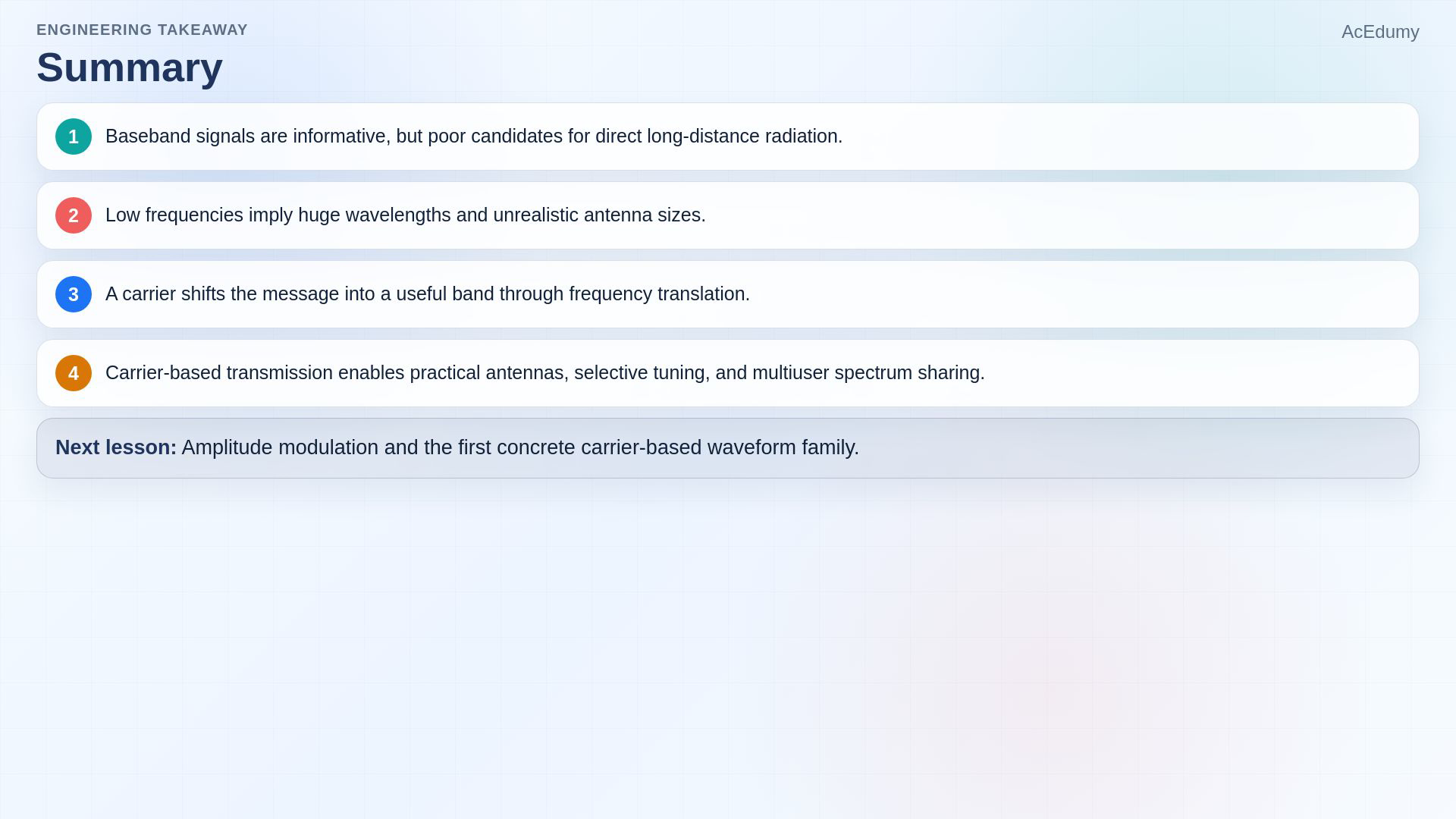
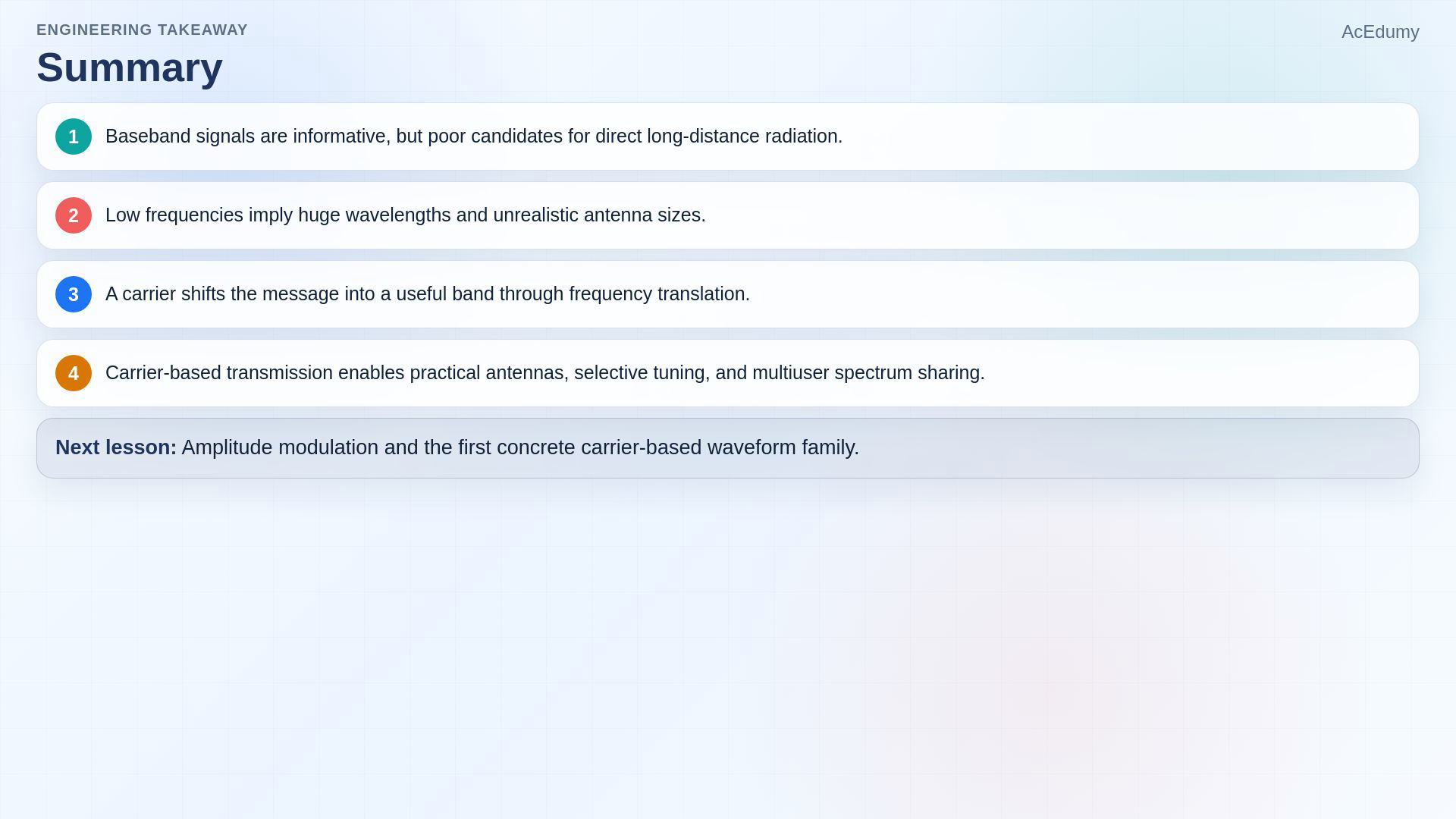
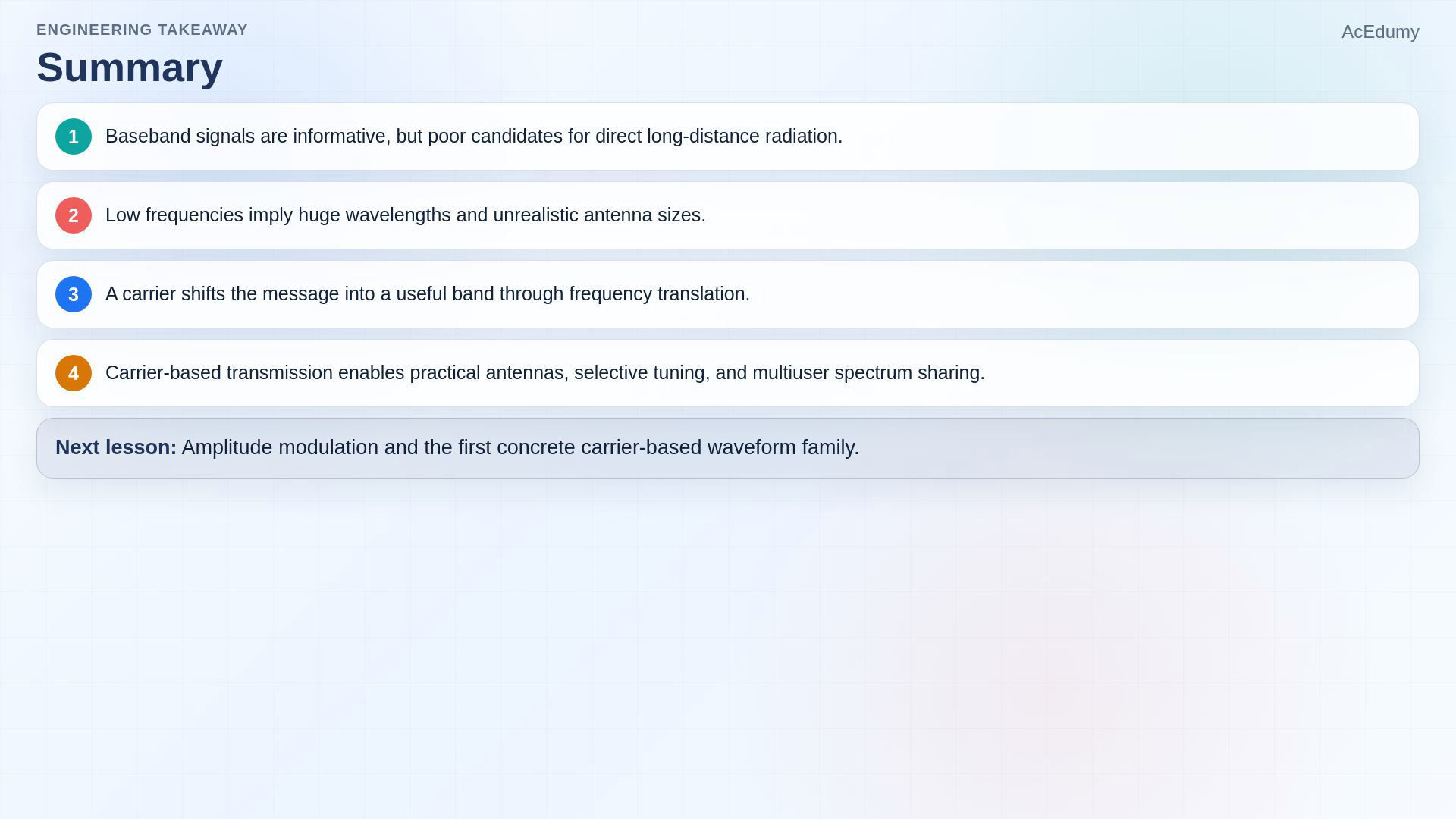
Original video reference, with scope stated in the notebook. Two misleading schematic frames are replaced by the same video's summary; the 3 kHz and quarter-wave example is not a universal antenna-size limit. Summary: modulation adapts a message to a chosen transmission channel.The low-frequency audio example is awkward for ordinary compact far-field antennas; this is not a prohibition on all baseband links.A suitable carrier and modulation rule can move information into a usable transmission band.With adequate band separation and filtering, antenna design, selective tuning and spectrum sharing become practical.The useful benefit is channel compatibility, not an automatic increase in signal power.Next: amplitude modulation, its waveform, spectrum and operating conditions.Narration transcript
Let us summarize the big idea. Baseband signals are poor candidates for direct long-distance radiation because their frequencies are low, their wavelengths are huge, and spectrum sharing is awkward. A carrier lets us move the message to a more useful band. That gives us practical antennas, selective tuning, and cleaner spectrum organization. So modulation is the bridge between a useful message and a transmission medium that can carry it efficiently. In the next lesson, we will take that idea one step further and study amplitude modulation in detail.
Source video: Analog Communication #01 | Why Modulation? | Baseband vs Carrier (3:42)