Communication Basics · MMDS, LMDS, WLL, WLAN, and Bluetooth
#11 Historical fixed wireless access, duplexing and multiple access, DSSS/FHSS, modern Wi-Fi, and Bluetooth Classic/LE distinctions
Separate historical wireless-access families from modern WLAN and Bluetooth, then place band, range, peak-rate, and security claims inside standards and link-budget context.
Question
Bound MMDS, LMDS, and WLL by historical and regional scope; separate duplexing from multiple access; explain that DSSS/FHSS is not cryptographic security; compare Wi-Fi 6/7 and Bluetooth Classic/LE without mixing their physical layers.
Written solution and narration transcript(shows the full solution)
Below are all the lines written in the notebook together with the full narration transcript.
1. Place MMDS/LMDS band, access, and range claims in regional system context
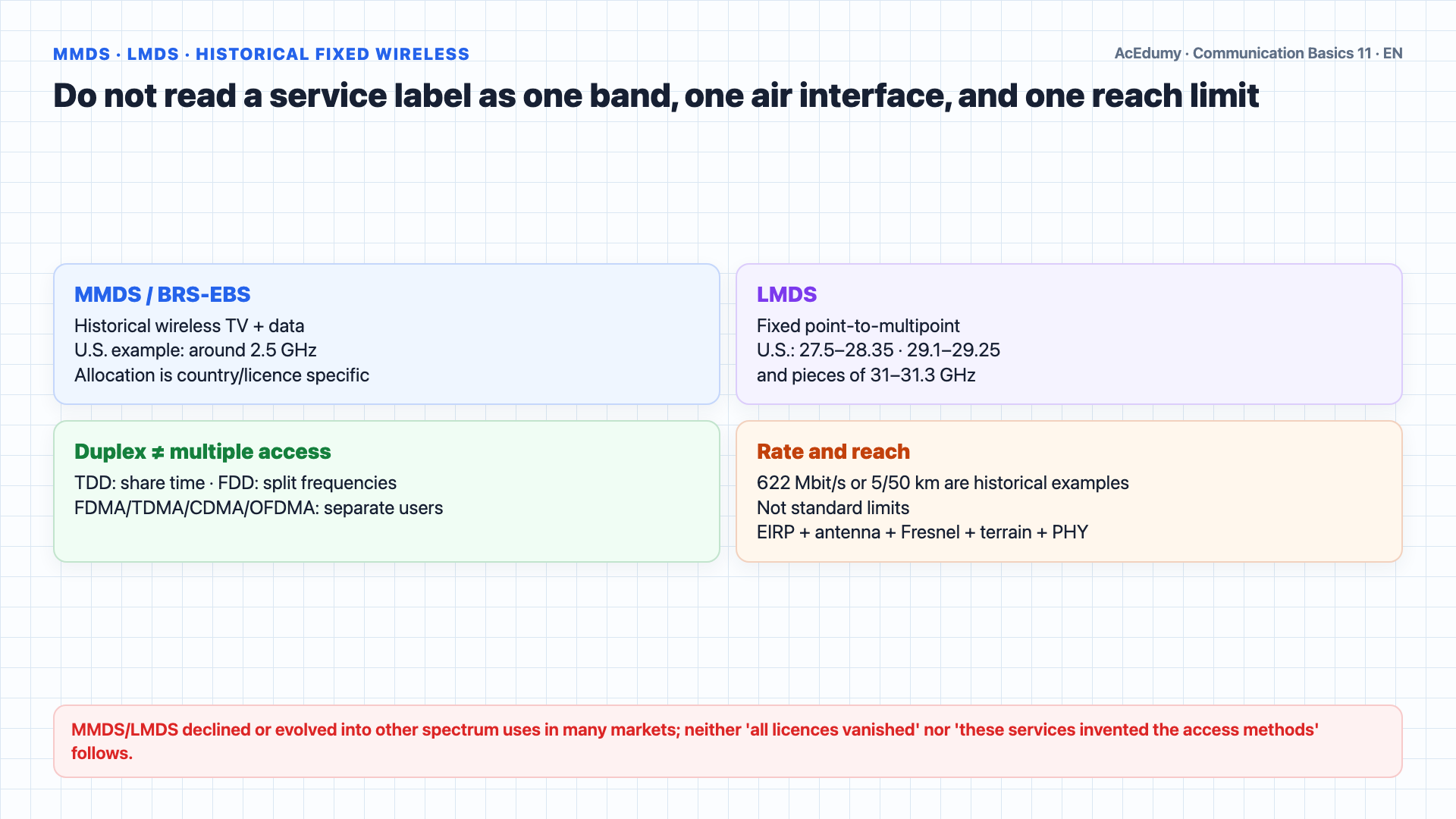
Band, speed, and range values are not universal limits; read them with the standard, regional allocation, device capability, and link budget. Before fiber and 4G became widespread, engineers developed wireless broadband alternatives.MMDS, Multichannel Multipoint Distribution Services, was essentially cableless television.MMDS/BRS-EBS spectrum is country- and licence-specific; the historical U.S. example sits around 2.5 GHz. Antenna type and reach are not fixed at 50 km; EIRP, antenna, LOS/Fresnel, terrain, and air interface decide them.LMDS allocation is regional; the U.S. example used pieces of 27.5–28.35, 29.1–29.25, and 31–31.3 GHz. 622 Mbit/s and 5 km are historical design examples, not standard limits.LMDS is not one PHY standard; an implementation may use TDD or FDD. TDD shares channel time, while FDD separates uplink and downlink frequencies; spectrum plan and system design decide.FDMA and TDMA are two multiple-access options; the LMDS/MMDS service name mandates neither, and CDMA/OFDMA or other air interfaces are possible.Mass-market MMDS/LMDS roles declined in many markets; spectrum and services evolved into BRS/EBS, fixed wireless, and mobile broadband uses. This does not mean every licence disappeared worldwide.TDD, FDD, FDMA, and TDMA predate these services; MMDS/LMDS were application examples, not their inventors. Modern cellular systems also use OFDMA and dynamic time-frequency scheduling.Narration transcript
Before fiber and 4G became widespread, engineers developed wireless broadband alternatives. MMDS, Multichannel Multipoint Distribution Services, was essentially cableless television. It operated in the 2.5 to 2.7 gigahertz band with an omni directional antenna reaching about 50 kilometers, delivering TV channels over wireless microwave links. LMDS, Local Multipoint Distribution Services, operated at much higher frequencies, 24 to 38 gigahertz, providing wireless broadband at up to 622 megabits per second, but only within about 5 kilometers. LMDS used either TDD, Time Division Duplexing, where transmitter and receiver take turns, or FDD, Frequency Division Duplexing, where uplink and downlink use separate frequency bands. Multiple access was achieved through FDMA, where users are separated by frequency, or TDMA, where users are separated in time. It is important to note that both MMDS and LMDS have been largely replaced today by cable, satellite TV, fiber to the home, and 4G or 5G fixed wireless access. However, the principles of TDD, FDD, FDMA, and TDMA that they introduced remain fundamental in modern cellular networks.
2. Separate WLL architecture from its air interface and spread spectrum from cryptographic security
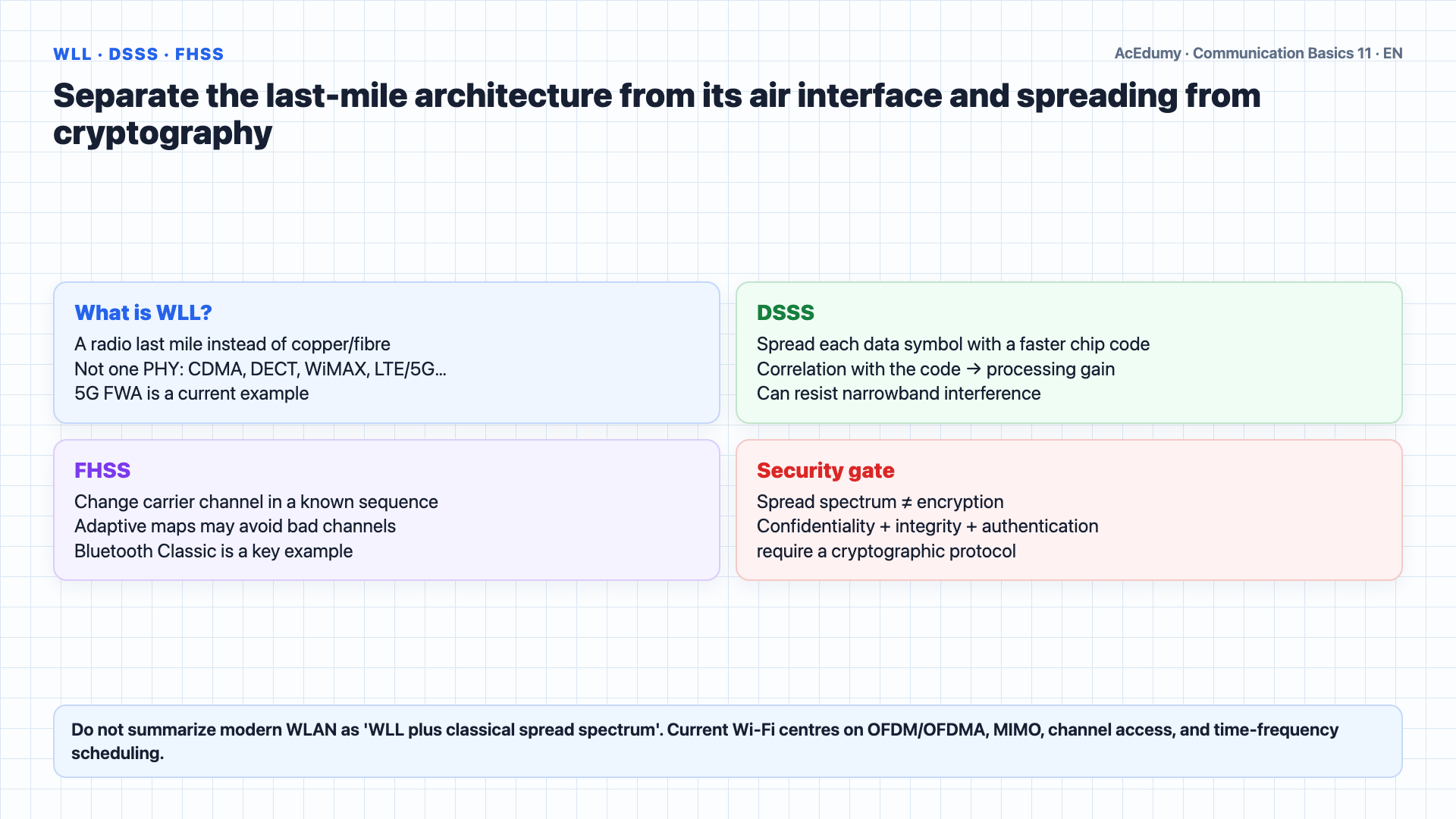
Band, speed, and range values are not universal limits; read them with the standard, regional allocation, device capability, and link budget. Wireless Local Loop, or WLL, aimed to replace the copper wire in the last mile with a wireless connection.WLL is a last-mile architecture, not one air interface: CDMA, TDMA, DECT, WiMAX, LTE/5G, and other systems have been used. Coverage is not fixed above 15 km; spectrum, EIRP, antenna, terrain, and link budget decide.Some early narrowband WLL implementations sat near 56–128 kbit/s; the WLL family has no universal rate range.5G FWA is a current example of a radio last mile. Gigabit-class peaks are possible; delivered rate depends on spectrum, cell load, radio conditions, device, and backhaul.WLL is an access architecture, and modern WLAN cannot be reduced to one classical spread-spectrum method. Early 802.11 used DSSS/FHSS; current Wi-Fi relies on OFDM/OFDMA, MIMO, and scheduling.In spread spectrum, the signal is deliberately spread over a bandwidth much wider than necessary.Spreading can provide processing gain and narrowband-interference resistance; it does not by itself provide confidentiality, authentication, or cryptographic security.DSSS and FHSS are two classic spread-spectrum families, not the only possible techniques.Direct Sequence Spread Spectrum, DS-SS, replaces each data bit with a longer code called a chip sequence.The receiver uses the same code to extract the original data.Without the spreading code, a DSSS signal may be hard to despread, but this is not a security boundary; robust confidentiality still requires encryption and authentication.Frequency Hopping Spread Spectrum, FH-SS, rapidly switches the carrier frequency in a pattern known only to the transmitter and receiver.Bluetooth Classic BR/EDR uses adaptive frequency hopping; Bluetooth LE also selects/hops channels but does not use Classic's 79-channel plan.Narration transcript
Wireless Local Loop, or WLL, aimed to replace the copper wire in the last mile with a wireless connection. WLL systems used CDMA, Code Division Multiple Access, and could cover areas with a diameter greater than 15 kilometers. The original WLL supported data rates of 56 to 128 kilobits per second. Today, this concept has evolved into 5G Fixed Wireless Access, or FWA, which delivers gigabit speeds wirelessly to homes and businesses. Both WLL and modern WLAN rely on a technique called spread spectrum. In spread spectrum, the signal is deliberately spread over a bandwidth much wider than necessary. This provides reliability, security, and resistance to interference. There are two main types. Direct Sequence Spread Spectrum, DS-SS, replaces each data bit with a longer code called a chip sequence. The receiver uses the same code to extract the original data. To an unintended receiver, DS-SS looks like low power background noise. Frequency Hopping Spread Spectrum, FH-SS, rapidly switches the carrier frequency in a pattern known only to the transmitter and receiver. FH-SS is used in Bluetooth, as we will see shortly.
3. Compare Wi-Fi generations and Bluetooth Classic/LE PHYs with the right boundaries
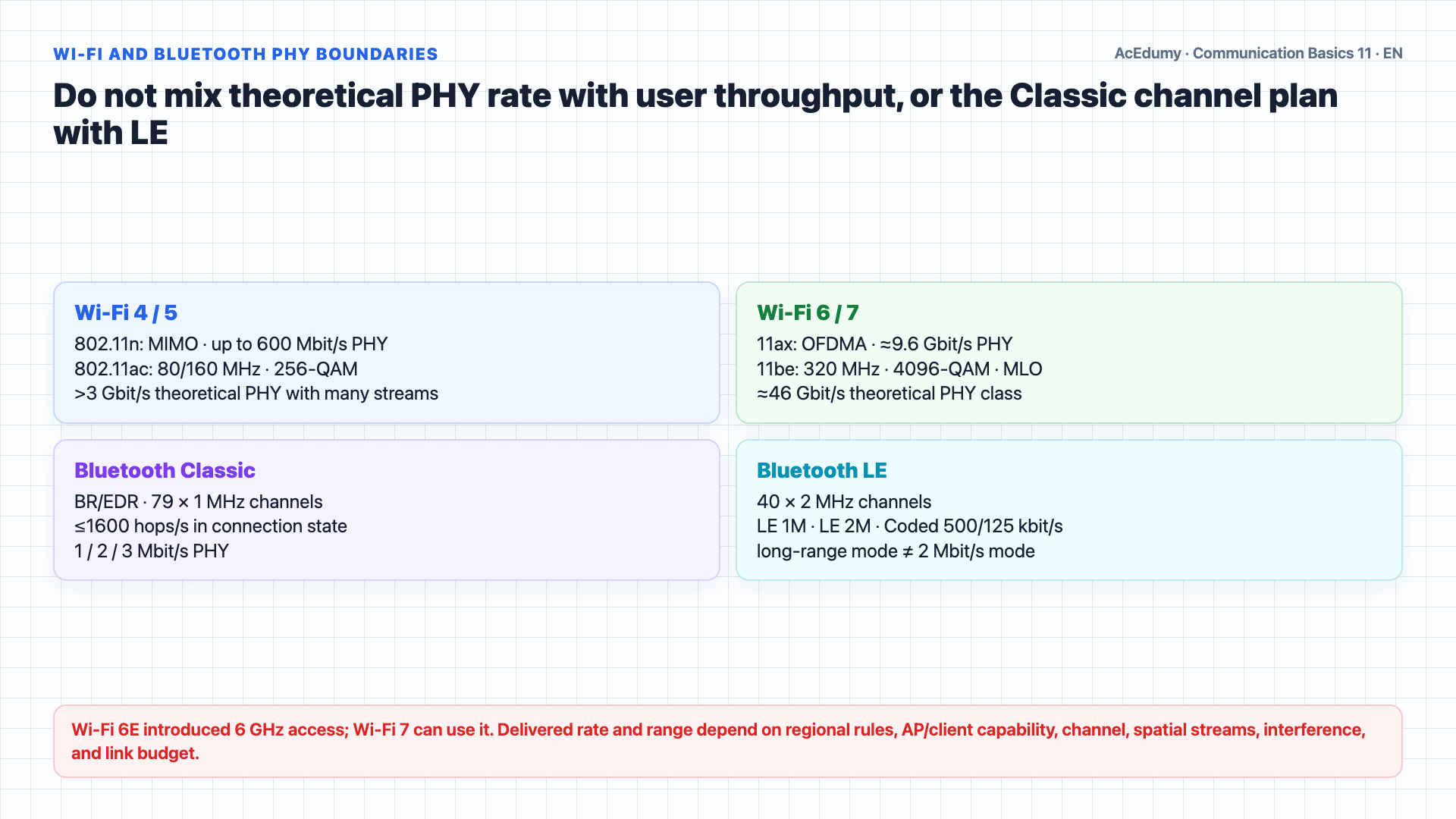
Band, speed, and range values are not universal limits; read them with the standard, regional allocation, device capability, and link budget. Wireless LAN, or WLAN, provides network connectivity without cables.The original standards from the early 2000s operated at 2.4 gigahertz and 5 gigahertz with data rates of 11 to 54 megabits per second.The technology has advanced dramatically since then.Wi-Fi 4/802.11n uses MIMO and channel bonding to reach 600 Mbit/s in the highest supported PHY configuration; this is not guaranteed application throughput.Wi-Fi 5/802.11ac can exceed 3 Gbit/s in theoretical PHY configurations using 80/160 MHz, 256-QAM, and multiple spatial streams; client capability constrains the result.Wi-Fi 6/802.11ax has a theoretical maximum PHY rate near 9.6 Gbit/s; OFDMA's main contribution is scheduled resource units and efficiency in dense environments, not a per-client speed guarantee.Wi-Fi 7/IEEE 802.11be can reach the roughly 46 Gbit/s theoretical PHY class through 320 MHz, 4096-QAM, multi-link operation, and more spatial streams. Wi-Fi 6E introduced 6 GHz access, subject to regional regulation.Modern Wi-Fi is built around OFDM/OFDMA, MIMO, channel access, and scheduling; classical DSSS/FHSS is not the common PHY core of every current generation.Bluetooth is another short range wireless technology operating at 2.4 gigahertz using Frequency Hopping Spread Spectrum.Seventy-nine 1 MHz channels and up to 1600 hops/s in connection state describe Bluetooth Classic BR/EDR. Bluetooth LE uses forty 2 MHz channels.Bluetooth Classic BR/EDR provides 1/2/3 Mbit/s PHYs. Bluetooth LE provides 1M, 2M, and range-oriented 500/125 kbit/s Coded PHYs; 2 Mbit/s and longest range are not the same mode, and real range is link-budget dependent.Narration transcript
Wireless LAN, or WLAN, provides network connectivity without cables. The original standards from the early 2000s operated at 2.4 gigahertz and 5 gigahertz with data rates of 11 to 54 megabits per second. The technology has advanced dramatically since then. Wi-Fi 4, based on 802.11n, introduced MIMO and reached 600 megabits per second. Wi-Fi 5, 802.11ac, pushed speeds to over 3 gigabits per second. Wi-Fi 6, 802.11ax, supports up to 9.6 gigabits per second with better performance in crowded environments through OFDMA. And the latest Wi-Fi 7, 802.11be, targets speeds up to 46 gigabits per second using 320 megahertz channels and the new 6 gigahertz band. Despite these massive speed increases, the fundamental spread spectrum principles remain at the core. Bluetooth is another short range wireless technology operating at 2.4 gigahertz using Frequency Hopping Spread Spectrum. It hops between 79 channels, 1600 times per second. Originally designed for cable replacement at 1 megabit per second, Bluetooth has evolved through version 5.0 and beyond to support speeds up to 2 megabits per second, ranges up to 400 meters, and low energy modes for IoT devices like fitness trackers and sensors.
4. Summarize wireless access through standards, PHY, and link-budget gates
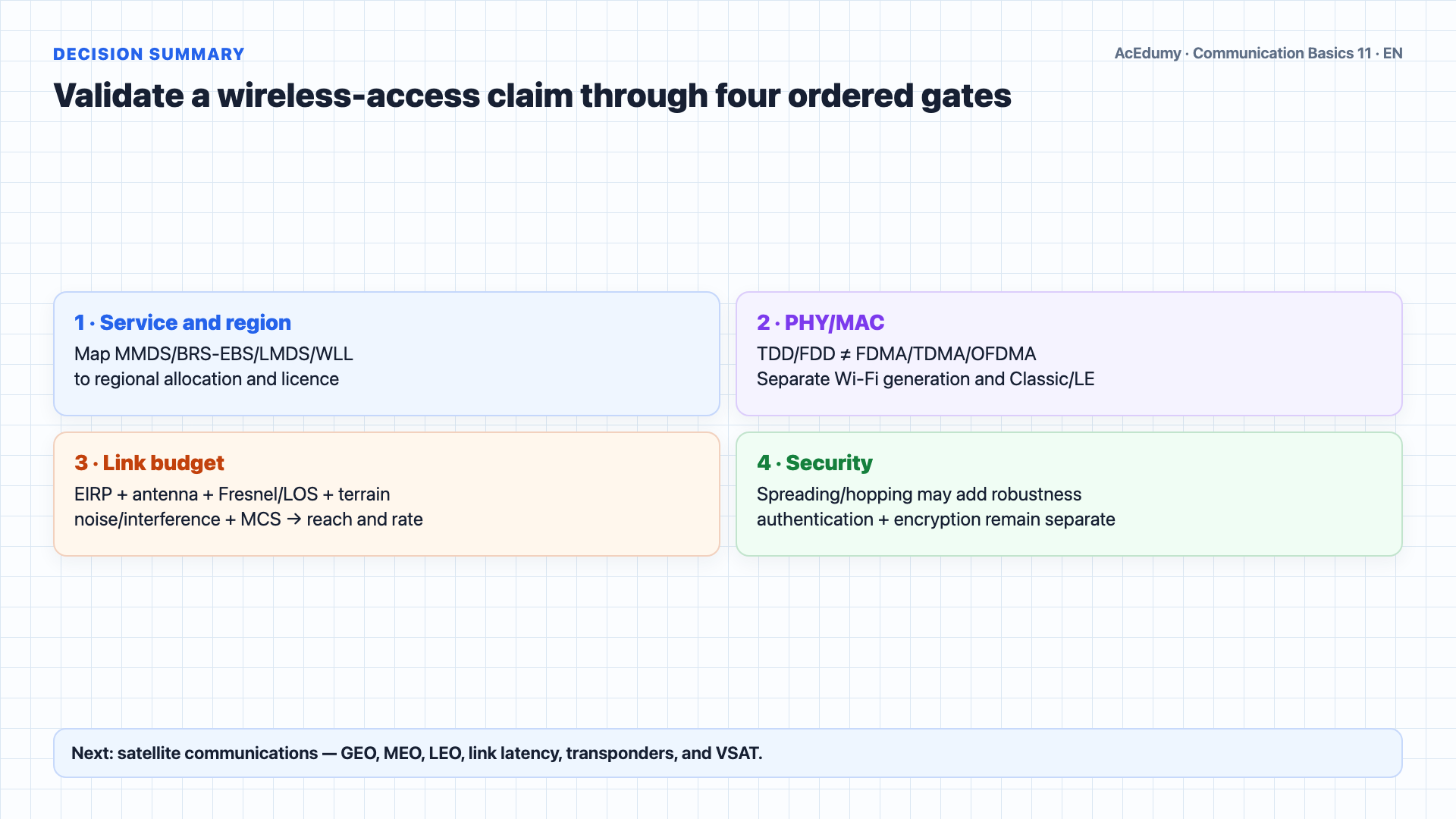
Band, speed, and range values are not universal limits; read them with the standard, regional allocation, device capability, and link budget. Let us review.MMDS and LMDS are historical fixed-wireless examples with regional bands and air interfaces. They did not invent TDD/FDD or FDMA/TDMA; current networks also use OFDMA and dynamic scheduling.WLL is a last-mile architecture family; from early narrowband examples to 5G FWA, rate depends on air interface, spectrum, and link budget.DSSS/FHSS can provide processing gain and interference resistance; cryptographic security separately requires authentication and encryption.Wi-Fi theoretical PHY rates grew from the 54 Mbit/s class to roughly 46 Gbit/s for Wi-Fi 7; the modern core is OFDM/OFDMA, MIMO, wide channels, and multi-link operation.Bluetooth operates at 2.4 GHz; Classic BR/EDR uses a 79-channel adaptive-hopping plan, while LE uses a distinct 40-channel PHY/hopping plan and supports low-power IoT profiles.In the next lesson, we will explore satellite communications: GEO, LEO, and MEO orbits, transponders, and VSAT systems.Narration transcript
Let us review. MMDS and LMDS were early wireless broadband technologies now largely replaced by fiber and cellular, but they introduced key concepts: TDD, FDD, FDMA, and TDMA that are fundamental in today's cellular networks. Wireless Local Loop evolved from 128 kilobits per second into modern 5G Fixed Wireless Access at gigabit speeds. Spread spectrum techniques, DS-SS and FH-SS, provide reliability, security, and interference resistance. Wi-Fi has grown from 54 megabits per second to Wi-Fi 7 at 46 gigabits per second, while maintaining spread spectrum fundamentals. Bluetooth uses FH-SS at 2.4 gigahertz for short range wireless and now supports IoT with Bluetooth Low Energy. In the next lesson, we will explore satellite communications: GEO, LEO, and MEO orbits, transponders, and VSAT systems.
Source video: Communication Basics #11 — MMDS, LMDS, WLL, WLAN & Bluetooth (6:14)