Circuit Theory 1 · Circuit Analysis Fundamentals
#10 Nodal analysis example 3 — current and power with three nodes
Builds and solves a three-node KCL system, verifying V₁=45 V, V₂=21 V, V₃=27 V, i=1.5 A, and P=54 W.
Question
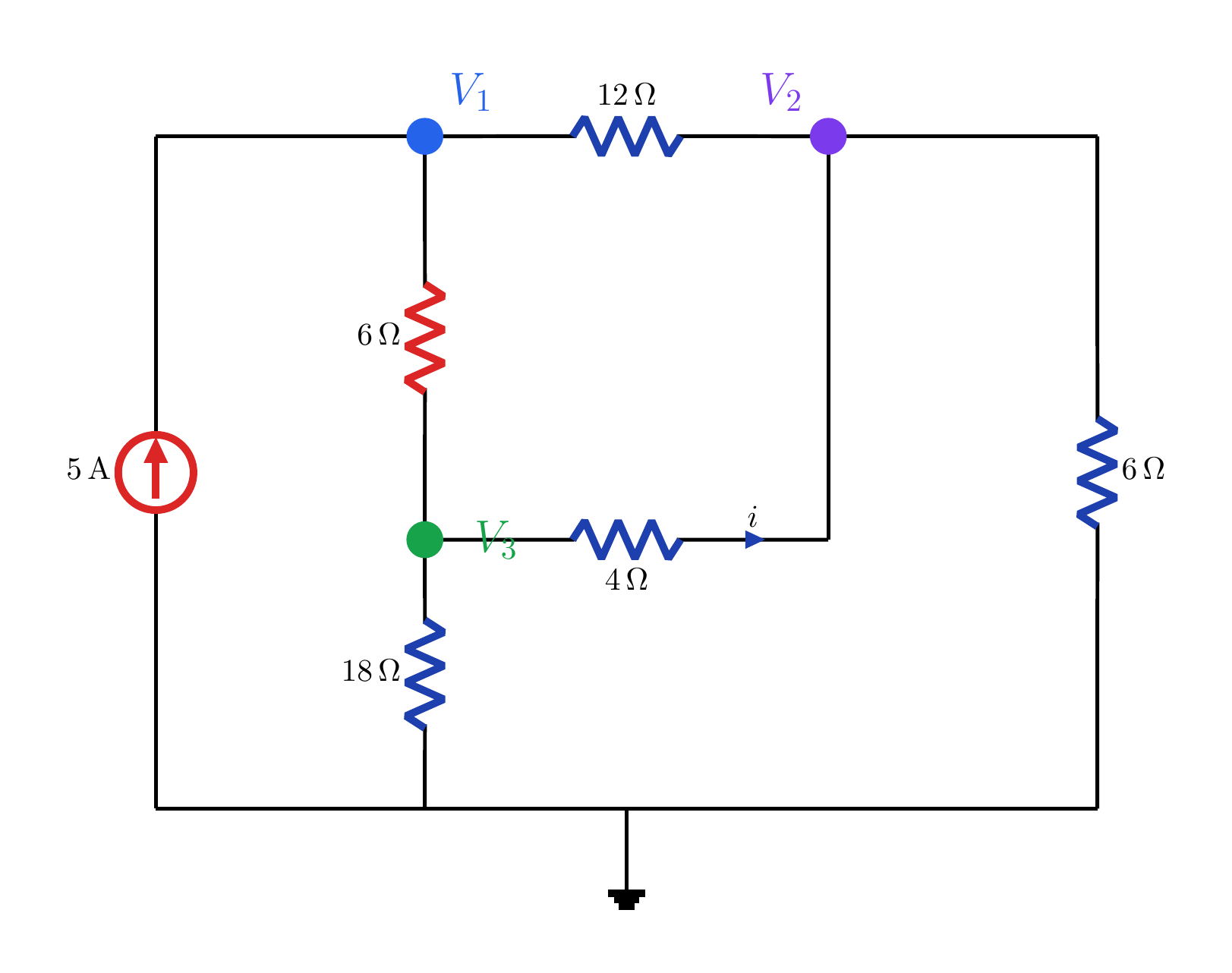
Use nodal analysis to find V_1, V_2, and V_3. Calculate current i through the 4 Ω resistor from V_3 to V_2 and the power dissipated by the red 6 Ω resistor.
Written solution and narration transcript(shows the full solution)
Below are all the lines written in the notebook together with the full narration transcript.
1. Read the circuit and targets
The red 6 Ω resistor lies between V₁ and V₃; current i is defined from V₃ to V₂ through 4 Ω. Unknowns: V1, V2, V3Target:Power in the red 6 Ω resistorNarration transcript
Here is our most complex example so far — a circuit with three unknown node voltages. Node V one connects to node V three through a six-ohm resistor — highlighted in red — and to node V two through a twelve-ohm resistor at the top. Node V two also connects to V three through a four-ohm resistor, and to ground through a six-ohm resistor on the right. Node V three connects to ground through an eighteen-ohm resistor. A five-ampere current source enters V one from below. Our task: find the current i through the four-ohm resistor, and the power dissipated by the red six-ohm resistor.
2. KCL at node V₁
The red 6 Ω resistor lies between V₁ and V₃; current i is defined from V₃ to V₂ through 4 Ω. Multiply by 12 and simplifyNarration transcript
Let's write KCL at node V one. Three terms. The six-ohm resistor to V three gives V one minus V three, over six. The twelve-ohm resistor to V two gives V one minus V two, over twelve. The five-ampere source enters V one, so we write minus five. Putting it together: V one minus V three over six, plus V one minus V two over twelve, minus five, equals zero. Multiply through by twelve to clear denominators. We get two times V one minus V three, plus V one minus V two, minus sixty, equals zero. Combining: three V one minus V two minus two V three equals sixty. That is our first equation.
3. KCL at node V₂
The red 6 Ω resistor lies between V₁ and V₃; current i is defined from V₃ to V₂ through 4 Ω. Multiply by 12 and simplifyNarration transcript
KCL at node V two. Three branches, no current source at this node. The twelve-ohm resistor gives V two minus V one, over twelve. The four-ohm resistor to V three gives V two minus V three, over four. The six-ohm resistor to ground gives V two over six. Equation: V two minus V one over twelve, plus V two minus V three over four, plus V two over six, equals zero. Multiply by twelve. We get V two minus V one, plus three times V two minus V three, plus two V two, equals zero. Combining: minus V one plus six V two minus three V three equals zero. Equation two.
4. KCL at node V₃
The red 6 Ω resistor lies between V₁ and V₃; current i is defined from V₃ to V₂ through 4 Ω. Multiply by 36 and simplifyNarration transcript
KCL at node V three. Again three branches, no source. The six-ohm resistor gives V three minus V one, over six. The four-ohm resistor gives V three minus V two, over four. The eighteen-ohm resistor to ground gives V three over eighteen. Multiply by thirty-six to clear all denominators. We get six times V three minus V one, plus nine times V three minus V two, plus two V three, equals zero. Combining: minus six V one minus nine V two plus seventeen V three equals zero. Equation three.
5. Solve and verify the system
The red 6 Ω resistor lies between V₁ and V₃; current i is defined from V₃ to V₂ through 4 Ω. Check at V_1:Narration transcript
We now have three equations with three unknowns. Equation one: three V one minus V two minus two V three equals sixty. Equation two: minus V one plus six V two minus three V three equals zero. Equation three: minus six V one minus nine V two plus seventeen V three equals zero. To solve this system we use elimination. Multiply equation two by six and subtract equation three. V one cancels and we get: forty-five V two minus thirty-five V three equals zero. So V three equals nine-sevenths of V two. Substitute back: V two equals twenty-one volts, V three equals twenty-seven volts, and V one equals forty-five volts. Quick verify at V one: forty-five minus twenty-seven over six is three amperes. Forty-five minus twenty-one over twelve is two amperes. Three plus two equals five, matching the five-ampere source. Correct.
6. Branch current and resistor power
The red 6 Ω resistor lies between V₁ and V₃; current i is defined from V₃ to V₂ through 4 Ω. Narration transcript
Now for the two quantities the question asks. The current i flows through the four-ohm resistor from V three toward V two. By Ohm's law: i equals V three minus V two, divided by four. That is twenty-seven minus twenty-one over four, which equals one point five amperes. For the power dissipated by the red six-ohm resistor between V one and V three: the voltage across it is V one minus V three, which is forty-five minus twenty-seven, equals eighteen volts. Power equals V squared over R: eighteen squared over six equals fifty-four watts.
7. Method summary
The red 6 Ω resistor lies between V₁ and V₃; current i is defined from V₃ to V₂ through 4 Ω. 1. Choose nodes 2. Write KCL3. Solve the system 4. VerifyBranch current: ΔV/RResistor power: V2/RNarration transcript
The main takeaway: the four-step nodal method scales directly from two nodes to three or more. The only difference is bigger algebra — three equations instead of two. Once you have the node voltages, Ohm's law gives any branch current, and P equals V squared over R gives any resistor power. In the next video, we'll see one more nodal analysis example.
Source video: Circuit Theory #10 | Nodal Analysis Example 3 — Three Nodes, Finding i and P (6:15)