Circuit Theory 1 · Circuit Analysis Fundamentals
#08 Nodal analysis — four-step worked example
Chooses a reference node, writes two KCL equations, solves V₁=64 V and V₂=48 V, and verifies both nodes.
Question
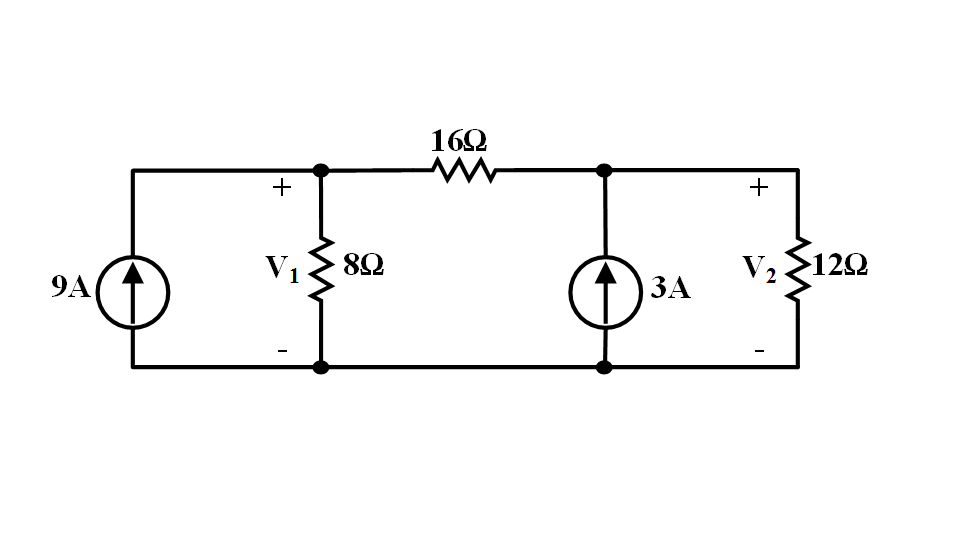
Take the bottom conductor as reference and use nodal analysis to find V_1 and V_2. Verify KCL at both nodes.
Written solution and narration transcript(shows the full solution)
Below are all the lines written in the notebook together with the full narration transcript.
1. Four-step nodal method
1) Choose a reference node2) Label the unknown node voltages3) Write KCL at every node4) Apply current-source signsNarration transcript
Nodal analysis is one of the most systematic methods for solving circuits. The key idea: write Kirchhoff's Current Law at each node, express each branch current in terms of node voltages using Ohm's law. Here is the four-step method. Step one: choose a reference node, also called ground. This will be our zero-volt reference. Step two: identify all other nodes in the circuit. Step three: write KCL for each node — for every branch, write current as voltage difference divided by resistance — then set the sum equal to zero. Step four: determine the sign of each current source using the entering-leaving rule. If a current source enters a node, write it as minus in the equation, because it leaves as branch current. If it leaves the node, write it as plus. Once you follow these four steps, you get a system of equations in node voltages.
2. Read the circuit and nodes
The bottom conductor is the reference node; the upper nodes are V₁ and V₂. Unknowns: V1 and V2Narration transcript
Let's apply the method to a concrete example. Here is our circuit. We have three resistors: eight ohms between node one and ground, sixteen ohms between node one and node two, and twelve ohms between node two and ground. We also have two current sources: a nine-ampere source entering node one, and a three-ampere source entering node two. Our goal is to find the voltages at node one and node two. Notice we already chose the bottom node as our reference ground. So we need two equations for two unknowns, V one and V two.
3. KCL at node V₁
The bottom conductor is the reference node; the upper nodes are V₁ and V₂. Multiply by 16:Narration transcript
Now let's write KCL at node one. First branch: the sixteen-ohm resistor connecting node one to node two. Current flowing from node one to node two is V one minus V two, divided by sixteen. Second branch: the eight-ohm resistor connecting node one to ground. Current is simply V one divided by eight. Now the current source: the nine-ampere source is entering node one. By our rule, entering means minus nine in the equation. Putting it all together: V one minus V two, divided by sixteen, plus V one divided by eight, minus nine, equals zero. Let's multiply through by sixteen to clear the denominator. We get V one minus V two plus two V one minus one hundred forty four equals zero. Simplifying: three V one minus V two equals one hundred forty four. That is our first equation.
4. KCL at node V₂
The bottom conductor is the reference node; the upper nodes are V₁ and V₂. Multiply by 48:Narration transcript
Now let's write KCL at node two. First branch: again the sixteen-ohm resistor. Current flowing from node two to node one is V two minus V one, divided by sixteen. Second branch: the twelve-ohm resistor to ground. Current is V two divided by twelve. Now the current source: the three-ampere source is entering node two. Again, entering means minus three. Writing the equation: V two minus V one, divided by sixteen, plus V two divided by twelve, minus three, equals zero. Multiply through by forty eight to clear denominators. We get three V two minus three V one plus four V two minus one hundred forty four equals zero. Simplifying: minus three V one plus seven V two equals one hundred forty four. That is our second equation.
5. Solve the equation system
The bottom conductor is the reference node; the upper nodes are V₁ and V₂. (1)+(2):V_1 check:V_2 check:Narration transcript
Now solve the two equations together. Equation one is three V one minus V two equals one hundred forty four. Equation two is minus three V one plus seven V two equals one hundred forty four. Adding them cancels the V one terms and gives six V two equals two hundred eighty eight, so V two is forty eight volts. Substitute this into equation one: three V one minus forty eight equals one hundred forty four. Therefore three V one is one hundred ninety two and V one is sixty four volts. Now verify both nodes. At node one, the current leaving through sixteen ohms is sixty four minus forty eight over sixteen, or one ampere. The current through eight ohms is sixty four over eight, or eight amperes. One plus eight equals the nine amperes entering from the source. At node two, the current defined as leaving toward node one is forty eight minus sixty four over sixteen, or minus one ampere. The current leaving through twelve ohms is four amperes, and the entering source contributes minus three amperes. Thus minus one plus four minus three equals zero. Both KCL equations check exactly.
6. Method summary
Branch current = node-voltage difference / RSource entering a node: minusSource leaving a node: plusBack-check every result with KCLNarration transcript
Let's summarize the nodal analysis method. First, choose a reference node. Second, identify all other nodes. Third, write KCL at each node, expressing branch currents as voltage differences over resistance, then set the sum to zero. Fourth, apply the entering-leaving rule for current sources: if the source enters the node, write it as minus in the equation. Once you have the equations, solve the linear system to find the node voltages. In the next video, we'll extend this method to supernodes, which handle cases where a voltage source connects two non-reference nodes directly.
Source video: Circuit Theory #08 | Nodal Analysis — 4-Step Method + Worked Example (6:19)