Circuit Theory 1 · Circuit Analysis Fundamentals
#13 The supernode method — worked examples 2 and 3
Solves a supernode coupled to an ordinary node and a two-source common-top-node circuit, then verifies both by KCL.
Question
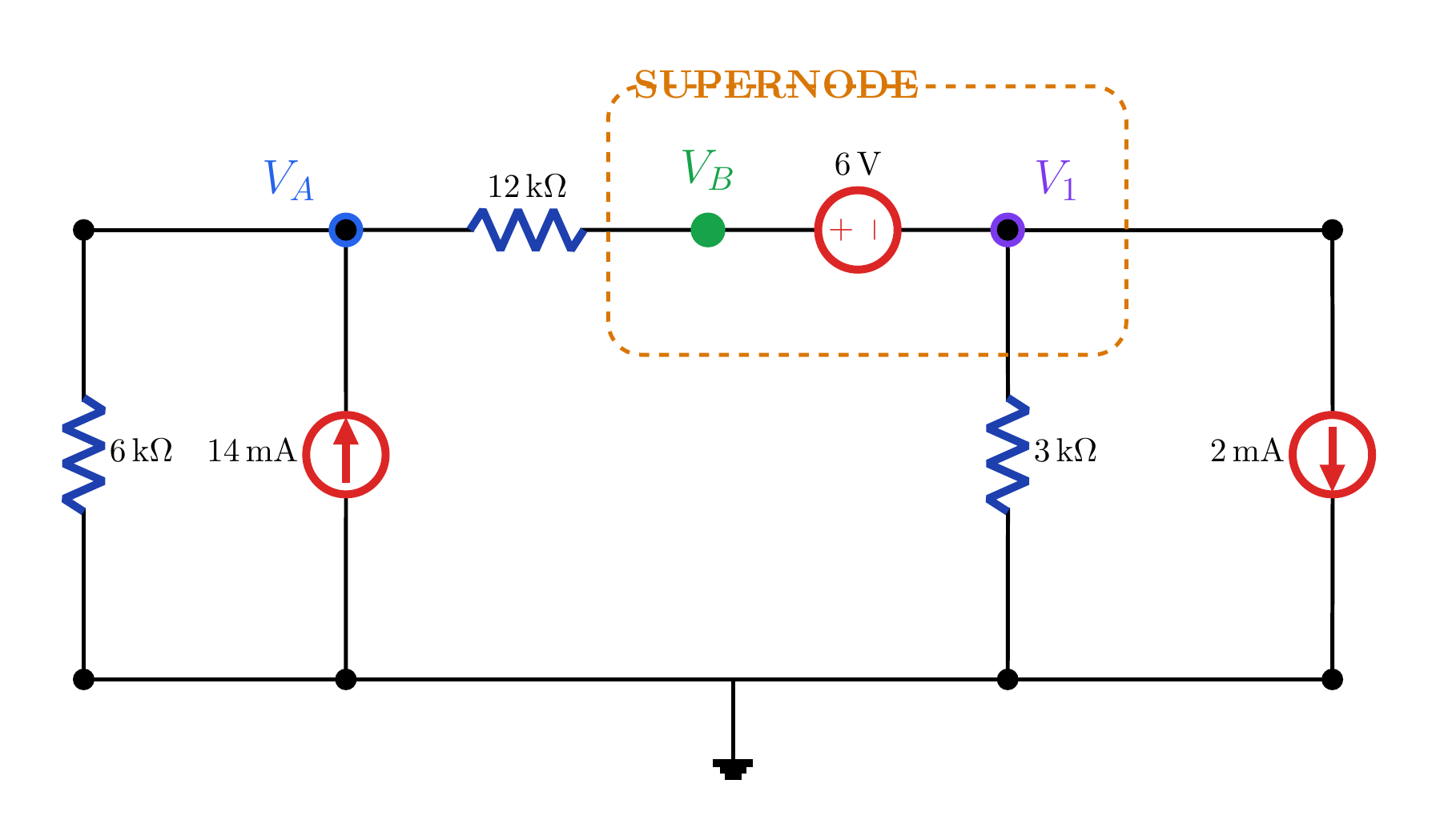
Solve both circuits with the supernode method. Find V_1 in Example 2 and V_0 in Example 3, writing every source-polarity constraint explicitly.
Written solution and narration transcript(shows the full solution)
Below are all the lines written in the notebook together with the full narration transcript.
1. Recall the method
The dashed boundary encloses only V_B, the 6 V source whose positive terminal is at V_B, and V_1. Supernode = boundary KCL + source constraintExample 2: ordinary node + supernodeExample 3: two voltage sources, one top nodeNarration transcript
In the previous lesson, we learned the core supernode idea. When a voltage source connects two non-reference nodes, we enclose both nodes and the source in one boundary, write Kirchhoff's Current Law for that boundary, and add one constraint equation from the voltage source. Now let us practice with two more examples. The first mixes an ordinary node with a supernode. The second uses two source branches tied to one top node. In both cases, the method stays the same: identify the boundary, count only crossing currents, and use source polarity for the constraints.
2. Example 2 — circuit and boundary
The dashed boundary encloses only V_B, the 6 V source whose positive terminal is at V_B, and V_1. Ordinary node: VASupernode: VB, 6 V source and V1Find: V1Narration transcript
Here is Example 2. On the left, node V A connects to a 6 kiloohm resistor to ground and a 14 milliamp source pointing upward into the node. That same node connects through a 12 kiloohm resistor to node V B. Then a 6 volt source connects V B to node V one, with the positive terminal on the V B side and the negative terminal on the V one side. At V one, a 3 kiloohm resistor goes down to ground, and a 2 milliamp source points downward from V one to ground. The supernode is only around V B, the 6 volt source, and V one. Node V A stays outside, so we will write one ordinary KCL equation at V A, one supernode KCL equation, and one source constraint. Our goal is V one.
3. Example 2 — three equations
The dashed boundary encloses only V_B, the 6 V source whose positive terminal is at V_B, and V_1. Narration transcript
Start with the ordinary node, V A. Its leaving-current equation is: V A over 6 k, plus V A minus V B over 12 k, minus 14 m, equals zero. Multiply by 12 k, and we get 3 V A minus V B equals 168. Now write Kirchhoff's Current Law for the supernode. The crossing currents are V B minus V A over 12 k, V one over 3 k, and the 2 milliamp source leaving the boundary. So the equation is: V B minus V A over 12 k, plus V one over 3 k, plus 2 m, equals zero. Multiply by 12 k, and we get negative V A plus V B plus 4 V one equals negative 24. The source constraint is simple: V B minus V one equals 6.
4. Example 2 — result and check
The dashed boundary encloses only V_B, the 6 V source whose positive terminal is at V_B, and V_1. Narration transcript
Now solve the three equations. From the constraint, V B equals V one plus 6. Substitute that into the supernode equation, and it becomes V A minus 5 V one equals 30. Put the same substitution into the first equation, and we get 3 V A minus V one equals 174. From the first reduced equation, V A equals 5 V one plus 30. Substitute once more: 3 times 5 V one plus 30, minus V one, equals 174. So 14 V one equals 84, and V one equals 6 volts. Then V B equals 12 volts and V A equals 60 volts. The check is clean: negative 4 m plus 2 m plus 2 m equals zero.
5. Example 3 — circuit and constraints
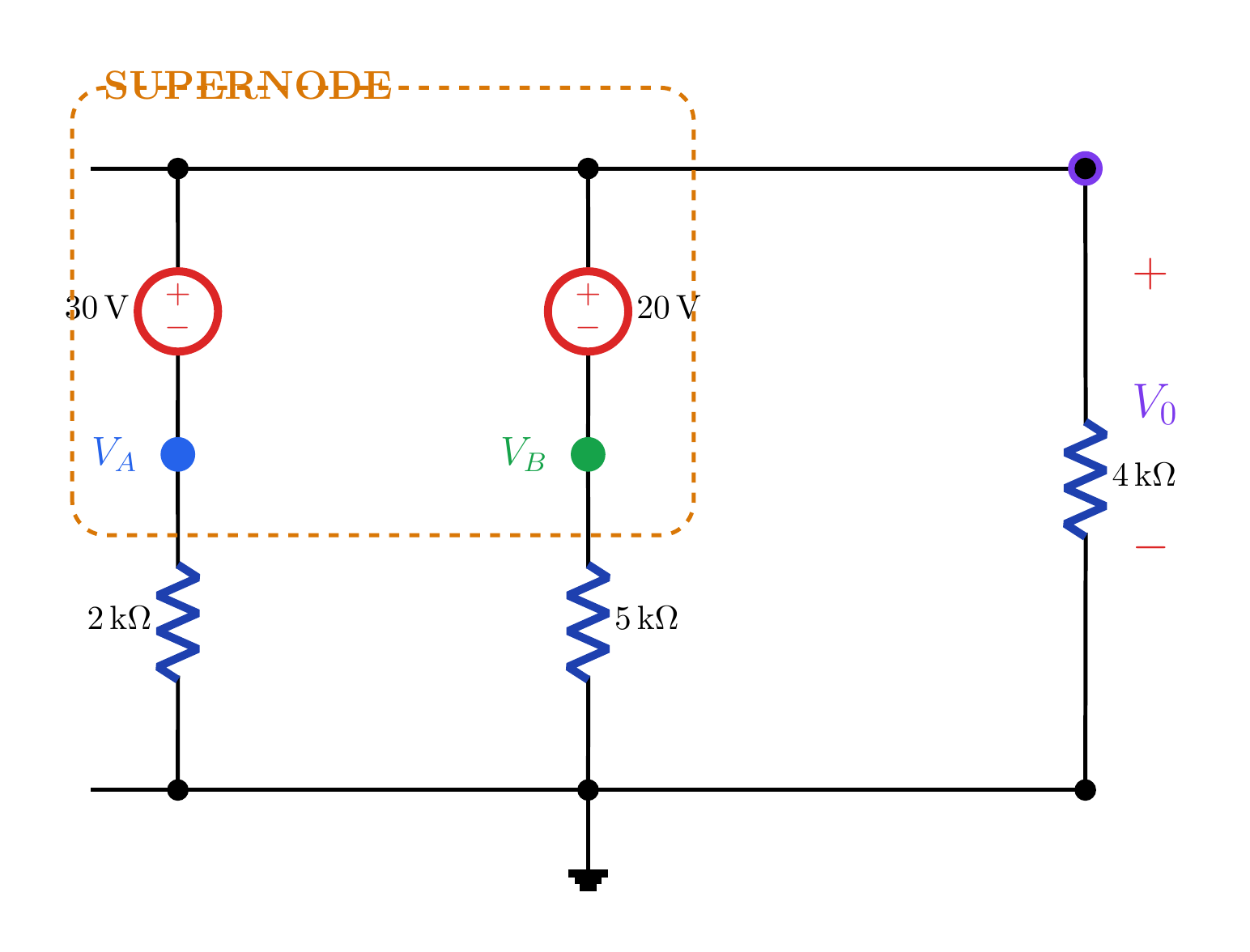
The positive terminals of both sources are at V_0; the dashed boundary encloses both sources and internal nodes V_A and V_B. Boundary currents: 2 kΩ, 5 kΩ and 4 kΩFind: V0Narration transcript
Now Example 3. There is one common top node, labeled V zero across the 4 kiloohm resistor on the right. Three branches connect that top node to the bottom reference rail. The left branch has a 30 volt source on top and a 2 kiloohm resistor below it. The middle branch has a 20 volt source on top and a 5 kiloohm resistor below it. The right branch is just a 4 kiloohm resistor. Because the two voltage sources connect the top node to two internal nodes, the supernode now contains the top node, both sources, and the two internal nodes beneath the sources. The only currents that cross the boundary are the currents through the 2 kiloohm, 5 kiloohm, and 4 kiloohm resistors. Our goal is V zero.
6. Example 3 — supernode KCL
The positive terminals of both sources are at V_0; the dashed boundary encloses both sources and internal nodes V_A and V_B. Narration transcript
First, write the source constraints. For the left branch, the top node is 30 volts above the internal node, so V A equals V zero minus 30. For the middle branch, V B equals V zero minus 20. Now apply Kirchhoff's Current Law to the whole supernode boundary. The current through the left resistor is V A over 2 k. The current through the middle resistor is V B over 5 k. The current through the right resistor is V zero over 4 k. Their sum must be zero. After substitution, we get: V zero minus 30 over 2 k, plus V zero minus 20 over 5 k, plus V zero over 4 k, equals zero. Multiply everything by 20 k. That becomes 10 times V zero minus 30, plus 4 times V zero minus 20, plus 5 V zero, equals zero. Expand the terms, and we get 19 V zero minus 380 equals zero.
7. Example 3 — result and check
The positive terminals of both sources are at V_0; the dashed boundary encloses both sources and internal nodes V_A and V_B. −5 mA+0+5 mA=0Narration transcript
So the answer is immediate: 19 V zero equals 380, and V zero equals 20 volts. Now compute the internal node voltages from the source constraints. V A equals 20 minus 30, which is negative 10 volts. V B equals 20 minus 20, which is zero volts. The branch-current check is elegant here. Through the 2 kiloohm resistor, the current is negative 10 over 2 k, or negative 5 milliamps. Through the 5 kiloohm resistor, the current is zero. Through the 4 kiloohm resistor, the current is 20 over 4 k, or positive 5 milliamps. Negative 5 m, plus zero, plus positive 5 m gives zero. Correct.
8. Method summary
The positive terminals of both sources are at V_0; the dashed boundary encloses both sources and internal nodes V_A and V_B. 1) Count only boundary-crossing currents2) Each internal voltage source adds a constraint3) Give every outside node its own KCLNarration transcript
These two examples show the range of the supernode method. Example 2 needed one ordinary KCL equation plus one boundary equation. Example 3 used source constraints first, then one boundary equation solved the circuit. So remember three rules. Count only currents that cross the boundary. Every ideal voltage source inside the boundary adds one constraint. And any ordinary node outside the boundary still needs its own Kirchhoff's Current Law equation. In the next lesson, we will move to supernodes with dependent sources.
Source video: Circuit Theory #13 | The Supernode Method — Worked Examples 2 and 3 (7:05)