Circuit Theory 1 · Thevenin and Norton
#25 Thevenin and Norton #25 — power in a 4 Ω load
Reduces the independent-source network to Thevenin and Norton forms, then finds the 4 Ω load current, its actual direction, and absorbed power.
Question
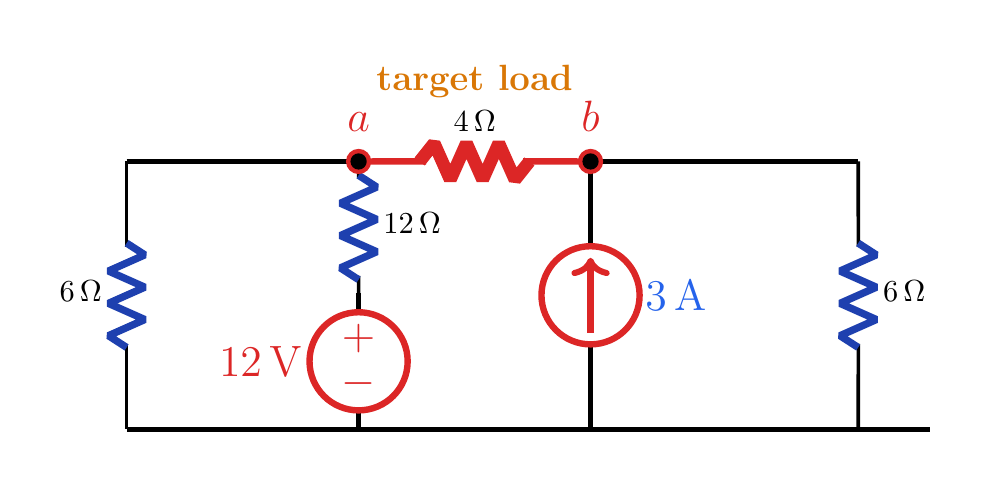
Treat the 4 Ω resistor between a-b as the load. Find the remaining network's Thevenin and Norton equivalents, the load current, and the absorbed power.
Written solution and narration transcript(shows the full solution)
Below are all the lines written in the notebook together with the full narration transcript.
1. Problem
The power absorbed by the 4 Ω load will be found from Thevenin and Norton equivalents. Target: power in the 4 Ω loadLoad: 4 Ω between a-bRemaining network → Thevenin equivalentRemove the load firstFind VTh and RThReconnect the 4 Ω loadRequired: P4ΩNarration transcript
In this lesson we use Thevenin's theorem on a circuit with only independent sources. The target is the power absorbed by the 4 ohm resistor between terminals a and b. Instead of solving the full circuit directly, we treat that 4 ohm resistor as the load, remove it, and replace the rest of the network by its Thevenin equivalent.
2. Remove the load
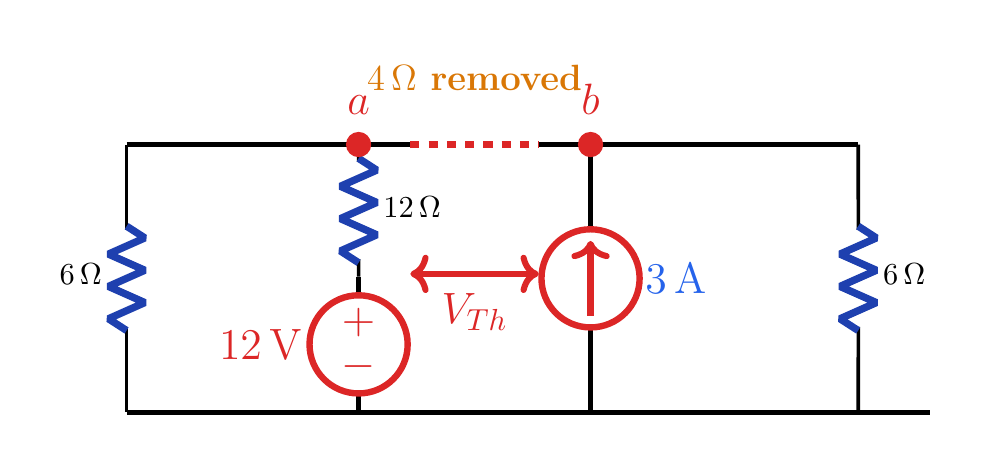
The voltage reference is V_Th=V_a−V_b. Remove the loadTake the 4 Ω resistor outa-b become open terminalsThevenin: VTh in series with RThReconnect 4 Ω afterwardKeep the a→b referenceNarration transcript
The first move is to remove the 4 ohm load. The remaining network is seen from terminals a and b. Everything to the left and right of those terminals will become a voltage source V Thevenin in series with a resistance R Thevenin. After that, the 4 ohm resistor can be connected back to the equivalent.
3. R_Th
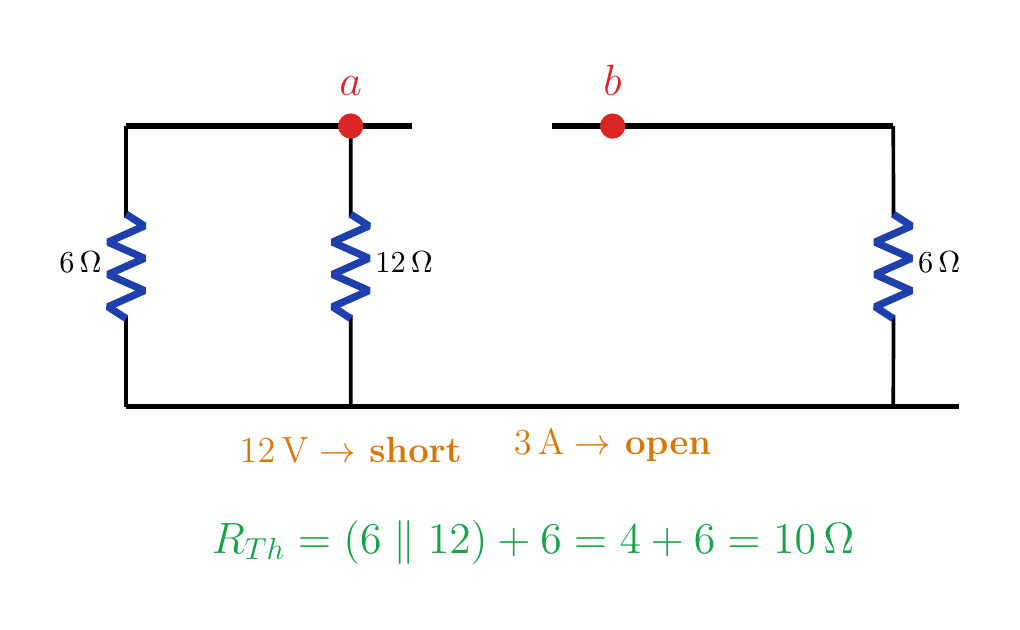
R_Th=(6∥12)+6=10 Ω. RTh: turn off sources12 V → short circuit3 A → open circuitThis result is in series with 6 ΩNarration transcript
To find R Thevenin, turn off the independent sources. The 12 volt source becomes a short circuit, and the 3 amp current source becomes an open circuit. Looking between a and b, the left side is 6 ohms in parallel with 12 ohms. That parallel part is 4 ohms. From b to the bottom node there is another 6 ohm resistor in series with that result. Therefore R Thevenin is 4 plus 6, equal to 10 ohms.
4. V_Th
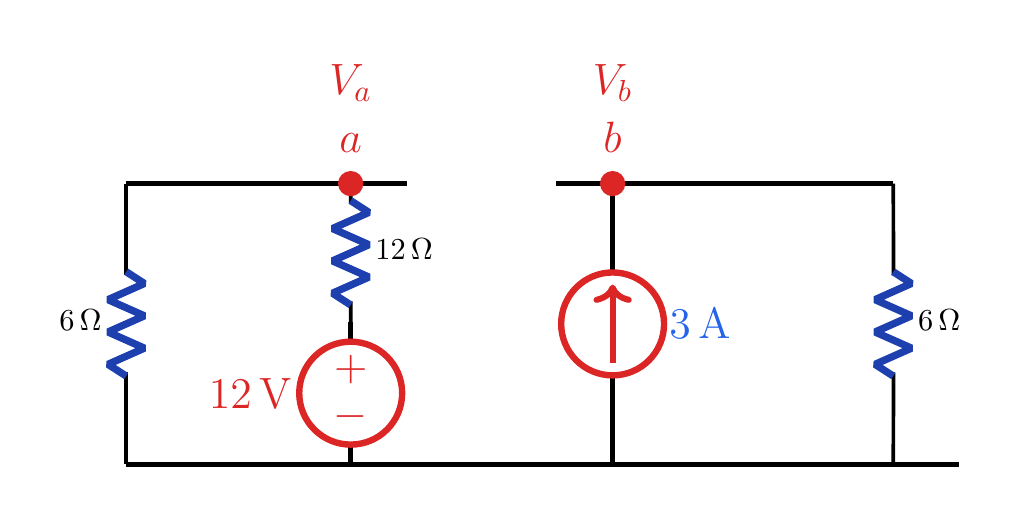
V_a=4 V, V_b=18 V, and V_Th=−14 V. Narration transcript
Now find the open-circuit voltage V Thevenin, equal to V a minus V b. For node a, KCL gives V a over 6 plus V a minus 12 over 12 equals zero. Multiplying by 12 gives 3 V a minus 12 equals zero, so V a is 4 volts. For node b, the 3 amp source injects current upward into the node, so V b over 6 minus 3 equals zero. Therefore V b is 18 volts. So V Thevenin is V a minus V b, which is 4 minus 18, equal to negative 14 volts.
5. Load current and power
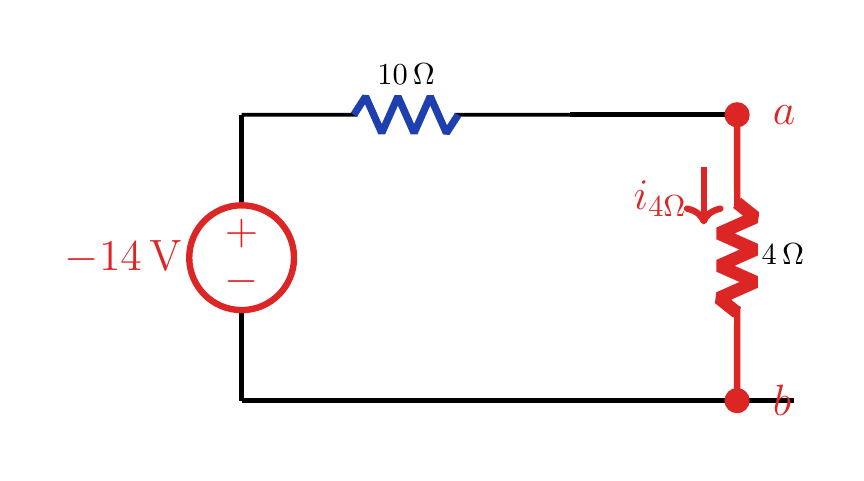
With the a→b reference i=−1 A; actual current is b→a and P=4 W. Reconnect the 4 Ω loadActual direction: b→aNarration transcript
Reconnect the 4 ohm resistor to the Thevenin equivalent. Using the current reference from a to b, the load current is V Thevenin divided by R Thevenin plus 4 ohms. That is negative 14 over 14, equal to negative 1 ampere. The negative sign only says that the actual current flows from b to a. The absorbed power is i squared R, so one amp squared times 4 ohms gives 4 watts.
6. Norton check
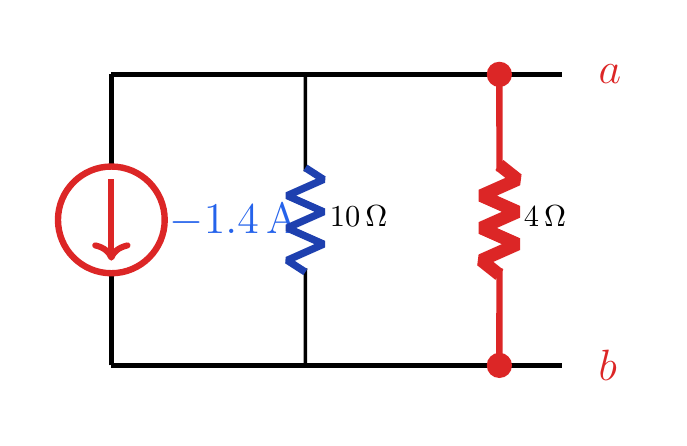
The Norton form also gives 4 W in the load. Check with Norton10 Ω is parallel with the sourceThe load still absorbs 4 WNarration transcript
The same result can be checked with Norton form. I Norton equals V Thevenin divided by R Thevenin, so it is negative 14 over 10, equal to negative 1.4 amperes for the a to b reference direction. The resistance is still 10 ohms in parallel. Whether we use Thevenin or Norton, the load terminals see the same behavior and the 4 ohm resistor absorbs 4 watts.
7. Method summary
With the a→b reference i=−1 A; actual current is b→a and P=4 W. ResultsActual current flows b→aNarration transcript
The key details are the terminal reference and the source deactivation rules. Here, the load is the 4 ohm resistor between a and b. Turning off the independent sources gives R Thevenin equal to 10 ohms. The open circuit node voltages are V a equal to 4 volts and V b equal to 18 volts, so V Thevenin is negative 14 volts. After reconnecting the 4 ohm load, the current reference is negative 1 ampere and the absorbed power is 4 watts.
Source video: Circuit Theory #25 | Thevenin/Norton with Independent Sources - Find Power in 4 Ohm (3:47)